

 55 minutes ago
5
55 minutes ago
5
ARTICLE AD BOX
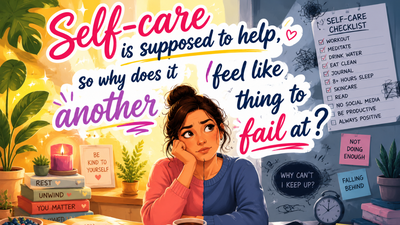
There's a particular kind of exhaustion that doesn't come from working too hard or sleeping too little. It comes from trying, very conscientiously, to be well. From tracking your sleep score and feeling guilty when it dips.
From buying the magnesium supplements because three separate Instagram accounts told you that you're probably deficient. From the journalling habit you started in January and quietly abandoned by February, which now sits on your bedside table as a small, daily reminder that you are not doing enough.Self-care was supposed to fix this. Instead, for a growing number of people, it's become another thing to fail at.We sat down with Dr. Alok Kulkarni, Senior Consultant Psychiatrist at Manas Institute of Mental Health and Neurosciences, Hubballi, Karnataka, to understand why self-care no longer feels as relaxing or restorative as it once did.
During the conversation, Dr. Kulkarni spoke in depth about the growing pressure to constantly improve oneself, the rise of “performative wellness,” and how self-care routines can slowly begin to feel like another task on an already exhausting to-do list.
He also discussed the difference between healthy self-improvement and the unhealthy belief that every aspect of one’s personality, productivity, emotions, or lifestyle always needs fixing.
How can someone tell the difference between healthy self-improvement and an unhealthy need to constantly "fix" themselves?
Dr. Alok Kulkarni: Healthy self-improvement is usually quiet, flexible, and driven by genuine curiosity or a clear practical need. You try something, see if it actually improves your life, and you can drop it without drama if it doesn’t. Unhealthy “fixing” is compulsive, shame-tinged, and never satisfied. The key test is simple: Does this practice reduce your anxiety about yourself, or does it increase it? Healthy growth expands your capacity to live; the unhealthy version shrinks your tolerance for being an ordinary, imperfect human on an ordinary day.
Do you think we're creating a culture where people feel guilty for resting unless that rest is productive, intentional, or part of a wellness routine?
Dr. Alok Kulkarni: We have successfully turned rest into another form of work. The modern wellness script now requires rest to be “intentional,” “restorative,” or “mindful,” which is just hustle culture wearing yoga pants. True rest has no agenda and needs no justification. When people feel they must earn their downtime or document its benefits, they have lost the ability to simply stop. That guilt is not natural; it is culturally manufactured and it is exhausting.
Social media often promotes routines, healing journeys, and wellness checklists. Can constant exposure to these messages create pressure to always be working on ourselves?
Dr. Alok Kulkarni: Yes, it does. Social media rewards the narrative of constant transformation because transformation content performs well. The result is an environment where simply living your life starts to feel like falling behind. People begin treating their own minds and bodies like unfinished projects that require daily updates, checklists, and visible progress. Over time this turns ordinary human existence into a performance of self-optimization, and anything that doesn’t look like forward movement starts to feel like failure.
In your experience, what does genuine self-care actually look like, and how does it differ from the version many people encounter online?
Dr. Alok Kulkarni: Genuine self-care is usually boring, private, and highly specific to the individual. It might be going to bed at a reasonable hour, saying no to something without explaining yourself, sitting in silence without trying to “process” it, or doing nothing at all for a while. It does not require a product, an aesthetic, or an audience. The online version is frequently the opposite: it is visible, Instagrammable, and often commercial.
It turns care into consumption - the right journal, the right supplement, the right morning routine, the right language around boundaries. Much of what circulates as “self-care” online is actually self-management marketed back to people who are already anxious about not doing enough. Real self-care protects your energy and your attention; the performative version often consumes both.That doesn't mean routines are bad or that therapy is a scam or that you should throw your journal out. It means the question worth asking isn't "am I doing enough to take care of myself?" It's "does this actually make me feel better, or does it just make me feel like I'm trying?"And sometimes the most radical thing available to you is a completely unoptimized evening. No supplements, no screen time limits, no mood tracking. Just existing in your own life without narrating it to yourself as either progress or failure.Rest that doesn't perform anything is still rest. You don't have to earn it. You don't have to document it. You just have to let yourself have it.









 English (US) ·