

 1 hour ago
4
1 hour ago
4
ARTICLE AD BOX
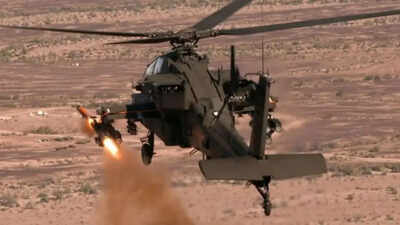
Spike NLOS, HELLFIRE II, and Altius 700: A guide to Apache's evolving arsenal Source: X/@anduriltech
The AH-64 Apache attack helicopter has long been the backbone of the U.S. Army's attack fleet, with over 5.3 million flight-hours and more than 1,300 aircraft in operation across 19 countries. As Boeing and the Army continue to modernize the platform, the Apache's lethality increasingly depends on the diversity of munitions it can carry.From precision-guided missiles to loitering drones, here are three key systems now being integrated with the Apache.
Spike NLOS
Developed by Rafael Advanced Defense Systems and offered to U.S. customers in partnership with Lockheed Martin, Spike NLOS is a multi-purpose, electro-optical/infrared missile system.The missile is designed to defeat stationary and defilade armor troops, field fortifications and urban structures, while achieving a range of more than 25 kilometers. Spike NLOS has already been "qualified" under the Army's Long Range Precision Munitions Directed Requirement on the AH-64E Apache helicopter.In October 2025, the Army advanced Spike NLOS to Phase Two of the M-LRPSM program and awarded Lockheed Martin a $30 million contract for continued development, integration, and safety testing. The final decision on program award is expected after the completion of Phase 2 testing, projected for mid-2026.Key specifications:Range: Up to 32 kilometers (fiber-optic wireless datalink)Guidance: Electro-optical/infrared seeker with real-time video imageryKey feature: Man-in-the-loop control allows operators to alter or abort missions mid-flightPlatforms: Ground, aviation, or maritimeThe system is already in service with U.S. forces and six other countries. Polish officials have expressed interest in integrating Spike NLOS onto Poland's future AH-64E Apache fleet.
AGM-114R HELLFIRE II
The
HELLFIRE
II is a semi-active laser (SAL) guided precision strike missile, designed to defeat a broad range of targets with a single multi-purpose warhead. The current production model, AGM-114R2 (also known as Hellfire Romeo), entered production in 2012 and consolidates all previous SAL Hellfire II variants into a single missile.Key specifications:Range: 8.7 km (LOAL, high trajectory); 8.0 km (LOAL, low/direct trajectory)Maximum range: 11 kmWeight: 49 kg (108 lb)Length: 163 cm (64 in)Diameter: 17.8 cm (7 in)Guidance: Semi-active laser (SAL)Speed: Mach 1.3Unit cost: $99,600 (All-Up Round, 2015 USD)Warhead: Multi-purpose — effective against armor, air defense, patrol boats, buildings, caves, and vehiclesIn production: 2012–presentThe HELLFIRE II can be employed autonomously or with remote designation, using lock-on before launch (LOBL) or lock-on after launch (LOAL) for increased platform survivability. It can be launched from helicopters, fixed-wing aircraft, ground vehicles, boats, and tripod launchers.The AH-64E Apache can carry up to 16 HELLFIRE missiles, along with 76 2.75-inch rockets and 1,200 30mm chain gun rounds.
Altius 700
Built by Anduril, the Altius 700 is a rocket-powered loitering munition and reconnaissance drone. In 2026, an AH-64E Apache successfully executed the first-ever airborne launch of an Altius 700 at Yuma Proving Ground during Concept Focused Warfighting Experiment 26 (CFWE26).The launch was conducted by Army aviators from the Combat Capabilities Development Command Aviation & Missile Center (DEVCOM AvMC), validating a new government-developed universal launch system designed to enable low-altitude drone deployment from rotary-wing aircraft. The Army executed launches both from a hover and while moving.The demonstration builds on a prior test in September 2025, where Army aviators executed multiple successful airborne launches of Altius 700s from a UH-60 Black Hawk helicopter. Altius-700 builds on prior launches of Altius-600 from Black Hawks beginning in 2020, offering expanded range, loiter time, and payload capacity.Key specifications (from Anduril):Diameter: 7 inches (17.8 cm)Endurance: Approximately 4 hours (ISR configuration)Range: Approximately 460 kmPayload: ISR, SIGINT, electronic warfareLaunch platform: Rotary-wing aircraft (tested on Apache and UH-60 Black Hawk)Altius-700M loitering munition variant:Diameter: 7 inchesWarhead payload: Up to 33 pounds — comparable to an AGM-114 Hellfire missileEndurance: Approximately 75 minutesRange: Up to 100 miles (160 km)Unlike traditional missiles, Altius 700 loiters over the battlefield, providing persistent surveillance before striking. The system supports manned-unmanned teaming (MUM-T), allowing Apache crews to deploy drones for scouting, targeting, and long-range engagement while staying farther from enemy threats.
What this means for the Apache
The Apache can carry 16 HELLFIRE missiles on its M299 launcher, but the integration of Spike NLOS and Altius 700 expands its mission set significantly.Spike NLOS allows the Apache to engage targets beyond visual range without exposing itself to enemy air defenses. The system has already been qualified on the AH-64E Apache and is now advancing through the Army's M-LRPSM program with a $30 million Phase Two contract.Altius 700 transforms the Apache into a launch platform for loitering munitions, enabling persistent surveillance and time-sensitive strikes. The 2026 demonstration at Yuma Proving Ground proved the Apache can release the system both from a hover and while moving. The Army moved from requirement to demonstrated Apache solution in less than six months despite a 43-day government shutdown during the development period.HELLFIRE II remains the go-to weapon for direct engagement of armored and hardened targets, with the AGM-114R2 variant combining all previous SAL Hellfire capabilities into a single missile.The AH-64E Apache introduces improved sensors, enhanced connectivity, and manned-unmanned teaming capabilities, allowing the helicopter to share data with other platforms and coordinate operations with unmanned systems. As Boeing and the U.S. Army continue to invest in the Apache's Open Systems Approach, the helicopter's ability to integrate new munitions and launched effects will keep it relevant into the 2060s.









 English (US) ·