

 48 minutes ago
1
48 minutes ago
1
ARTICLE AD BOX
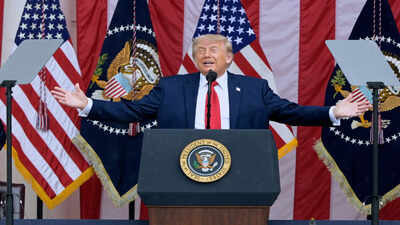
President Donald Trump speaks during the Memorial Day ceremony at Arlington National Cemetery, in Arlington, Va. AP/PTI
TOI correspondent from Washington: US President Donald Trump on Monday dramatically raised the stakes in already delicate peace efforts in the middle east by demanding that key Muslim allies – including Saudi Arabia, Pakistan, Turkey, and Qatar – sign onto the Abraham Accords as a condition for participating in what he described as a historic regional settlement with Iran.The sudden and sweeping proposal, unveiled in a lengthy Truth Social post after a weekend conference call with Arab and Muslim leaders, stunned diplomats across the Middle East and South Asia and immediately triggered resistance from Pakistan and unease in Riyadh and Doha.“It should be mandatory that all of these Countries, at a minimum, simultaneously, sign onto the Abraham Accords,” Trump declared, referring to Saudi Arabia, Qatar, Pakistan, Türkiye, Egypt, Jordan and Bahrain.
Countries refusing to do so, he warned, “should not be part of this Deal.”The Abraham Accords, brokered during Trump’s first term in 2020, normalized relations between Israel and several Arab states, including the United Arab Emirates and Bahrain, later joined by Morocco and Sudan. The agreements were hailed in Washington as a strategic breakthrough that reshaped Middle Eastern diplomacy by prioritizing economic cooperation and security ties over the long-frozen Palestinian issue.
Critics, however, argued they merely institutionalized an anti-Iran regional bloc while sidelining Palestinian aspirations for statehood.Demand threatens already fragile US-Iran negotiationsUS President Donald Trump’s new demand that Muslim allies join the Abraham Accord threatens to complicate already fragile US-Iran negotiations by injecting perhaps the most politically combustible issue in the Islamic world – normalization with Israel – into talks ostensibly centered on regional security and nuclear tensions. According to accounts of Trump’s conference call with Muslim leaders on Saturday, he startled them by abruptly insisting that normalization with Israel be tied to any broader Iran settlement. “There was silence on the line and Trump joked and asked if they are still there,” according to one account. Saudi Arabia has repeatedly insisted that formal recognition of Israel can occur only after there is an “irreversible pathway” toward an independent Palestinian state with East Jerusalem as its capital – a condition flatly rejected by the Netanyahu government.Pakistan’s opposition is even more categorical. Islamabad has never recognized Israel and has historically tied any normalization to the creation of a sovereign Palestinian state. Former Pakistani senator and veteran foreign policy commentator Mushahid Hussain Syed dismissed Trump’s proposal as “completely rejected by the peoples of Pakistan, Saudi Arabia and Qatar and the majority of the Muslim world.”In a post on X, Mushahid said asking Muslim countries to join the “so-called Abraham Accords” while Gaza remains under bombardment amounted to “rewarding Israel for Gaza genocide” and bypassing “the core cause of conflict in the Middle East, namely establishing a Palestinian state with Jerusalem as its capital.”Yet analysts noted that Trump’s own post appeared to tacitly acknowledge the political impossibility of forcing some countries into normalization immediately. “It may be possible that one or two have a reason for not doing so, and that will be accepted,” he wrote – language seen as a nod toward Saudi Arabia and Pakistan.Trump nevertheless pressed ahead with characteristic maximalism, calling the accords “the most important Deal that any of these Great, but always in Conflict Countries, will ever sign.”
He went even further, floating the extraordinary possibility of Iran itself eventually joining the Abraham Accords if Tehran reaches an agreement with Washington.“Wow, now that would be something special!” he wrote.The idea of Iran – whose revolutionary ideology since 1979 has centered on opposition to Israel and U.S. influence – joining the US-brokered normalization framework was greeted in diplomatic circles with a mixture of astonishment and disbelief.Still, the proposal won enthusiastic backing from Trump allies, particularly Republican hawks who see Arab-Israeli normalization as the cornerstone of a new regional order. Senator Lindsey Graham called it "one of the most consequential" diplomatic initiatives in Middle Eastern history.“Saudi Arabia, Qatar, and Pakistan joining the Abraham Accords would be beyond transformative for the region and world,” Graham said.
“It is a brilliant move by President Trump.” He also warned Gulf states against resisting the initiative, saying refusal “would have severe repercussions for our future relationships.”But many analysts believe Trump may be overplaying his hand by conflating separate diplomatic tracks – Iran nuclear diplomacy, Gulf security architecture, Arab-Israeli normalization and Palestinian statehood – into a single grand bargain.
The timing is particularly sensitive. Anger across the Muslim world over the Gaza war has hardened public opinion against normalization with Israel. Even governments quietly interested in closer ties with Israel now face intense domestic political constraints.For Saudi Crown Prince Mohammed bin Salman, normalization without visible concessions on Palestine risks accusations of abandoning the Arab consensus. Pakistan confronts similar pressures from Islamist parties and public sentiment. Yet Trump appears convinced that a sweeping diplomatic reset remains possible -- one that could simultaneously contain Iran, formalize Israeli ties with the Muslim world and cement his self-image as the ultimate dealmaker, a finale that will almost certainly put him on track for the Nobel Peace Prize that he so openly covets.






 English (US) ·