

 1 hour ago
7
1 hour ago
7
ARTICLE AD BOX
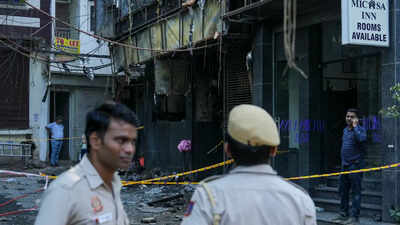
Police personnel stand guard near the site of a fire at a hotel in the Malviya Nagar area (PTI Photo)
A family had booked a room at the Flourish Stay bed-and-breakfast to be close to a critically ill relative undergoing treatment at a nearby hospital. On the morning of June 3, they were having breakfast in the basement when a fire broke out.
Trapped without an escape route, the family, along with several others, desperately tried to get out. Despite frantic phone calls and rescue attempts, they could not escape. Hours later, eight members of the family were found dead, their bodies burnt beyond recognition.Among the 22 people killed in the tragic fire at a hotel in Delhi’s Malviya Nagar were eight members of the extended Agarwal family. Vivek Agarwal, a Gurugram-based chartered accountant, had been staying at the hotel with his family to remain close to his father, who was admitted to the ICU of the nearby Max Hospital.
A week after losing most of his family in the fire, 75-year-old Radhe Shyam Agarwal succumbed to a lung infection at the hospital on Tuesday.Mahender Garg recalls that his cousin Vivek sounded frantic during a phone call made about 10 minutes before the fire escalated.“I am trapped in the basement. Please send the fire brigade quickly and get me out of here,” he pleaded.
How the tragedy unfolded
According to reports, the fire may have originated from a commercial LPG cylinder explosion in the basement kitchen or from an air-conditioning unit on the ground floor.
Before the blaze engulfed the building, witnesses reported hearing a loud explosion.As the flames intensified, thick black smoke spread rapidly through the hotel, fuelled by combustible materials. The smoke travelled through a single central staircase, gradually engulfing the entire building.Guests staying on the upper floors had little choice but to jump from windows to escape the flames. Local residents and neighbours placed mattresses on the ground to cushion their fall.
One woman jumped from the third floor carrying a child in her arms. Though injured, both survived. Those trapped in the basement had no such option.While some victims suffered fatal burn injuries, most reportedly died due to severe smoke inhalation and respiratory damage. The smoke was unable to escape because of poor ventilation, sealed windows and glass panels.Among the many alleged safety lapses at the hotel was the basement’s sole entrance, which was reportedly locked.
Rescue teams took around 10 minutes to gain access, after which six or seven people were rescued.
What Delhi’s basement laws say
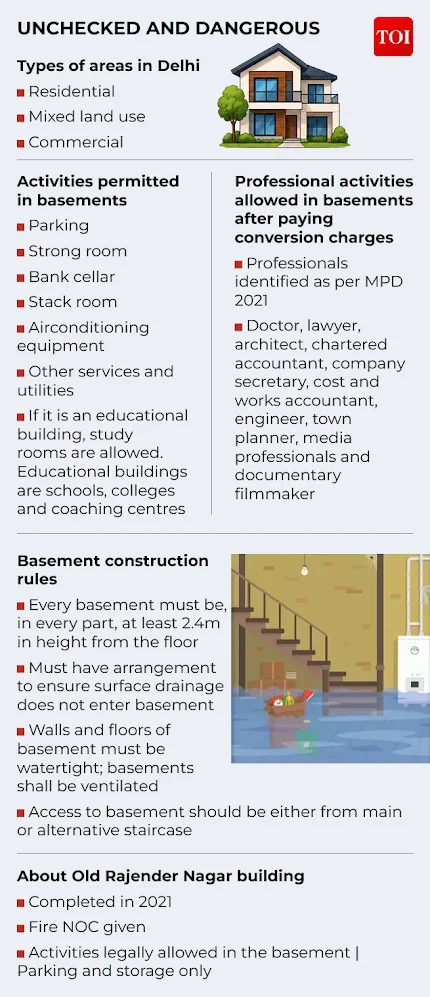
Basements in Delhi are regulated by the Unified Building Bye-Laws (UBBL) and the Master Plan for Delhi (MPD). Rule 7.4.11 of the UBBL-2016 permits basements to be used for the storage of household goods, non-flammable materials, dark rooms, strong rooms, bank cellars, library stack rooms, air-conditioning equipment and other utilities.Rule 4.4.3 of the Delhi Building Bye-Laws states that basements are not counted under the Floor Area Ratio (FAR) of a building and therefore cannot be used as independent residential units. The regulations also mandate a minimum height of 2.4 metres, adequate ventilation, fire safety measures, waterproofing and proper drainage.
UNCHECKED AND DANGEROUS
“Vents with cross-sectional area (aggregate) not less than 2.5 per cent of the floor area spread evenly round the perimeter of the basement shall be provided in the form of grills or breakable stall board lights or pavement lights or by way of shafts,” the law states.“Alternatively, a system of air inlets shall be provided at basement floor level and smoke outlets at basement ceiling level.”Cooking activities and kitchens in basements and on rooftops were banned after the 2019 fire at Hotel Arpit Palace in Karol Bagh that claimed 17 lives. Yet reports following similar incidents repeatedly point to violations of these regulations, often with fatal consequences.Dwelling on what-ifs after a tragedy can seem futile. Yet one question lingers: if the Agarwal family had been anywhere else in the hotel and not in the basement, could their lives have been saved?
Not an isolated catastrophe
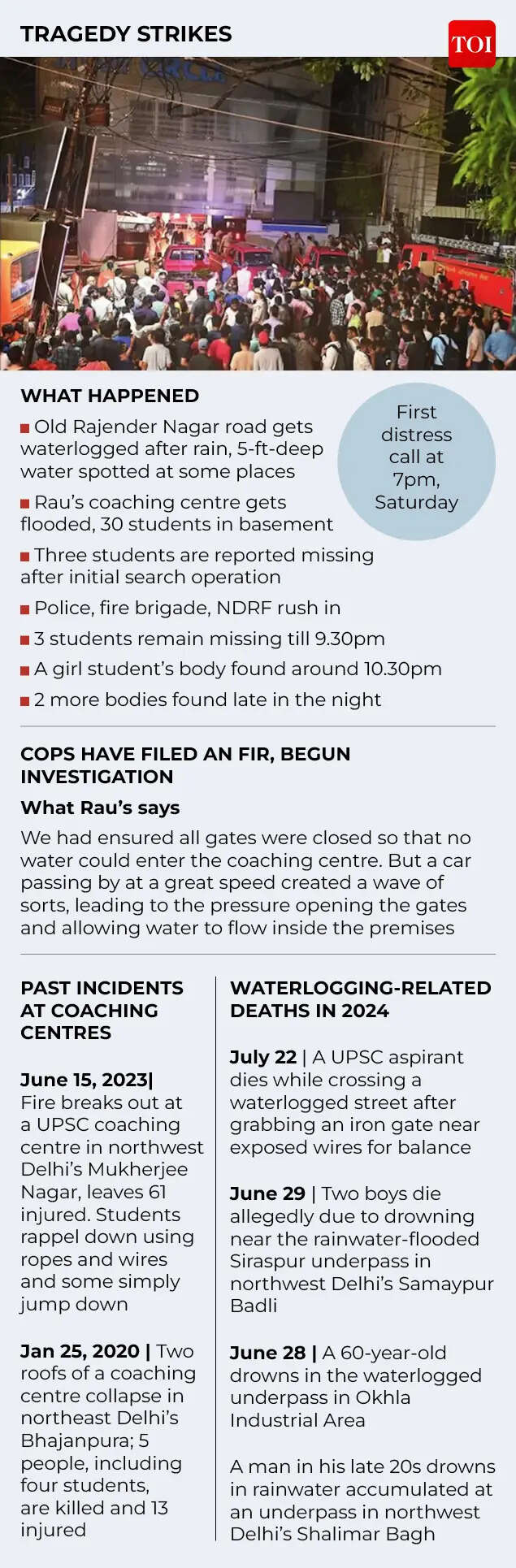
Basement misuse in Delhi has been under scrutiny following several tragedies, most notably the 2024 Rajendra Nagar incident, in which three students drowned in the basement library of Rau’s IAS Study Circle after rainwater flooded the premises.
The basement was authorised only for storage, parking and utility purposes, not as a library.The negligence that led to the avoidable deaths of three young students was not an isolated violation of safety norms.Rajendra Nagar, Mukherjee Nagar and Ber Sarai are major hubs for students preparing for civil services and other competitive examinations. These areas are densely populated, with buildings packed closely together.“Look at how closely the houses are built to one another. In case a fire breaks out, it will not remain confined to one building. It will spread,” said a local resident.Students point out that many libraries continue to operate from basements despite repeated incidents involving flooding, fires and structural hazards.“Accidents are unpredictable. In case of flooding or a sudden fire, there is no possibility of escape,” said Nikhil, an 18-year-old student from Uttar Pradesh.
TRAGEDY STRIKES
Students’ apprehensions
Many students living in these coaching hubs come from outside Delhi. They leave home in pursuit of better opportunities, while their families place immense trust in landlords, hostel operators and coaching institutions to keep them safe in an unfamiliar city.But with each new tragedy, that trust gives way to anxiety.Ajit had come to Ber Sarai to visit his younger brother, who is preparing for competitive examinations.
He spoke of the constant worry that comes with having a sibling living far from home.“The MCD should inspect the kind of structures being built, the ventilation arrangements and the number of exits available. The government must be responsible. If a library or coaching centre is operating out of a basement, there should be at least two exits,” he said.Ajit recalled his own time living in Mukherjee Nagar when the Rajendra Nagar tragedy occurred.
Following the incident, coaching classes were disrupted and several libraries were shut down. He said his years there were marked by recurring safety concerns, including fire incidents he had personally witnessed.Yet such tragedies continue to recur, claiming the lives of students, workers, migrants and tourists. Stampedes, drownings and fires become headlines every year. Systemic change rarely follows, and accountability seldom extends beyond individual punishment.Incidents such as the Malviya Nagar hotel fire and the Rajendra Nagar coaching centre tragedy have repeatedly drawn attention to the misuse of basements and violations of safety norms in the capital. Yet questions remain over how effectively existing regulations are being enforced, and whether lessons from past disasters are translating into meaningful changes on the ground.






 English (US) ·