

 1 hour ago
5
1 hour ago
5
ARTICLE AD BOX
Last Updated:June 18, 2026, 16:53 IST
West Asia repeatedly reappears on G7 agenda in different forms, whether as an energy supplier, a conflict zone, or a source of wider regional instability


Based on summit communiqués and historical summaries, the G7 has, over time, not only expanded its agenda but also moved away from issues that once defined it. Image/AP
The core G7 summit agenda has changed a lot since it started in 1975. It began as a response to the oil crisis and the economic shocks that followed. Over time, its focus shifted to inflation, globalisation, terrorism, climate change, and now AI and China.
But one pattern stays constant: West Asia keeps reappearing in different forms in the G7 agenda. It is not always discussed in the same way, but it rarely disappears. This is rooted in the origins of the G7 itself, which formed in the aftermath of the 1973 oil shock that exposed how deeply global stability depended on West Asia energy flows. Since then, summit discussions have repeatedly circled back to the region—through wars in the Gulf, post-9/11 conflicts, Syria, Iran, and today’s energy and security tensions.
What the G7 has focused on over time
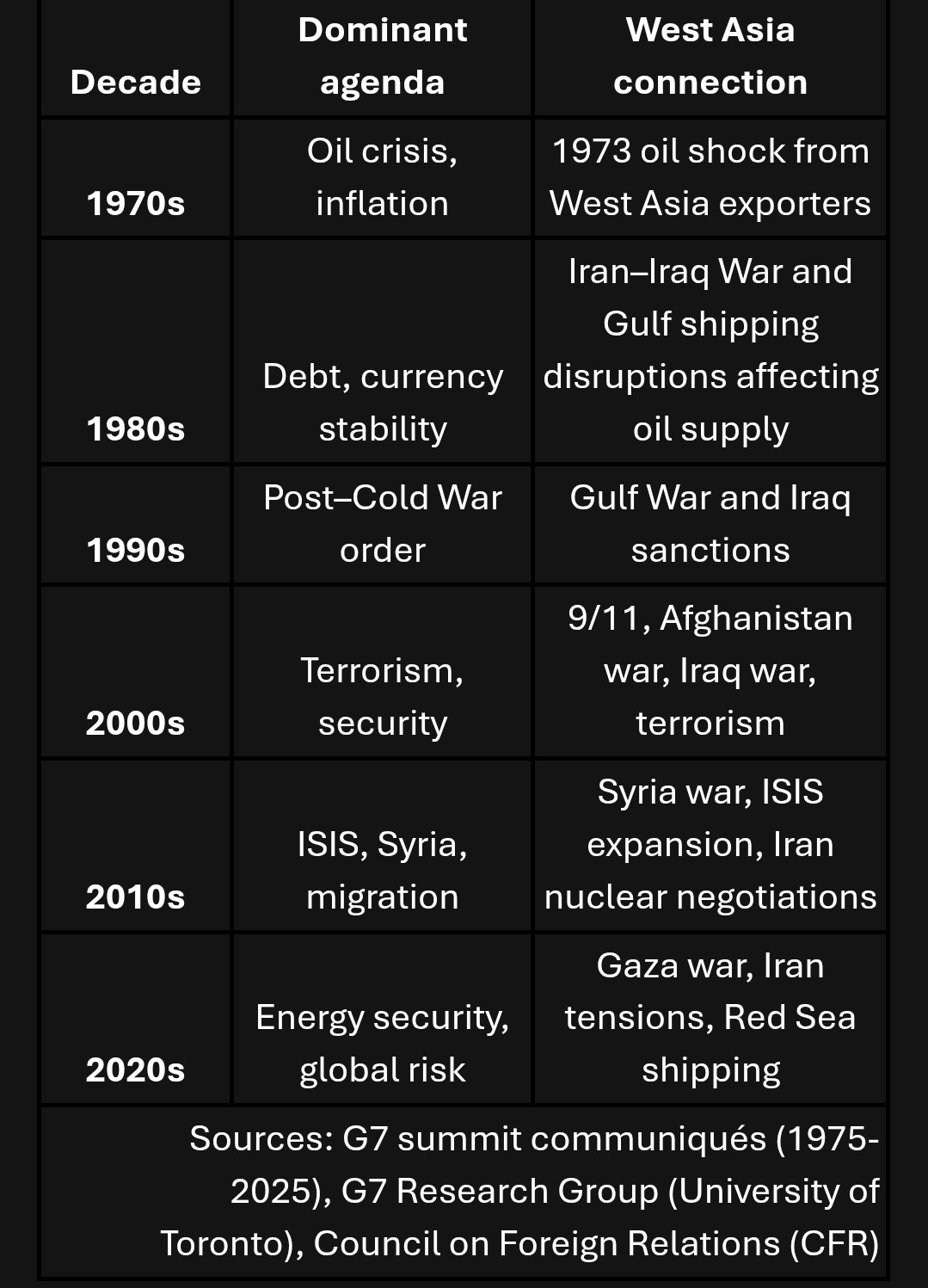
West Asia appears across every decade, but the reason changes:
- 1970s: oil supply risk
- 1980s-90s: regional wars and sanctions
- 2000s: terrorism and military conflict
- 2010s: civil wars and extremist groups
- 2020s: energy routes and geopolitical escalation
The G7 is often seen as shifting focus over time. But in reality, West Asia is the one region that rarely leaves the agenda—the label merely takes a new form.
It remains a constant source of economic and security risk, even as new issues like AI and China dominate headlines.
What has faded from the G7 agenda over the years
Based on summit communiqués and historical summaries, the G7 has, over time, not only expanded its agenda but also moved away from issues that once defined it.
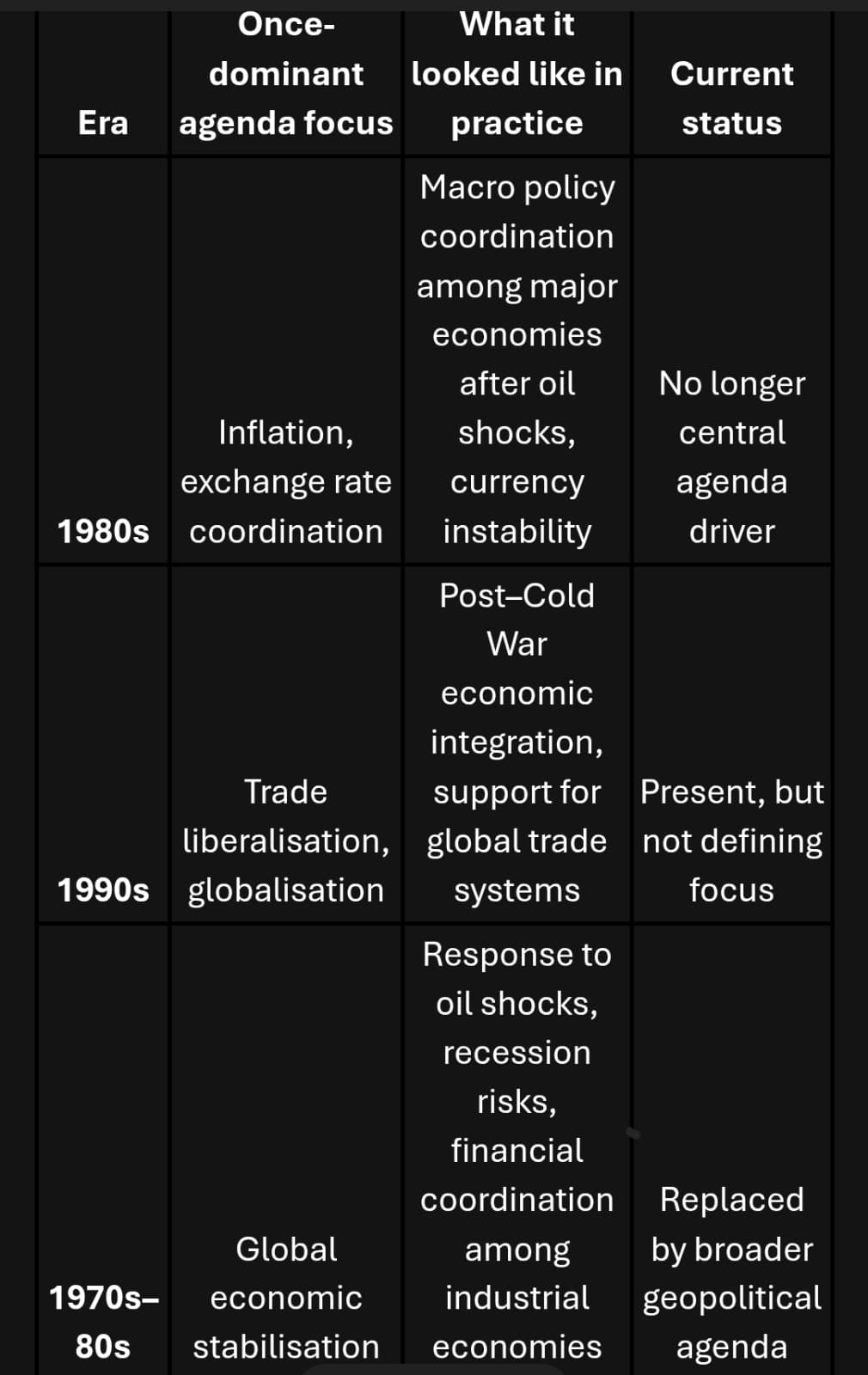
System-wide economic management (early G7 identity)
The original G7 format was designed around managing global economic shocks. Early priorities included stabilising industrial economies, responding to oil-driven crises, and also coordinating recovery from global recessionary pressures and financial instability. That role has gradually shifted from economic coordination to broader geopolitical crisis management.
This original role is reflected in the fact that the first summits were not symbolic gatherings but crisis response meetings. The 1975 summit itself was convened in the aftermath of the 1973 oil shock and global recession, when industrial economies faced inflation and energy shortages at the same time. Early communiqués show a strong focus on coordinating recovery policies rather than geopolitical strategy, marking the G7’s initial identity as a stabilisation forum for the industrialised world.
Inflation, exchange rates and macroeconomic coordination (1980s core focus)
In the 1980s, G7 summits were heavily focused on stabilising the global economy after the oil shocks and the breakdown of earlier monetary systems. Key priorities included controlling inflation, managing exchange rates, and coordinating macroeconomic policy among major industrial economies. Today, these issues still exist in the background, but they are no longer the defining feature of summit agendas.
This phase is visible in repeated summit efforts to coordinate monetary policy among major economies during periods of high inflation and currency volatility. Historical summit records show frequent references to exchange rate stability and coordinated fiscal discipline, reflecting the post-Bretton Woods environment and the lingering effects of earlier oil shocks. This was also the period when coordinated statements like the Plaza Accord in September 1985—where the G5 nations collaboratively devalued the US dollar and altered currency markets—shaped how seriously G7 leaders treated currency instability as a shared global risk.
Trade liberalisation and globalisation (1990s to early 2000s)
During the 1990s, the G7 played a stronger role in supporting global trade expansion, reinforcing post–Cold War economic integration and coordinating positions around emerging global institutions like the WTO system. In recent years, while trade remains present, as seen in recent tariff and industrial policy tensions, including renewed US tariff measures, it is being discussed in the overall context of security, resilience, and geopolitical risk.
The shift towards globalisation is clearly visible in post–Cold War summit communiqués, which increasingly emphasised trade liberalisation, financial integration, and support for multilateral institutions such as the WTO. During this period, G7 discussions reflected confidence in expanding global trade networks, with repeated references to strengthening open markets and integrating transition economies into the global system. However, even as economic integration expanded, emerging crises in the late 1990s and early 2000s began to shift attention toward instability outside the economic domain.
Across 50 years, the G7 has constantly rewritten its agenda. But beneath these shifts, one pattern remains steady. West Asia repeatedly reappears in different forms, whether as an energy supplier, a conflict zone, or a source of wider regional instability. The issues change, but the region continues to sit at the centre of global risks the G7 cannot easily ignore.
Handpicked stories, in your inbox
A newsletter with the best of our journalism
News world The G7’s 50-Year West Asia Challenge That Never Left the Agenda
Disclaimer: Comments reflect users’ views, not News18’s. Please keep discussions respectful and constructive. Abusive, defamatory, or illegal comments will be removed. News18 may disable any comment at its discretion. By posting, you agree to our Terms of Use and Privacy Policy.
Read More







 English (US) ·