

 1 hour ago
4
1 hour ago
4
ARTICLE AD BOX
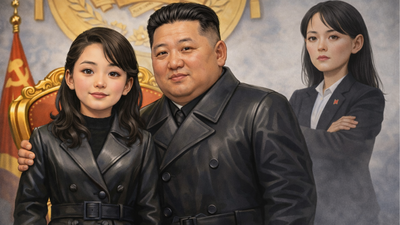
Could North Korea get its first female supreme leader?
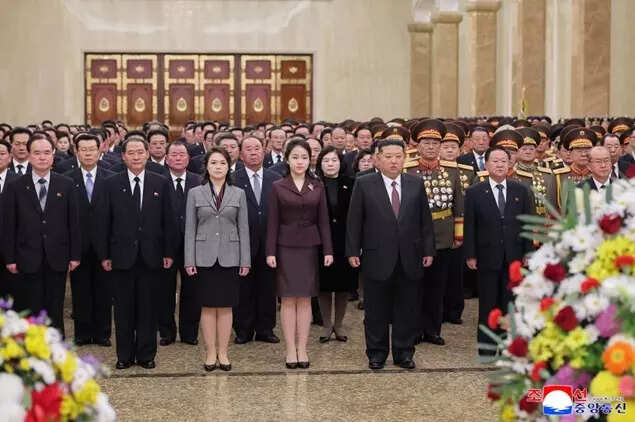
For most of the world, North Korea remains a sealed stage.Apart from routine missile launches, grand military parades and the carefully filtered images released by state media, the inner workings of Pyongyang’s ruling elite remain deeply opaque.Rarely does a single photograph disrupt that familiar script. But recently, one did.On New Year’s Day in 2026, inside the grand Kumsusan Palace of the Sun, where the embalmed bodies of Kim Il Sung and Kim Jong Il lie in state, Kim Jong Un stood beneath chandeliers and marble arches for a customary tribute.
.
On the surface, it appeared to be just another carefully choreographed moment from one of the world’s most secretive regimes.
Yet something about the image stood out. Standing beside him was a young girl.She was not trailing behind or positioned discreetly at the edge of the frame. She stood shoulder to shoulder with North Korea’s supreme leader — calm, composed and confident. The placement looked deliberate.The girl was Kim Ju Ae, believed to be around 13 years old. And her growing presence beside her father has reignited speculation over the future of one of the world’s most enduring political dynasties.
Is Kim Ju Ae being prepared to become North Korea’s next leader?
The rise of Kim Ju Ae
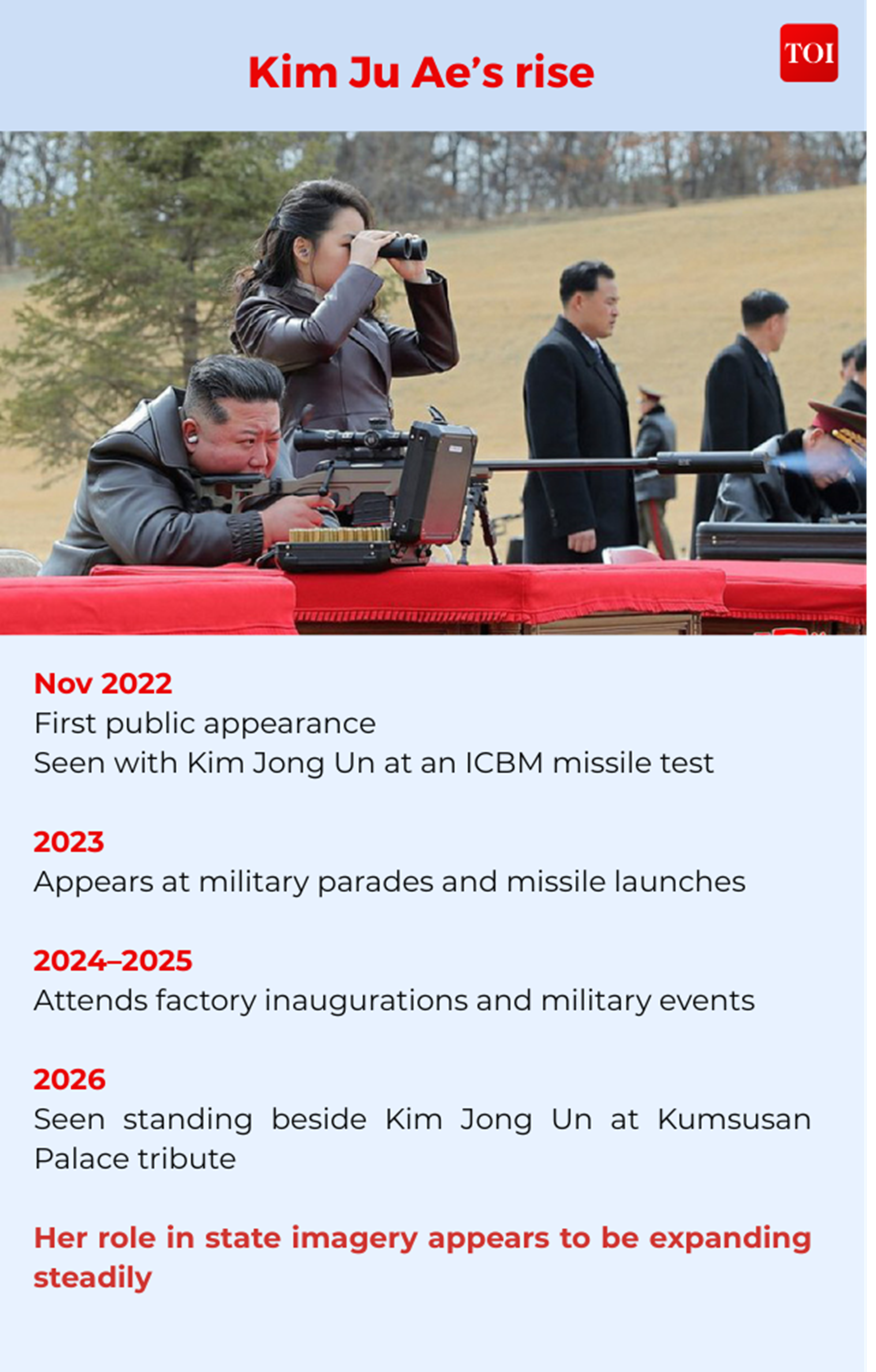
The girl at the centre of the frame is no longer just the regime’s “beloved daughter”. Increasingly, she is being presented as its possible future.South Korea’s National Intelligence Service recently told lawmakers that Kim Ju Ae appears increasingly likely to be designated as North Korea’s successor. According to intelligence officials, her public appearances alongside Kim Jong Un are carefully orchestrated and politically meaningful.Her introduction to the world came suddenly.
.
In November 2022, Kim Ju Ae made her first public appearance at a long-range missile launch site. Wearing a white puffer jacket, she was photographed holding her father’s hand in front of an intercontinental ballistic missile.The message was unmistakable.Since then, her appearances have steadily expanded. She has accompanied her father to missile tests, large military parades and key industrial projects, including factory openings and defence-related events.In North Korea, where public visibility is tightly controlled, such appearances are rarely accidental.Each event has gradually moved her from the margins to the centre of the regime’s imagery.
The sacred bloodline of Mount Paektu
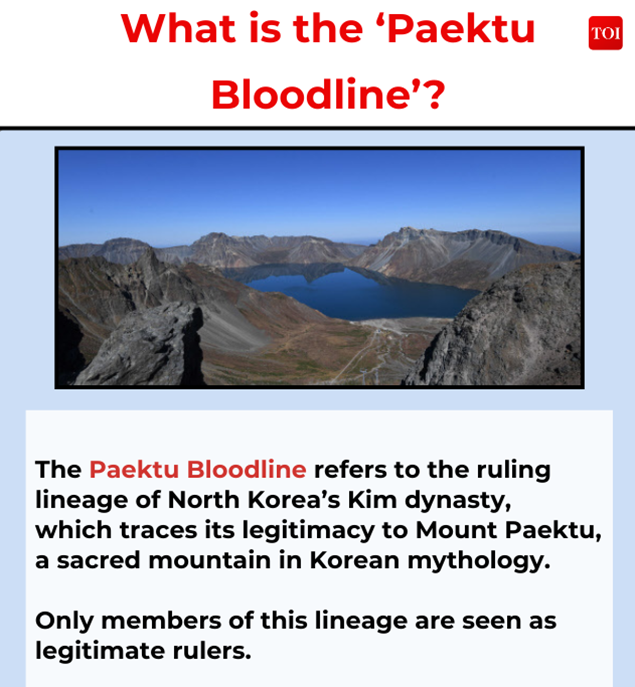
Succession in North Korea does not follow elections, political parties or constitutional debates. Instead, legitimacy flows through what the regime calls the “Paektu Bloodline.”
.
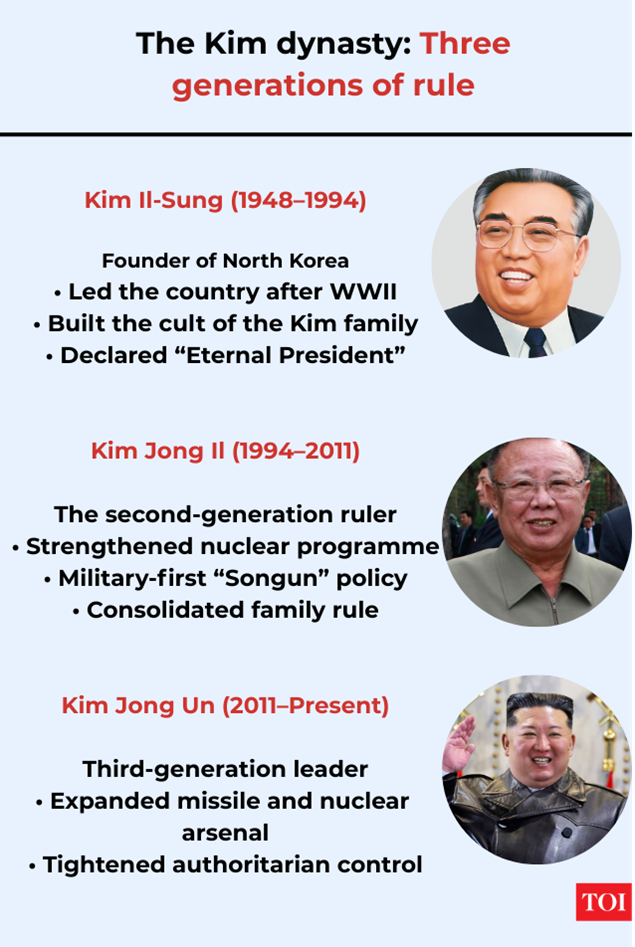
Mount Paektu, the snow-covered volcano on North Korea’s northern border, sits at the heart of the country’s political mythology.According to state propaganda, the mountain is the birthplace of the revolution and the sacred origin of the Kim family’s authority.Kim Jong Il, the country’s second leader, is officially said to have been born in a secret guerrilla camp on the mountain’s slopes, although historians widely believe he was actually born in a Soviet military camp in Russia.Regardless of the historical truth, the symbolism remains powerful.In the North Korean narrative, loyalty to the state is inseparable from loyalty to the Paektu bloodline.The right to rule is not earned or elected. It is inherited.
,
The aunt in the shadows
Yet succession inside dynasties is rarely simple — even in Pyongyang.Soon after consolidating power in 2011, Kim Jong Un ordered the execution of his uncle Jang Song Thaek, once one of the regime’s most powerful figures. The purge was widely interpreted as a brutal move to eliminate a potential rival.For three generations, leadership has followed a clear patriarchal line: father to son.From Kim Il Sung to Kim Jong Il, and then to Kim Jong Un, the transition has always remained within the male line of the family.A female successor would be unprecedented.That is where another powerful figure enters the equation: Kim Yo Jong.Kim Jong Un’s younger sister has spent years building influence within the regime. She has issued official statements attacking foreign governments, threatened South Korea and was widely believed to have orchestrated the demolition of the inter-Korean liaison office in 2020.For much of the past decade, she has functioned as one of her brother’s most trusted lieutenants, and in many ways, his political voice.If Kim Ju Ae is being positioned as heir while still a minor, governance would likely require an experienced adult figure to run the machinery of state.Kim Yo Jong is widely viewed as the most plausible candidate.But the question remains whether a woman who has spent years consolidating power would willingly step aside for her young niece.
Why now?
The urgency surrounding the succession question may also be linked to Kim Jong Un’s health.At 42, the North Korean leader has long been reported by foreign intelligence agencies to struggle with severe obesity, diabetes and high blood pressure, conditions that also plagued his father and grandfather.Neither of them lived past their late sixties.While reliable medical information about Kim is scarce, speculation about his health periodically surfaces in intelligence assessments and diplomatic circles.If the regime believes there is even a remote possibility of an unexpected leadership vacuum, it may be trying to secure the dynasty’s continuity in advance.By bringing Ju Ae into the public spotlight early, Kim could be attempting to establish her legitimacy while he still has the authority to enforce it.
The economic backdrop
Behind the carefully choreographed imagery, North Korea’s economic reality remains fragile.Years of international sanctions tied to Pyongyang’s nuclear and missile programmes have restricted trade, curtailed access to global finance and deterred foreign investment.China remains the country’s primary economic lifeline, providing fuel, food and industrial inputs that keep the system functioning.Even modest fluctuations in that relationship can ripple across North Korea’s tightly controlled markets.Independent assessments suggest the country allocates an enormous share of its resources to military spending — often estimated at more than a quarter of its economic output, to sustain its expanding nuclear and ballistic missile programmes.Meanwhile, many ordinary citizens rely heavily on informal black markets, known as Jangmadang, to obtain basic goods.Yet despite the economic strain, the regime continues to prioritise military development and strategic deterrence.
The question that remains
For now, no official declaration has been made about succession.But Kim Ju Ae’s increasingly prominent role in state imagery has altered the conversation around North Korea’s future leadership.In a country where symbolism is rarely accidental, the image of a teenage girl standing beside the supreme leader and attending key events of the country may carry deeper political meaning than it appears.Whether Kim Ju Ae ultimately inherits the throne, or whether other power centres within the Kim family assert themselves, remains uncertain.What is clear is that the next chapter of the Paektu dynasty may already be quietly unfolding.





 English (US) ·