

 1 week ago
14
1 week ago
14
ARTICLE AD BOX
They are so small that billions of transistors can sit on a chip no bigger than a fingernail, yet they are powerful enough to run data centres, smartphones and now artificial intelligence systems.
Semiconductor chips are among the most extraordinary feats of human engineering. Building them demands work at a scale measured in nanometres, where a tiny error can derail an entire product. It is at this microscopic frontier that careers in AI and semiconductors are increasingly being forged.Gokul Subramaniam, president of Intel India, believes that while AI may dominate headlines, it is silicon that makes the revolution possible.
“Compute and semiconductors are the foundation of AI,” he says . “Everything AI does ultimately runs on chips.”That foundation is complex. Designing a chip is not a single job but a chain of interlocking disciplines. There is chip architecture, circuit design and verification. There is testing after the chip is manufactured. There is the board it sits on, the way heat is managed, and how the final system works in a laptop, a server rack or a car.
AI tools are now being used across all these stages. “We use AI right from early design to validation,” Subramaniam explains. “In many cases it starts as an assistant, helping engineers build the first version faster.
As the tools improve, they can take on more responsibility.”For students and young professionals, however, he offers a clear warning: do not confuse using AI tools with understanding engineering. “Strong fundamentals are necessary— there is no shortcut and no compromise there,” he says . In other words, before relying on AI to design circuits or optimise systems, you must understand how they work.
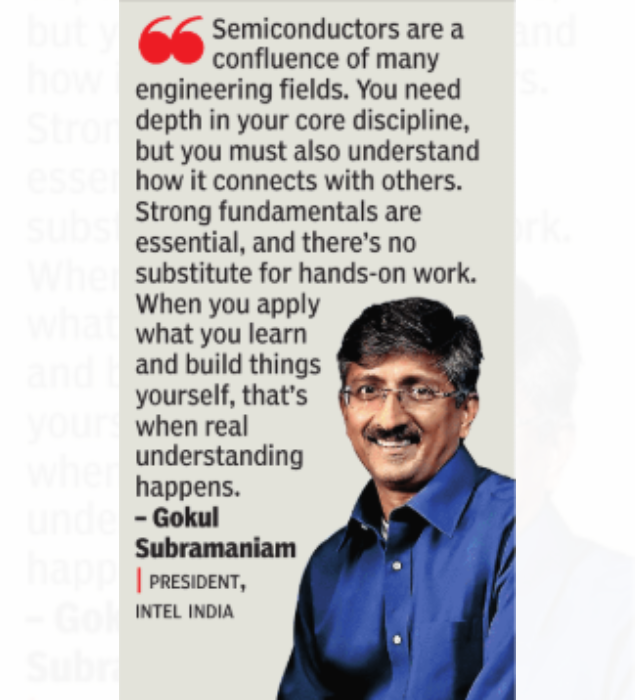
Semiconductors sit at the crossroads of multiple branches of engineering.
Electrical engineering shapes the circuits. Computer science influences processor design and software. Mechanical and materials engineering affect packaging and heat dissipation. Even chemistry and physics play a role in manufacturing. “It’s a confluence of many engineering fields,” Subramaniam says . To build a future-ready career, students must go deep in one area but remain aware of how others connect to it.He suggests thinking in two dimensions. The first is your core discipline — for instance, electrical engineering or computer architecture. The second is the domain where the chip will be used: data centres, edge devices, robotics, automobiles or defence systems. “The requirements of those domains shape how you design and manufacture the chip,” he says . Understanding both gives engineers an edge.AI, meanwhile, is evolving at remarkable speed. Unlike earlier technology shifts such as the rise of the PC or the internet, he says, “AI is moving much faster and changing much more quickly” .
That makes curiosity essential. Engineers cannot afford to ignore it. They must experiment, test and learn continuously.Keep tinkeringOne habit he returns to repeatedly in this context is to tinker with things. When hiring graduates, he looks beyond marksheets. “We look for depth in fundamentals, but also curiosity,” he says . “Have you built something? Have you experimented? What did you learn from it?” A GitHub repository, a circuit built in a lab, a simulation project that failed and was improved — all signal practical engagement.He does see gaps when trying to hire fresh graduates however. Sometimes graduates know the theory but have not applied it. “If you focus only on exams and not on projects, weaknesses will show up,” he cautions . The remedy is to use internships, summer breaks and open-source tools to gain handson experience. Students need not wait for perfect institutional support; they can form teams, seek mentors and build independently.For mid-career professionals already in the industry, Subramaniam says it’s worth asking yourself how AI can make you more efficient in your job. Think of AI as an exoskeleton — something that enhances your capability rather than replaces it. At the same time, be mindful of data security and company policies when using public AI tools.Above all, Subramaniam urges young engineers to lean into excitement rather than anxiety. Engineering has always evolved, but the pace is now faster than ever. The chips at the heart of AI may be unimaginably small, yet the opportunity to work on them is vast. Those who combine solid fundamentals, cross-disciplinary awareness and a willingness to experiment will be best placed to thrive at this intersection of silicon and intelligence.







 English (US) ·