

 1 day ago
8
1 day ago
8
ARTICLE AD BOX
History mostly navigates time like a surprise guest; it rarely signals the moments that will echo through centuries.Take King John in 1215, for example. Forced into a meadow by the Thames, just outside London, he signed Magna Carta, more out of desperation than vision.
He couldn’t have guessed that his battle with rebellious nobles would become a cornerstone of future democracies, putting even the king under the law with some of the first notions about rights and fairness.Or picture this: when a French doctor transfused sheep's blood into a teenage boy in 1667, was he aware that he was conducting an experiment that would help pave the way for modern medicine? Or take this one: when a young African American woman crossed the Atlantic to learn how to fly in 1921, she didn’t know that she was quietly breaking barriers that seemed immovable.Every June 15 seems to throw up a turning point. Across more than 800 years, it has witnessed lost dynasties, scientific breakthroughs, rights marches, pop-culture moments — this date’s been crammed with them. Some are world-famous. Others barely make the history books, but they all left marks.Here’s a quick road trip through some of June 15’s biggest events, and why folks still talk about them.
1215: Sealing the Magna Carta
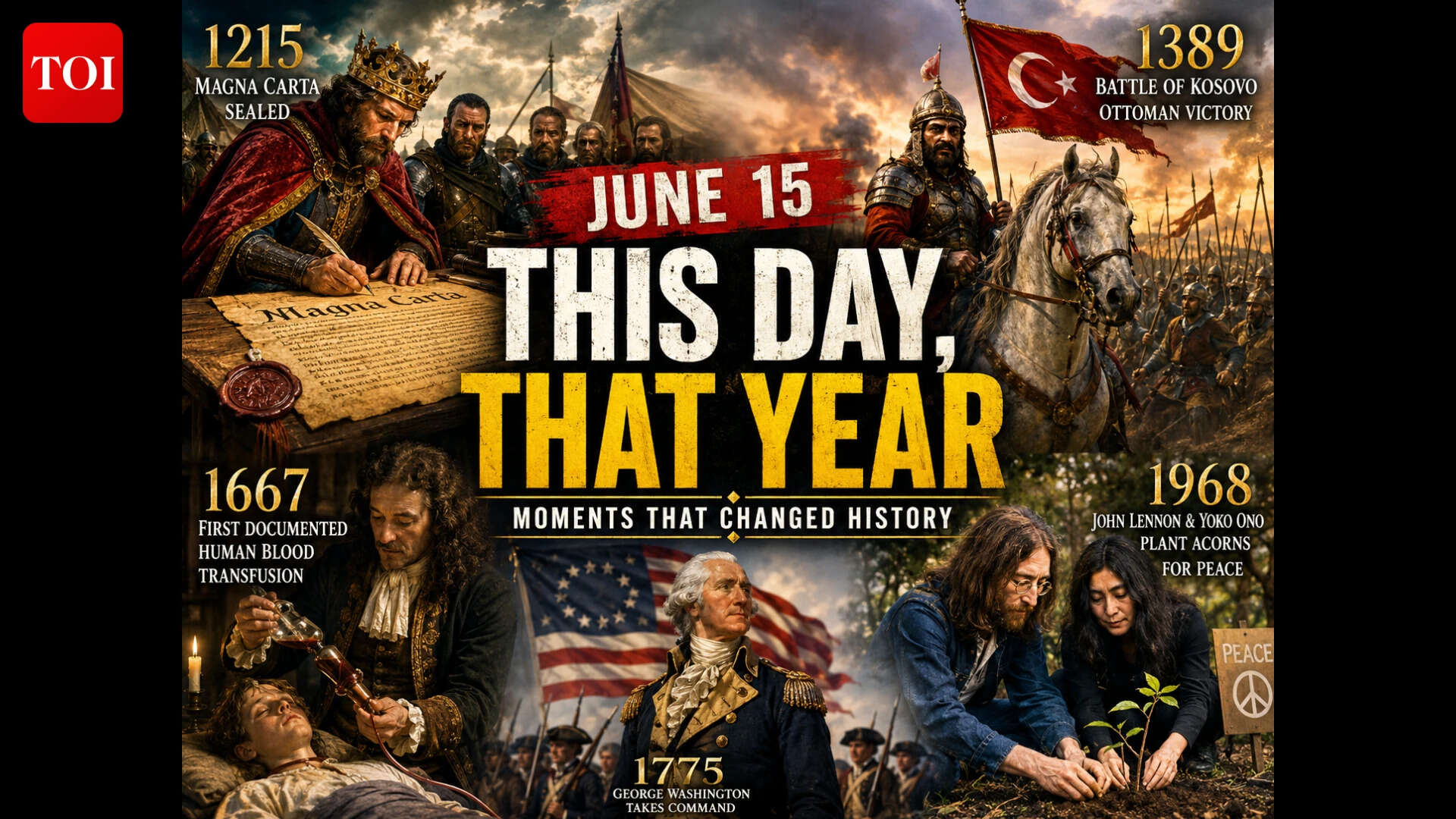
Crowns don’t come with rulebooks. On June 15, 1215, when King John’s power and taxes pushed his nobles too far, rebellion broke out and forced him to seal Magna Carta at Runnymede, a meadow near Windsor in Surrey.
The document was created after a revolt by powerful English barons who were frustrated with the king's taxes, military failures, and arbitrary rule. Although the Magna Carta was initially intended as a peace agreement between the monarch and his nobles, King John hoped it would end the crisis, but its legacy was bigger, introducing the idea of a king obeying the law.
Centuries later, it inspired moves for democracy and fair justice everywhere.
1389: The battle of Kosovo and rise of the Ottomans
One of the most famous battles in Balkan history took place on June 15, 1389. On this day, the Serbs (Serbian forces) tried to stall the Ottomans, who wanted control of the Balkans. Both sides took heavy losses, but the Ottomans had the last word, which accelerated Ottoman influence throughout Southeastern Europe. For Serbia, Kosovo became a defining historical and cultural memory, inspiring centuries of literature, folklore, and national identity.
For the Ottomans, the battle marked another step toward establishing dominance in the Balkans, a position they would maintain for centuries.
1667: First documented human blood transfusion in history
Medical history took a dramatic turn on June 15, 1667. Imagine a French doctor in the 1600s deciding to save a sick teenager by giving him a transfusion of sheep’s blood. That’s what Dr. Jean-Baptiste Denys did on June 15. Amazingly, the boy lived. In a procedure that sounds alarming by modern standards, Denys transfused a small quantity of sheep's blood into the boy.
Remarkably, the patient survived. Sure, the science was shaky (and risky), but it nudged medicine onto a path that would, hundreds of years later, make safe transfusions routine.
1775: George Washington takes command
Just a day after the Continental Army formed, on June 15, 1775, the Continental Congress appointed George Washington in charge and as commander-in-chief of the newly formed Continental Army. Sure, Washington was selected partly because of his military experience and partly because his Virginian background helped unite the American colonies, but the outcome of the Revolutionary War was far from certain.
Turns out, it did — Washington's leadership would eventually guide the colonies to independence from Britain and help shape the future United States.
Another historic bonus: America got its first president out of the bargain.
1864: Equal pay for Black soldiers
In the chaos of the Civil War, Congress took an important step toward racial equality. On June 15, 1864, legislation was passed granting equal pay to Black soldiers serving in the Union Army.
Before that, African American troops had often received lower wages despite performing the same duties and facing the same dangers as white soldiers. So, June 15 was a progress, but not enough — full equality took much longer. Still, it was a major nod toward justice and a line in the timeline of civil rights, especially in the United States.
1883: Germany creates world's first National Health Insurance System
Ever wonder where the idea of “public healthcare” came from? On June 15, Chancellor Otto von Bismarck’s Germany became the first country to introduce a national system of health insurance through "The Act on Health Insurance for Blue-Collar Workers."
The law provided workers with access to medical care and financial support during illness. Eventually, other countries copied the model, setting off a domino effect that led to today’s social safety nets.
1908: Women’s rights movement goes global in Amsterdam
The World Congress for Women's Rights opened in Amsterdam in June 1908. June 15 saw activists from all over the world rally for women’s rights. The congress reflected the growing international nature of the women's rights movement and helped strengthen cooperation among suffragists and reformers.
The issues would take decades to sort out, but global gatherings like this one kept the fire burning, leading to voting rights and reforms across continents.
1916: Boeing’s first flight
Aviation history gained a new chapter on June 15, 1916. This might sound weird in today’s world, but Boeing wasn’t always a juggernaut. Its very first plane, the Model 1 seaplane, as the B&W Seaplane, took flight on this day. That little test run led to jetliners, rockets, an entire modern travel industry, and turned Boeing into a company that would later become one of the world's largest aerospace manufacturers.
That first flight marked the humble beginning of a global aerospace giant.
1921: Bessie Coleman breaks aviation barriers
On June 15, 1921, Bessie Coleman earned her pilot's license in France, becoming the first African American woman and the first Native American woman to receive one. Denied entry to flight schools in the United States (racism and sexism, what else? ), Coleman went all the way to France, learnt French, earned her pilot’s license, and became a pioneer for generations.
Her achievement challenged racial and gender barriers in aviation and inspired generations of future pilots.
She’s now a legend and proof that closed doors can be kicked down.
1967: Ronald Reagan signs California’s abortion reform
Long before he was president, on June 15, 1967, Reagan signed the Therapeutic Abortion Act. The legislation expanded legal access to abortion in certain circumstances, including cases involving rape, incest, or risks to a woman's physical or mental health.
At the time, it was considered progressive. Little did he know that the topic would become a flashpoint for US politics for decades.
1968: John Lennon and Yoko Ono plant acorns for peace
John Lennon and Yoko Ono were never short on symbolism. On June 15, 1968, Lennon and Ono planted acorns at Coventry Cathedral in England as part of their peace campaign. Planting acorns was a quiet protest, a gentle nudge for peace, even as the world argued its way through the Vietnam War era.
The acorns became part of a broader artistic and political effort that blended celebrity influence with calls for peace and international understanding.
1986: Amnesty International's 'Conspiracy of Hope' tour ends with a historic concert
On June 15, 1986, human-rights advocacy took center stage when Amnesty International's "Conspiracy of Hope" tour concluded with a massive concert at Giants Stadium in New Jersey. The event featured an extraordinary lineup including U2, Sting, Peter Gabriel, Bryan Adams, Joan Baez, Lou Reed, Joni Mitchell, Miles Davis, The Police, Yoko Ono, and many others.
The concert helped raise awareness about political prisoners, human-rights abuses, and Amnesty International's global campaigns, and even after nearly half a century, it remains one of the most significant examples of music being used as a platform for activism.
2012: An Apple I computer sells for a record price
Once, Steve Jobs and Steve Wozniak built these in a California garage. On June 15, one of the earliest computers designed by Steve Jobs and Steve Wozniak sold for $374,500 at auction.
The extraordinary sale price highlighted the historical significance of the personal-computer revolution and the immense cultural influence of Apple on modern technology. The auction was testament: what was once a garage-built machine had become a prized collector's item.
2018: Stephen Hawking takes his place among titans
On June 15, 2018, the ashes of physicist Stephen Hawking were interred in Westminster Abbey in London. It was poetic, as his final resting place was between the graves of Isaac Newton and Charles Darwin: a scientist whose mind roamed black holes, eternally lying among scientific giants.
2018: Elizabeth Holmes’ fall and the Theranos reckoning
On June 15, 2018, Elizabeth Holmes and her unicorn startup Theranos came crashing down, charged with fraud. For the unversed, Theranos, which had once been valued at billions of dollars and was celebrated as a revolutionary healthcare startup, was charged with fraud over claims related to the company's blood-testing technology. After investigations revealed that many of its claims about Theranos’ technology were misleading, it became one of Silicon Valley's most notorious scandals, as well as a wake-up call.








 English (US) ·