

 55 minutes ago
4
55 minutes ago
4
ARTICLE AD BOX
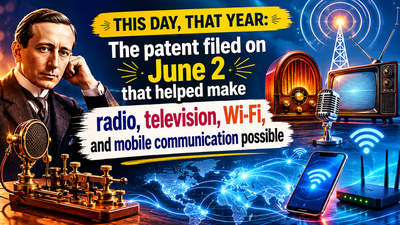
Pick up your phone right now. Send a message. Stream a song. Connect to Wi-Fi. Every single action traces back to a piece of paper filed in London on June 2, 1896. It was filed by a 22-year-old Italian with no formal university degree, working out of borrowed laboratory space, guided by his cousin and backed by a family that believed in him when almost nobody else did.
His name was Guglielmo Marconi. And what he submitted that day, a patent application titled "Improvements in Transmitting Electrical Impulses and Signals, and an Apparatus therefore," published as British Patent No. 12039, would quietly become one of the most consequential documents in the history of human communication.Under the guidance of his cousin Henry Jameson Davis, Marconi filed his final specification for the world's first patent for a system of telegraphy using Hertzian waves. British Patent number 12039 (abridgement version of this is available online) was filed on June 2, 1896.
What the patent actually described
The patent described the use of Marconi's sensitive tube receiver, or coherer, connected to an earth and elevated aerial, and the timing of the transmitting and receiving circuits with each other. It was a system for sending coded signals through the air using electromagnetic waves, no wires, no cables, no physical connection between sender and receiver. By the standards of the day, that was not just novel. It was almost incomprehensible.
The idea that information could travel invisibly through open space contradicted how most people understood the world to work.Marconi filed his patent in England and during that and the following year gave a series of successful demonstrations, in some of which he used balloons and kites to obtain greater height for his aerials. He was able to send signals over distances of up to 6.4 km on Salisbury Plain and to nearly 14.5 km across the Bristol Channel (as per Britannica).
The invention that kept inventing
Here's what makes the June 2 patent so remarkable in retrospect: it didn't just lead to the radio. It led to everything that came after the radio. Television uses radio frequency waves to transmit images and sound. Wi-Fi and Bluetooth operate using similar principles of short-range wireless communication. Mobile phones rely on radio wave transmission to send data, voice, and video. The core principle Marconi patented, that information could be encoded in electromagnetic waves and sent through space without a physical connection, is the same principle underpinning every wireless technology that exists today.In 1932, Marconi's team built the first microwave telephone system, paving the way for the modern telecommunications revolution. And he kept going. In 1924, he convinced the British government to create a chain of wireless stations circling the globe using shortwave radio. In 1931, he created the world's first international broadcasting service — a papal blessing transmitted to millions simultaneously, demonstrating in real time what global reach actually meant.
About Guglielmo Marconi
Born in Italy in 1874, Marconi became fascinated by science at a young age. He was particularly interested in the work of physicists who had discovered that invisible electromagnetic waves could travel through space. He wondered if these waves could be used to send messages over long distances without the need for wires.Marconi received the Nobel Prize in Physics in 1909 for his contributions to wireless telegraphy. When Marconi died on July 20, 1937, radio stations around the world observed a two-minute silence in his honour. It's considered to be one of the more poetic tributes in the history of technology.But the real tribute is this: 130 years after that patent was filed in London, you are reading this on a device that wouldn't exist without it.









 English (US) ·