

 1 hour ago
3
1 hour ago
3
ARTICLE AD BOX
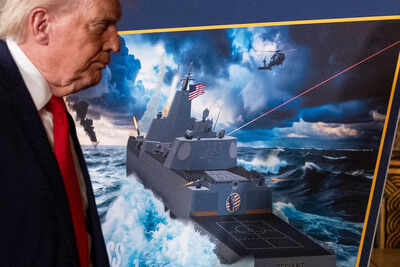
President Trump unveiled plans for "Trump-class" warships, colossal missile-heavy vessels intended to form a "Golden Fleet" for the US Navy. These massive ships aim to counter China's growing naval power and revive American shipbuilding. However, the ambitious project faces significant challenges including industrial capacity issues and questions about the relevance of such large vessels in modern warfare.
TL;DR: Driving the newsPresident Donald Trump announced plans for a new “Trump-class” warship-colossal missile-heavy battleships that he says will form the centerpiece of a newly envisioned Golden Fleet for the US Navy.
The first ship, USS Defiant, is expected to begin construction soon and promises to be “100 times more powerful than any battleship ever built.
”“We’re desperately in need of ships,” Trump said at Mar-a-Lago, surrounded by renderings of sleek warships and his own defiant image. “Some of them have gotten old and tired and obsolete, and we’re going to go in the exact opposite direction,” he said.These ships, envisioned as 880-foot, 35,000-ton supercombatants, are meant to reverse the Navy’s declining ship count and reestablish dominance against rising maritime rivals-chief among them, China.Why it matters
- The new fleet isn’t just about military strength-it’s about strategic signaling. Trump is explicitly framing his naval ambitions as a deterrent against Beijing’s rapidly expanding naval footprint.
- “They’ll help maintain American military supremacy, revive the American shipbuilding industry and inspire fear in America’s enemies,” Trump said.
- The plan is audacious. It is also risky. At stake is not just whether the Navy can build the largest surface combatants it has attempted since World War II, but whether America’s aging shipbuilding system can deliver anything close to what Trump is promising-on time, on budget, and in a form that actually deters Beijing rather than inviting new vulnerabilities.
- But the program faces towering challenges: stalled shipyards, outdated industrial capacity, a shrinking workforce, and tech hurdles involving unproven weapons like rail guns and nuclear missiles.
- It also raises serious questions: Are behemoth warships the right answer in an era dominated by unmanned systems, hypersonics, and swarm drone warfare?
The big picture: It’s China, stupidThe administration’s argument is straightforward. China is building ships faster than the United States. Its navy is larger in raw numbers. To deter Beijing, Washington needs ships with more firepower, longer reach, and greater survivability.But critics argue that Trump’s solution may collide head-on with China’s actual strategy.The People’s Liberation Army fields the DF-26 intermediate-range ballistic missile, nicknamed the “carrier killer,” designed to strike large US warships at long distances.
That threat has already raised uncomfortable questions about the future of aircraft carriers, the most powerful symbols of US naval might. A Trump-class battleship, even more expensive and just as visible, would face the same targeting problem.Some analysts argue that the lesson of modern warfare-from the Pacific to Ukraine-is that dispersion beats concentration. Smaller ships, unmanned systems, and large numbers of missiles spread across many platforms make it harder for an adversary to land a decisive blow.Yu Jihoon, a research fellow at the Korea Institute for Defense Analyses, told CNN that “the advantages of small battleships and unmanned systems are that the quantity can be increased at a relatively low cost and viability can be increased by dispersing risk across multiple platforms.”“The PLAN is nearing the ability to challenge our access to the Western Pacific, a direct and clear threat to our national security,” retired Navy captain Carl Schuster told CNN.
“We can’t do this alone-we need allies like Japan and South Korea onboard.”
In giving the new class of ships his own name, Trump also continued a self-aggrandizing streak of imprinting his brand on various aspects of the federal government. Just last week, Trump’s name was added to the John F. Kennedy Center for the Performing Arts, the premier performing arts center in Washington. The center’s board of trustees, a majority of which were handpicked by Trump, voted to rename the institution.
An article in NYT
Zoom in: Inside the Trump-class warshipAccording to the Navy’s official website and USNI News, the Trump-class ships are slated to feature:* Hypersonic nuclear-capable missiles (12 cells)* 128 vertical launch tubes for Tomahawks, anti-ship missiles, and interceptors* Rail guns and directed-energy lasers* Two 5-inch guns, not the massive cannons of WWII-era battleships* AI-driven combat systems and reduced crew needs (650–850 sailors)* Displacement: 30,000–40,000 tons (twice that of current destroyers)Trump promised construction would begin “almost immediately” and last 2½ years per ship, though industry insiders say the actual timeline is far longer-closer to 7–10 years, especially for new shipyards.“You need something two-to-three times the size of an Arleigh Burke-class destroyer,” Bryan Clark, a naval analyst with the Hudson Institute, told the WSJ. “More firepower, more missile tubes, more defenses-these ships could be critical, but only if done right.”
Some critics warned the “battleship” and the Navy’s overarching plans for a “Golden Fleet” — upgraded surface combatant ships joining the Navy’s inventory of aircraft carriers and submarines — fell short of what was needed to deter China and other maritime adversaries.
The NYT article
What they're saying: Hope meets skepticismWhile shipbuilders like HII and Bath Iron Works cheered the announcement, naval experts voiced deep reservations.As per a NYT report, Mark Montgomery, retired rear admiral and senior fellow at the Foundation for Defense of Democracies, called the Golden Fleet “exactly what we don’t need.”“We do not need ships that are not optimized to provide lethality against the Chinese threat,” he told WSJ. “These battleships will achieve none of the tactical goals necessary in a modern fight.”Instead, Montgomery and others advocate for a distributed fleet-smaller, faster, unmanned vessels dispersed across the Pacific to avoid becoming sitting ducks for China's missiles.“The advantage of small ships and unmanned systems is quantity and survivability,” Yu Jihoon, a former South Korean naval officer, told CNN. “They’re harder to target and far cheaper.”Between the lines: The industrial gap is realBuilding ships is no longer the US advantage it once was. Most shipyards today are maxed out, underfunded, or shuttered. As per a CNN report, even existing programs are badly delayed:* USS John F Kennedy: 2 years late* Constellation-class frigate: Cancelled after 3-year slip* Zumwalt-class destroyers: Cut from 32 to 3; final ship still uncommissioned* Rail guns: Program axed in 2021 after $500M+ in sunk costsNavy Secretary John Phelan said it bluntly: “All of our programs are a mess,” he told Congress in June.
“Our best ship is 6 months late and 57% over budget.”Even more concerning: the workforce. Shipyard jobs are hard, long, and underpaid-especially compared to Amazon warehouses or service work.“A national-scale recruitment and training program is required,” Schuster told CNN. “And if Trump wants this to succeed, he must clean house at NAVSEA, which has botched every surface warship this century.”What’s next: Can the Trump fleet get to sea?The administration plans to use tax incentives to revive US shipbuilding, expand shipyards, and penalize slow contractors.
Trump has created a new Office of Shipbuilding and will meet with defense firms next week.But even if a Trump-class warship launches in the 2030s, it may still fall short of congressional requirements. Critics note it will be missile-centric and lack the traditional firepower of past battleships-yet it still won’t deliver the distributed, survivable capabilities many experts say are essential.There are also legal issues: Deploying nuclear cruise missiles at sea could violate existing non-proliferation agreements with Russia-another diplomatic landmine.And even the technology isn't fully ready. The rail gun, for example, was shelved because it consumed too much power and wasn’t reliable. Lasers are more viable but still years away from widespread deployment.The bottom lineTrump’s Golden Fleet is bold, expensive, and personally branded-equal parts military buildup and political theater. Supporters say it could revive American dominance at sea and jumpstart shipbuilding.
Critics say it's the wrong tool for a high-tech naval future.Like his “Space Force” or steam-powered catapult push, the Trump-class project blends nostalgia with ambition-and carries a heavy dose of aesthetic flair.“The US Navy will lead the design of these ships along with me, because I’m a very aesthetic person,” Trump said.But if the Navy can’t build them fast, affordably, or at scale, they may become more of a monument to Trump’s naval vision than a check on China’s growing reach.What to watch:* Will Congress fund the full fleet or push back on cost and treaty concerns?* Can new shipyards come online before 2030?* How will China respond to this direct signal of deterrence?Until the USS Defiant sails, the debate continues: Is the Trump-class a turning point in naval power-or a $300 billion gamble on an outdated concept?(With inputs from agencies)









 English (US) ·