

 1 hour ago
4
1 hour ago
4
ARTICLE AD BOX
When Pep Guardiola arrived at the house in Rosario, at his former teammate Gabriel Batistuta’s insistence, he assumed he would only have a brief conversation on coaching. He was there for 11 hours instead. When Héctor and Amalia Pochettino heard a knock on their door at 1 am in Murphy, they feared one of two things: trouble or tragedy. Instead, they found a football coach, who had heard a lot about their 13-year-old son, Mauricio, and wanted to meet him.
Both Guardiola and Pochettino now regard the man they met as the best coach of all time.
Given their résumés — Guardiola being one of football’s decorated managers, and Pochettino being a Ligue 1 champion — you would assume their shared idol ought to be a serial winner. He is not. He is Marcelo Bielsa — a man with six major trophies in a managerial career spanning nearly four decades.
One could consider Bielsa a trailblazer who transcended conventional thinking to prove footballing success has little to do with trophies. Or, is he a benefactor of a facade, with radical ideas that only work in theory but are inefficacious in reality?
We would never know.
Bielsa is expected to step down as Uruguay manager after the 2026 FIFA World Cup. Saturday’s meeting with defending European champions Spain could be his final match on the touchline. If it is, he will depart as he lived — impossible to decipher and even harder to explain.
Under Bielsa, Uruguay began with promise, but it has since unravelled. They are staring at their first group stage exit since 2002. Uruguay have drawn against Saudi Arabia and Cape Verde, and now face Spain.
The madman
Colloquially known as ‘El Loco,’ or the madman, there is a bizarre legend behind the nomenclature. Then managing Newell’s Old Boys, Bielsa oversaw a 6-0 defeat to San Lorenzo at the Copa Libertadores. Furious supporters gathered outside his home to confront him. They could barely believe what happened next. Bielsa showed up with a grenade, and threatened, “I will pull the pin if you don’t go away.”
Story continues below this ad
Did it actually happen? We might never have a definitive answer. Such has been his life that exaggeration cannot be separated from reality. Instead, we could analyse the tenets of Bielsa’s coaching philosophy, and draw our own conclusions.
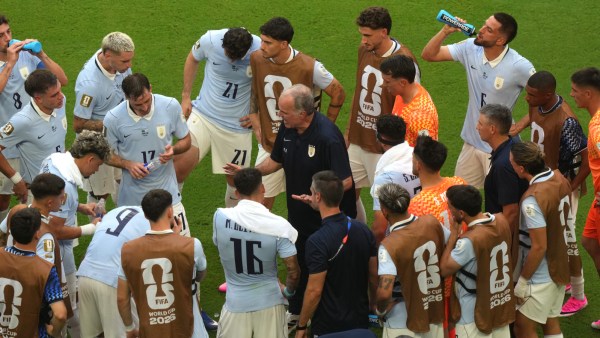 Uruguay head coach Marcelo Bielsa talks to players during the World Cup Group H match against Saudi Arabia. (AP)
Bielsa has an obsession with football. Among his earliest jobs was to scout talented kids for the Old Boys. He scoured through the entire nation with his Fiat 517, hunting for talent in forgotten towns and overlooked fields. This is how Pochettino was discovered.
He also has a moral compass that remains untainted. Despite winning the league with Old Boys, he resigned because the club did not punish players when they broke curfew after attending a wedding. At the Athletic Club in Bilbao, he got into an argument with a construction worker. The disagreement was quickly forgotten by everyone involved. Everyone, except Bielsa. He showed up at the police station and demanded an arrest. Not the worker’s, but his. Iker Muniain, then playing for Athletic, was asked by a journalist: “Is Bielsa really as mad as we all think?” The winger replied: “No. He is even madder.”
In his own right, Bielsa is also a rebel. Following Chile’s impressive run at the 2010 World Cup, the squad was invited to La Moneda by President Sebastián Piñera. Players and staff queued to greet the country’s first democratically elected right-wing president since the end of military rule, but Bielsa chose not to. Until he was almost forced.
Story continues below this ad
Bielsa has never voiced his political position, though his values paint a picture. At Leeds United, Bielsa once ordered his players to spend three hours picking up litter around the city. The intention was simple — players must know roughly how long working-class supporters had to work to afford a match ticket. At the World Cup, he is the only person who chose not to pose during the photoshoot. The reason was simple: “I’m not a model.” Rebellion, as opposed to subservience.
Rosario, after all, is famous not only as the birthplace of Lionel Messi, but also of Che Guevara.
Luis Suarez, who has been a vocal critic of the Argentine, had urged fans: “I ask people not to take it out on the players if something goes wrong. Bielsa has separated the whole group.”
Bielsa’s response could not have been more Bielsa: “I’m a generator of tension. When I arrive, the environment becomes tense. I’m toxic. To associate yourself with me makes you worse off.”
Story continues below this ad
Who is Bielsa? To some, he is a prophet whose intellect and ideas shaped a generation of coaches. To some, he is the master of illusion, masquerading as a legend. Oscillating between a god and a fraud, Bielsa remains one of football’s greatest paradoxes.
At Leeds, a Bielsa mural reads: “A man with new ideas is a madman, until his ideas triumph.”




 English (US) ·