

 1 hour ago
8
1 hour ago
8
ARTICLE AD BOX
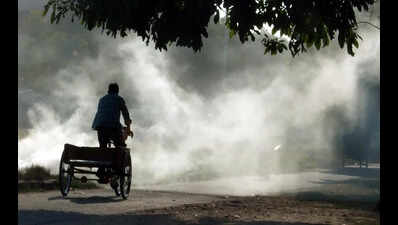
Chandigarh to measure its carbon footprint
Chandigarh: How much greenhouse gas pollution does Chandigarh generate, which sectors contribute the most, and how much of it is offset by the city’s extensive green cover? To find answers, the Chandigarh administration will soon launch a comprehensive scientific assessment of the city’s carbon footprint and carbon stock, an exercise aimed at accurately measuring Chandigarh’s environmental burden and identifying key emission hotspots across the Union Territory.The study, one of the most extensive climate assessments undertaken in the city, will evaluate emissions generated by households, commercial establishments, transport systems, industries and waste management activities while simultaneously measuring the carbon absorption potential of forests, parks, gardens and other green spaces.The assessment will cover entire UT area. The city, regarded as one of India’s greenest cities, has nearly 4,500 hectares of green cover, comprising parks, gardens, institutional campuses, roadside plantations and open green spaces.
Of this, around 3,200 hectares are notified forest areas, including the ecologically important 26-sq-km Sukhna Wildlife Sanctuary. All major green assets will be scientifically mapped and assessed to determine their carbon storage and absorption potential.A dedicated carbon stock inventory will be created by measuring not only above-ground vegetation but also below-ground root biomass and soil organic carbon.
In addition, a separate carbon sequestration database will be developed for the Sukhna Wildlife Sanctuary, enabling authorities to accurately estimate how much carbon is absorbed and stored by Chandigarh’s natural ecosystems and how effectively they offset the city’s emissions.Officials said the scientific assessment would provide Chandigarh with its first comprehensive picture of the balance between emissions generated and carbon absorbed within the city, helping shape future environmental and climate policies through data-driven decision-making.BOX1: How it will be doneTo develop a detailed emissions inventory, Chandigarh will be divided into 2 km x 2 km grids. Using high-resolution satellite imagery and Geographic Information System (GIS) technology, authorities will map emissions across different localities and identify areas contributing the highest carbon load.Carbon emissions will be quantified across seven major sectors, including energy consumption, transportation, buildings and infrastructure, waste management, industry, agriculture and other activities.BOX2: The aimThe exercise is expected to establish benchmark emission levels for households, vehicles and commercial establishments, providing a scientific basis for targeted policy interventions.Beyond assessing current emissions and carbon stocks, the study will analyse greenhouse gas trends over the past five to ten years and prepare projections for 2030 and beyond.The findings will be used by a designated institution to formulate a long-term action plan covering renewable energy expansion, sustainable transportation, waste management reforms and urban forestry initiatives.BOX3: Carbon savingsThe carbon audit coincides with significant progress made by Chandigarh in renewable energy adoption. The UT has achieved 100% rooftop solar saturation across all 377 viable govt non-residential buildings, with solar installations completed at 11,663 locations. Most viable govt residential housing complexes have also been covered wherever feasible.These installations collectively generate around 84 million units of clean electricity annually, reducing carbon dioxide emissions by nearly 57,960 tonnes every year.The use of public bicycle sharing has reduced annual carbon dioxide emissions by 36,000 kg, which helps purify the environment equivalent to planting 1,600 trees.The city has also witnessed rapid growth in electric mobility. Over the last five years, the number of electric vehicles on Chandigarh roads has increased sixteen-fold, resulting in a twenty-six-fold rise in cumulative carbon emission savings. These savings have grown from 5.65 kilotonnes of CO₂ equivalent in 2021 to nearly 150 kilotonnes by 2025.









 English (US) ·