

 1 hour ago
3
1 hour ago
3
ARTICLE AD BOX
The morning after February 28 did not begin with silence. It began with celebration. As confirmation spread that Iran’s Supreme Leader had been killed in coordinated US–Israeli strikes, videos surfaced of few people and especially women celebrating the attack.
The targeted killing of Supreme Leader Ali Khamenei and senior officials, including Defense Minister Aziz Nasirzadeh, drew widespread condemnation across the world. But reactions inside the country appeared far more complicated. For some citizens, the sense of relief circulating online was not about celebrating the deaths of officials. Instead, it reflected a fragile hope that the upheaval might trigger long-awaited change.
Many believe that a shift in the regime could open the door to reforms long demanded in Iran’s social, legal, and economic systems, particularly those affecting women.Iranian-American journalist Masih Alinejad, who also participated in the 2022 protests in Iran, posted a video on X on March 1, visibly emotional. In the clip, she tears up and says, “ I want to run, I want to shout.”British-Iranian actress Elika Ashoori took to Instagram and shared, “My stance has always been and always will be anti-war, but I refuse to be boxed into a moral code that asks me to mourn a firing squad or not rejoice at their destruction.
For 46 years, the Islamic regime has not been a government; it has been an occupying force at war with its own people, relentlessly massacring, assaulting and abusing with no mercy. Killing thousands of children, women and men in the process.
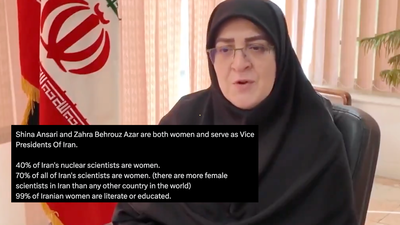
”There were reactions from both sides of the spectrum. Thus, as footage of women celebrating circulated, critics of Western intervention argued that Iran’s women were not oppressed in the first place.One widely shared post read: “Fatemeh Mohajerani is the official spokesperson of the Iranian government. She's been the official government spokesperson for over 2 years. Shina Ansari and Zahra Behrouz Azar are both women and serve as Vice Presidents Of Iran.
- 40% of Iran's nuclear scientists are women.
- 70% of all of Iran's scientists are women. (there are more female scientists in Iran than any other country in the world)
- 99% of Iranian women are literate or educated.
Do with this information whatever you want. So much for liberating Iranian women. The jokes really do write themselves”The implication was clear: the idea of “liberating” Iranian women is nothing more than Western propaganda. In the comment section, several users who resonated with the tweet lashed out at the western nations for their need to interfere. One user wrote, “Everything they told you about Iran is false. Make your own research, find your own truth. All the West knows how to do is propaganda.”Another said, “The only problem they have with Iranian women is the use of Hijab. When you ask them how Iranian women are being oppressed, their only defense is often the use of Hijab nothing more.
Their definition of freedom is seen in only not using the Hijab.”Third wrote, “The liberation the west is preaching is literally inappropriate dressing and onlyfans.”A fourth commented, “Western liberalism and feminism making women to end up at Epstein massage rooms. That's western feminism.”But whether that claim holds any truth is a debate for later. First, it is worth examining the romanticized picture the user painted of life for women in Iran.
Fact-checking the claims
Fatemeh Mohajerani is indeed the current spokesperson of the Iranian government, appointed on August 28, 2024. She is the first woman to hold the role.However, women remain significantly underrepresented in Iran’s political system. In the 290-member parliament, women typically hold between 14 and 17 seats, under 6 percent. No woman has ever held the presidency, and none occupy the highest clerical offices.Of the two other officials mentioned: Shina Ansari serves as Vice President for Environment.Zahra Behrouz Azar serves as Vice President for Women and Family Affairs, appointed in August 2024.While these appointments are real, the second role oversees women and family policy, a portfolio traditionally aligned with gendered social governance. It does not signal parity in executive authority.The claim that “40% of Iran’s nuclear scientists are women” appears to trace back to remarks reported by Press TV, a state-funded arm of the Islamic Republic of Iran Broadcasting (IRIB).
During a 2024 joint press conference in Tehran, Mohammad Eslami, head of Iran’s Atomic Energy Organization, stated that IAEA Director General Rafael Grossi was “astonished” by the number of women managing Iran’s nuclear industry.
No independent data confirms the 40 percent figure.Similarly, the claim that “70% of all of Iran’s scientists are women” lacks verification from international databases.On literacy, however, the trend is measurable.According to data from the World Bank and UNESCO Institute for Statistics, female literacy in Iran has risen dramatically. In 1976, adult female literacy stood at roughly 35 percent. By 2023, it had reached approximately 85 percent. That places Iran above the Middle East and North Africa regional average of around 67 percent for adult female literacy.This transformation is significant. Iranian women are highly educated.
They dominate university classrooms in many fields. They are visible in medicine, engineering and academia.So where does the contradiction lie?
Education without autonomy
Iran promotes women’s education. It appoints women to visible administrative roles. It showcases female scientists in state media.Yet it operates within strict ideological boundaries.Under Article 109 of Iran’s constitution, the Supreme Leader must be a male cleric.
Under Article 115, presidential candidates must come from “rijal,” interpreted by the Guardian Council as religious men, female candidates have repeatedly been disqualified.Mandatory hijab laws are enforced through morality policing, fines and surveillance. The 2024 “Chastity and Hijab” legislation expanded penalties, including vehicle seizures and social media restrictions. The 2022 death of Mahsa Amini while in morality police custody ignited the “Woman, Life, Freedom” protests, demonstrations met with violent suppression.Family law remains unequal. Men may unilaterally divorce. Women must meet strict legal thresholds and often risk losing custody or financial support. Husbands can restrict their wives’ travel by withholding passport permission. Article 1117 allows a husband to ban his wife from employment deemed “incompatible” with family interests. Girls may legally marry from age nine with judicial approval.
Feminism — but defined by the State
The notion of an independent women’s movement in Iran is not merely debated, it is actively denied by the ruling establishment.
Officials routinely frame demands for gender equality as foreign infiltration rather than domestic dissent.This tension between state-defined roles for women and independent activism has repeatedly surfaced in public protest, and in the state’s response to it.1979: International Women’s Day ProtestsOn March 8, 1979, thousands of women gathered in Tehran to protest statements by Ayatollah Ruhollah Khomeini indicating that Islamic dress should be observed in workplaces. Contemporary reporting and later historical research estimate participation over several days at tens of thousands, with some estimates reaching 100,000.The demonstrations were met with hostility from pro-revolutionary groups. By 1983, mandatory hijab was formally codified into law, making non-compliance punishable under the penal code.2009: The Green MovementAfter the disputed re-election of President Mahmoud Ahmadinejad, mass protests erupted across Iran between June and December 2009.Women played a visible role in demonstrations.Human rights organizations documented at least 72 deaths and more than 4,000 arrests. Allegations of torture and sexual abuse in detention centers, including Kahrizak prison, were later reported by detainees and investigated by Iranian authorities, resulting in limited prosecutions of some officials.One of the most widely reported deaths was that of Neda Agha-Soltan, who was shot during a protest; video of the incident circulated globally.2017–2019: Hijab Defiance and “Bloody November”In late 2017, individual acts of protest against compulsory hijab began appearing publicly. Women stood on utility boxes in Tehran, removing headscarves in what became known as the “Girls of Revolution Street” movement.In November 2019, nationwide protests broke out over fuel price increases. Demonstrations expanded into broader anti-government unrest.Amnesty International reported that at least 304 people were killed during the crackdown.
Reuters later cited Iranian officials estimating approximately 1,500 deaths. Iranian authorities have not publicly confirmed a final death toll.Women participated in the protests. Video evidence showed security forces using live ammunition in multiple cities.2022: Mahsa (Jina) Amini and “Woman, Life, Freedom”On September 13, 2022, 22-year-old Mahsa (Jina) Amini was detained by Iran’s morality police for alleged improper hijab. She collapsed while in custody and died on September 16.Iranian authorities attributed her death to underlying health conditions. Her family publicly rejected that explanation.Her death sparked nationwide protests under the slogan “Woman, Life, Freedom.” Demonstrations spread to more than 100 cities.According to HRANA (Human Rights Activists News Agency), 551 protesters were killed, including 68 children. Authorities have not confirmed those figures. Thousands were arrested; some estimates exceed 20,000 detentions.Two realities can exist simultaneously.It is factually correct that women in Iran hold senior government roles. Women serve as vice presidents, members of parliament, university professors, scientists, and doctors. Female literacy rates are high. Women comprise a significant share of university graduates and research professionals.It is also factually correct that:
- Compulsory hijab remains law.
- Public opposition to that law has repeatedly led to arrests, imprisonment, and in multiple documented cases, lethal force.
- Protest movements in 1999, 2009, 2017–2019, 2022, and beyond have resulted in mass detentions.
- Activists such as Narges Mohammadi remain imprisoned for their advocacy.
Holding office in Iran does not automatically mean advocating for liberal feminist reform as understood in Western political discourse. Public officials operate within the ideological framework of the Islamic Republic. Advancement within the system generally requires alignment with its constitutional and religious foundations.



 English (US) ·