

 1 week ago
10
1 week ago
10
ARTICLE AD BOX
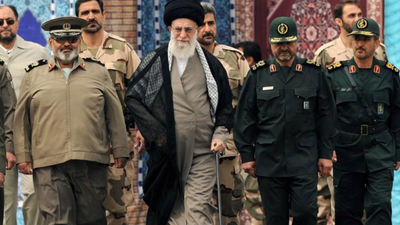
The Islamic Revolutionary Guard Corps (IRGC), Iran’s elite military force, has long been a pillar of the Iranian regime, tasked with countering threats abroad and suppressing dissent at home.In a video address announcing a “major” military operation in Iran, US President Donald Trump warned members of the IRGC, the armed forces and police: “You must lay down your weapons and have complete immunity, or in the alternative, face certain death.”The statement followed a major US-Israeli attack on Iran on Saturday, with initial strikes reportedly targeting areas near the offices of Supreme Leader Ayatollah Ali Khamenei.
Iranian media reported explosions across the country, and smoke was visible rising over the capital, Tehran.
What is the IRGC?
The Islamic Revolutionary Guard Corps (IRGC) was established after the 1979 Islamic Revolution, which overthrew Iran’s Western-backed Shah, Mohammad Reza Pahlavi, and brought Shia cleric Ayatollah Ruhollah Khamenei to power as the country’s first Supreme Leader.Formed from various paramilitary groups that had helped topple the monarchy, the IRGC was designed to “guard” the theocratic system and resist integration into the regular army.
Its power was further consolidated during its involvement in the Iran-Iraq War in the 1980s.The IRGC’s mandate, enshrined in the Iranian constitution, is to protect the Islamic Revolution both within Iran and abroad, as cited by CNN.Today, the IRGC stands as Iran’s most powerful military branch, functioning independently of the regular army. With an estimated 150,000 to 190,000 members, it oversees its own army, navy, air force and intelligence operations, and exerts extensive influence within the country’s civilian economy.
Quds Force: Iran’s elite unit for foreign operations
The Quds Force is an elite expeditionary unit within the IRGC, originally tasked with conducting operations abroad, beginning with support for Hezbollah in Lebanon. Over the years, it has extended its backing to a range of non-state actors across the Middle East, including Hamas in Gaza, the Houthis in Yemen, and the Taliban in Afghanistan during the 1990s.
Basij: Iran’s domestic force enforcing regime and morality
The Basij, one of the five branches of the IRGC, functions as a domestic, street-level force similar to a police organization. Its name, meaning “mobilization” in Farsi, reflects its role as a volunteer force drawn from across Iran, often from poorer and more conservative communities. The Basij is primarily tasked with supporting the regime internally and enforcing Islamic moral codes among the population.





 English (US) ·