

 3 days ago
9
3 days ago
9
ARTICLE AD BOX
For 22 months, BJP leader Samrat Choudhary wore the muretha (turban) as a vow. He pledged to remove it only after ousting Nitish Kumar from the chief minister's post. Choudhary was named Bihar's new CM on Tuesday. But the muretha was off over a year ago.
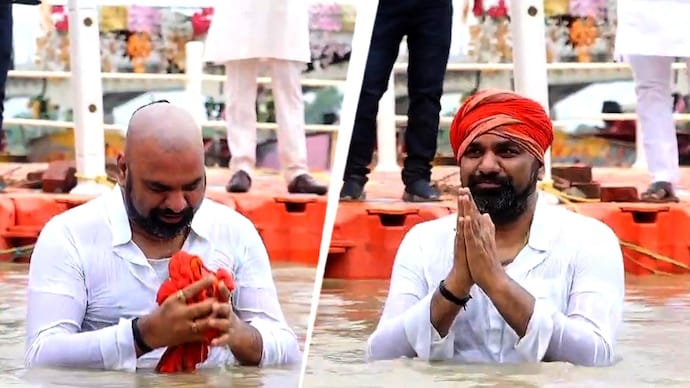
Samrat Choudhary had vowed to remove his muretha only after unseating Nitish Kumar, but he offered the turban to Lord Ram much earlier. (Image: X via Samrat Choudhary)
New Delhi,UPDATED: Apr 14, 2026 18:49 IST
Samrat Choudhary was named Bihar's new Chief Minister on Tuesday, marking the end of Nitish Kumar's over two-decade-long hold on the post and the state's politics. Kumar, who has served as CM for most of the period since 2005, resigned quietly, handing over the reins to Choudhary, his deputy. But the development carries a special irony for Choudhary. Nearly three years ago, when Nitish Kumar was heading a Mahagathbandhan government with the Rashtriya Janata Dal (RJD), Congress and Left parties, Choudhary, then state BJP president, made a dramatic vow in public.
During an exchange in the state legislature, Nitish asked Choudhary why he always wore a traditional muretha (turban). Choudhary replied, "This is my resolve — to remove you from the post of Chief Minister. The turban will come off the day you are removed."
He had donned the muretha after taking a sankalp (oath) that it would stay on his head until Nitish was out of power.
The gesture became a symbol of BJP's aggressive opposition to the ruling alliance, especially after the CBI filed a chargesheet against then-Deputy Chief Minister Tejashwi Yadav in the "land-for-jobs" scam.
But, politics in Bihar changes course like the Kosi river in flood. Often unpredictable.
Choudhary's muretha came off much sooner, long before he himself replaced Nitish as Chief Minister.
When Nitish Kumar, aka Paltu Ram, abandoned the Mahagathbandhan and returned to the NDA fold in January 2024, Choudhary's vow was seemingly fulfilled.
Months later, in July 2024, he travelled to Ayodhya, took a dip in the Sarayu river, got a mundan (head shave) done and offered the muretha to Ram Lalla at the Ram Janmabhoomi temple. He was accompanied by several BJP ministers and legislators. Choudhary, who belongs to the Luv-Kush community (Kurmi and Koeri castes), described the act as surrendering his sankalp at the feet of Lord Ram, the community's presiding deity.
The move came 22 months after he made the vow. But 21 months before he would replace Nitish as the CM.
The RJD was quick to pounce on him. Party spokesperson Shakti Singh Yadav accused Choudhary of insulting his own community's traditions. "Raghukul riti sada chali aayi, praan jaaye par vachan na jaaye," he said, implying that once a vow is taken, it should be kept even at the cost of life.
"The purpose for which he wore the turban was not achieved, yet he removed it. He has forgotten the dignity of his kul (clan)."
Samrat Choudhary was earlier with the RJD, a party that is synonymous with the muretha and lathi.
Choudhary's journey from vowing to oust Nitish to occupying his chair has been quick in the churn of politics. The man who once promised to remove Nitish has done exactly that, just not in the manner he originally scripted, as is often the case in Bihar politics. The muretha went long before that.
- Ends
Published By:
Anand Singh
Published On:
Apr 14, 2026 18:49 IST
Tune In


 English (US) ·