

 1 day ago
2
1 day ago
2
ARTICLE AD BOX
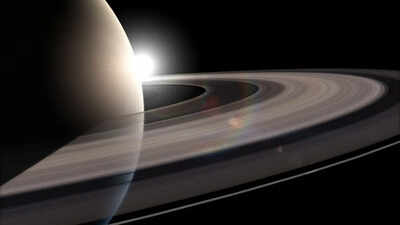
A planet nearly ten times wider than Earth sounds like the definition of solidity. Saturn certainly looks that way. Its broad rings, pale golden bands, and immense size have made it one of the most recognisable objects in the Solar System for centuries.
Yet beneath that imposing appearance lies a surprisingly unusual reality.According to NASA, Saturn is the second-largest planet orbiting the Sun, but it is also the only planet whose average density is lower than that of water. The statistic often appears as a curious piece of trivia, though it points to something much more revealing about the nature of the giant world itself. Saturn is not remarkable because it is heavy. It is remarkable because so much of its enormous size comes from extraordinarily light material.
How Saturn became a giant without becoming dense
The rocky planets closer to the Sun are made largely from dense materials such as iron, nickel, and silicate rock. Saturn followed a different path when the Solar System was taking shape around 4.5 billion years ago.NASA explains that the planet formed primarily from hydrogen and helium, the same elements that dominate the Sun. Those ingredients were pulled together by gravity until they formed a vast globe now measuring roughly 120,500 kilometres across.
That composition changes the way Saturn behaves as a planet. Instead of a solid body wrapped in a thin atmosphere, Saturn is essentially an enormous envelope of gases and fluids surrounding a compact interior. Much of what gives the planet its colossal dimensions is material that weighs relatively little for the amount of space it occupies. The result is a world whose physical presence is far greater than its overall density might suggest.
A planet with no surface to stand on
Images of Saturn can sometimes create the impression of a planet with a clearly defined surface. In reality, NASA notes that no such surface exists.A spacecraft descending into Saturn would encounter increasingly dense layers of gas before reaching regions where pressure becomes extreme. Temperatures and compression levels rise dramatically with depth. Eventually, conditions become severe enough to crush and destroy any conventional spacecraft.This means Saturn is not a place where an astronaut could stand, nor is it a world with continents, oceans, or mountains. What appears from a distance to be a familiar planetary sphere is actually a gradual transition from atmosphere to fluid layers and, much deeper down, a dense central core. The planet's enormous size, therefore, hides a surprisingly delicate structure. Much of Saturn is, in a sense, atmosphere.
The surprising reason Saturn is less dense than water
Planetary size often creates assumptions about mass and density.
Saturn challenges those assumptions. NASA describes a planet with a core containing heavier materials, including metals and rocky compounds, but that core occupies only part of the world beneath the clouds. Surrounding it are extensive layers of hydrogen in different forms, including liquid metallic hydrogen and liquid hydrogen.Because hydrogen is such a light element, Saturn's volume grows far faster than its density.
The planet becomes vast without becoming proportionally compact.That contrast explains why Saturn can appear so imposing while remaining relatively low in density compared with every other planet in the Solar System. It is not a lightweight world in absolute terms. Saturn still contains around 95 times the mass of Earth. Yet its material is spread across such an immense volume that the overall average remains surprisingly low.
Why Saturn remains one of the Solar System's strangest worlds
Saturn's rings often dominate conversations about the planet, and understandably so. They are among the most spectacular features in the Solar System. Yet the planet itself may be even more unusual than the icy structures surrounding it.According to NASA, Saturn is a world where familiar ideas about what a planet should look like begin to break down. It has no true surface, experiences seasons much like Earth despite being nearly 1.4 billion kilometres from the Sun, and contains hundreds of confirmed moons.
At the same time, it remains a giant sphere made largely from the lightest elements in existence.Seen from afar, Saturn looks powerful and substantial. A closer examination reveals something stranger: a planet whose grandeur comes less from what it contains and more from the immense space occupied by those simple ingredients. It is one of the clearest examples in the Solar System that appearances can be misleading, even on a planetary scale.









 English (US) ·