

 4 days ago
8
4 days ago
8
ARTICLE AD BOX
A special three-day Parliament session from April 16–18 will consider amendments to implement 33% women's reservation before 2029, advancing the timeline beyond the current post-2027 Census delimitation requirement.
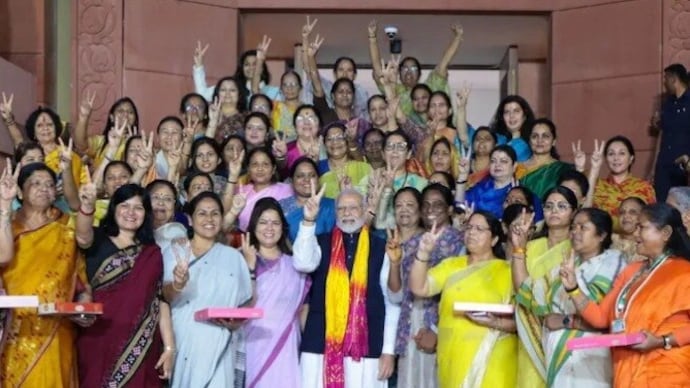
Prime Minister Narendra Modi with woman Lok Sabha MPs outside Parliament premises. (File photo)
New Delhi,UPDATED: Apr 14, 2026 07:35 IST
The Centre’s push to fast-track the Constitutional amendment required to operationalise the Nari Shakti Vandan Adhiniyam (Women's Reservation Act 2023) ahead of the 2029 Lok Sabha elections faces a significant political hurdle: the absence of assured support from the Congress-led Opposition.
A special three-day session of Parliament from April 16 to 18 has been convened to introduce amendments that would enable 33 per cent reservation for women in the Lok Sabha and state assemblies before 2029, instead of the current timeline linked to post-2027 Census delimitation.
Prime Minister Narendra Modi has urged all parties to back the move, calling for implementation in its “true spirit,” while the BJP has issued a whip to ensure full attendance.
However, the arithmetic in Parliament makes Opposition support indispensable.
NUMBERS THAT MATTER
In the Lok Sabha, the NDA holds 293 seats, while the Opposition has 240 and others 12.
A Constitutional amendment requires a two-thirds majority of members present and voting, which translates to at least 364 votes if all members participate.
This leaves the government well short of the required mark without Opposition backing.
A similar gap exists when considering the combined strength of both Houses—Lok Sabha and Rajya Sabha—where the NDA does not independently command the supermajority needed to amend the Constitution.
This places the spotlight squarely on Congress and its allies. While Opposition parties are wary of being seen as blocking women’s reservation, they have raised substantive concerns about the timing and intent of the proposed amendments.
OPPOSITION BY OPPOSITION
Congress chief and Leader of Opposition in the Upper House, Mallikarjun Kharge, has questioned the "sudden hurry," alleging the move is driven by “political mileage” amid ongoing elections. He has also demanded broader consultations, stating that such constitutional changes must involve all stakeholders.
A key sticking point is the linkage between reservation and delimitation.
Congress MP Sonia Gandhi has warned that delimitation, rather than women’s empowerment, is the "core issue," calling the proposed exercise "extremely dangerous" and an "assault on the Constitution".
The Opposition fears that any seat redistribution based on population could disproportionately benefit northern states while disadvantaging southern and northeastern regions.
Echoing these concerns, Congress Rajya Sabha MP Jairam Ramesh said, "This delimitation issue is very harmful for South India. We do not want any change in the current arrangement. We don't want any disturbance in the present relative strength. We don't want any state to suffer".
LOK SABHA SEATS MAY SEE 50% RISE
The government is also reportedly considering increasing Lok Sabha seats by up to 50 per cent, which has intensified Opposition resistance. Congress leaders argue that without clarity on delimitation and representation, meaningful discussion on the amendment is not possible.
At the same time, Opposition parties may push for sub-quotas for women from backward classes within the reservation framework, adding another layer of negotiation.
With an INDIA bloc meeting scheduled ahead of the session, the Opposition’s final stance will be crucial.
While politically difficult to oppose a women’s quota outright, the Congress’s position on delimitation and representation could determine whether the amendment secures the numbers needed—or stalls despite broad rhetorical support.
- Ends
Published On:
Apr 14, 2026 07:35 IST
Tune In





 English (US) ·