

 1 hour ago
5
1 hour ago
5
ARTICLE AD BOX

Parkinson's disease can creep up on individuals, manifesting through subtle signs such as a quieter voice or dwindling handwriting size, often brushed aside as mere effects of aging or stress. Long before visible symptoms like tremors emerge, one might experience early indicators like disrupted sleep patterns and a diminished sense of smell.
Parkinson’s disease rarely begins with something dramatic. There is no sudden collapse, no sharp alarm. Instead, it often starts with quiet changes that blend into everyday life.
A slightly altered walk. A softer voice. A strange sense of fatigue that does not go away.Many people brush these signs aside. They blame stress, ageing, or a busy routine. But the body does not send signals without reason. It communicates early, just not loudly enough.
Watch
All you need to know about Parkinson's disease
Dr Pradyut Ranjan Bhuyan explains it simply, “Parkinson's disease begins with its first symptoms which show up as mild signs. The disease first manifests through its first signs which appear in a subtle way that people commonly mistake for regular stress and aging and minor health problems.”
The science behind early changes
Parkinson’s is a progressive neurological disorder. It develops slowly as certain brain cells begin to degenerate, especially those that produce dopamine. This chemical plays a key role in movement, mood, and coordination.What makes Parkinson’s tricky is timing. The brain changes begin years before visible symptoms appear. By the time tremors or stiffness become obvious, the process has already been underway for a long time.
According to the National Institute on Aging, early non-motor symptoms can show up years before diagnosis. These include sleep disturbances, loss of smell, and mood changes.This gap between internal change and visible symptoms is why early signs often go unnoticed.

These early signs are easy to overlook, but recognising them can lead to earlier diagnosis and better management.
The signs most people ignore
The early signs of Parkinson’s are not always what people expect. Tremors may not even be present at first.Dr Bhuyan notes, “The first signs of Parkinson's disease appear when a person experiences an unnoticeable hand tremor during rest.
This condition does not show immediate symptoms to all people who develop it.”But beyond tremors, there are quieter clues:
- Smaller handwriting (micrographia): Words become cramped and tight over time
- Loss of smell: Difficulty recognising familiar scents like food or perfume
- Constipation: Persistent digestive issues without clear cause
- Sleep problems: Acting out dreams or restless sleep
- Unusual fatigue: Feeling drained despite rest
Neha Sinha adds a crucial insight, “Parkinson’s disease does not typically present with tremors in its early stages. Instead, it often begins with subtle changes, such as a softer voice, smaller handwriting, diminished sense of smell, reduced facial expressions, disrupted sleep, constipation, anxiety, or slight stiffness.”These changes are easy to dismiss because they do not feel urgent.
Behavioural shifts that often go unnoticed
The body is not the only place where Parkinson’s leaves early traces. Behaviour and emotions can shift too.People may speak more softly. Their face may appear less expressive. Movements may slow down without conscious awareness.Dr Bhuyan explains, “People might observe three changes in their behavior, which include a quieter way of speaking and reduced possibilities to show emotions through their face and an ongoing decrease in their regular body movements.”Mood changes are another overlooked sign. Anxiety, depression, or apathy can appear without any clear trigger. This is not just psychological. It reflects underlying brain changes.A report by the National Institute of Neurological Disorders and Stroke highlights that non-motor symptoms like mood disorders can precede motor symptoms by years.
Why early diagnosis changes everything
Recognising these signs early can make a real difference. Parkinson’s cannot yet be cured, but it can be managed effectively, especially when caught early.Dr Bhuyan emphasises, “The early signs of the disease make a significant impact on diagnosis progress because early diagnosis leads to better disease management.”Neha Sinha echoes this, “Initiating care at an early stage allows for the introduction of medication, physiotherapy, and structured routines that can slow functional decline and support prolonged independence.”Early care can help maintain mobility, preserve independence, and improve quality of life.
It also allows patients and families to prepare, adapt, and plan ahead.
Managing Parkinson’s with intention, not reaction
Managing Parkinson’s is not just about medication. It is about building a routine that supports the brain and body every day.Neha Sinha highlights a practical approach, “A comprehensive approach must incorporate consistent physical and cognitive engagement. Structured activities that emphasise balance, coordination, rhythm, and routine, such as walking programmes, yoga, and guided movement, are instrumental in preserving motor abilities and reinforcing neural connections.”
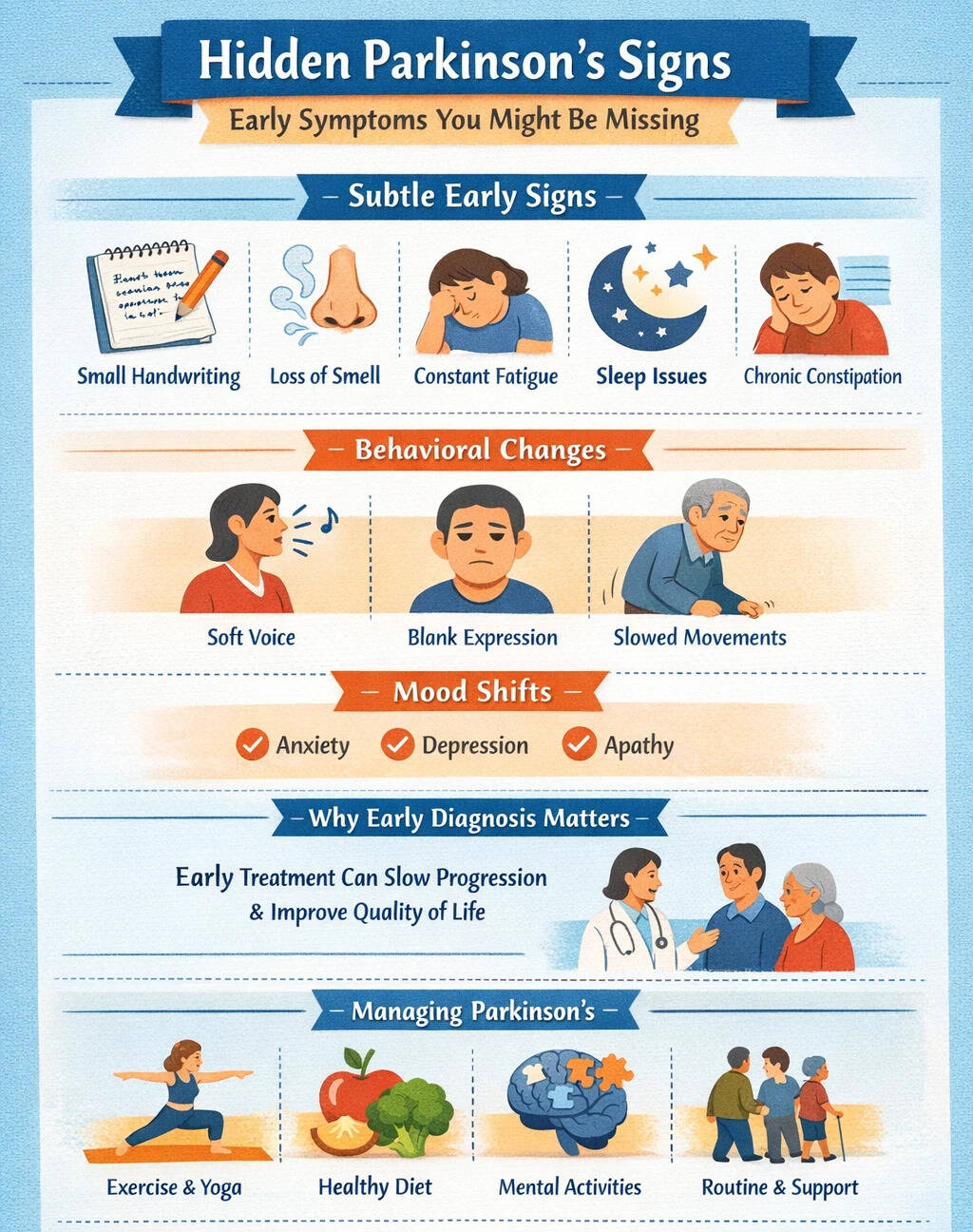
With timely care, structured routines, and consistent support, individuals can maintain independence and quality of life for longer.
Simple steps can make a difference:
- Regular walking or light exercise
- Yoga or stretching for balance and flexibility
- Mental stimulation through reading or puzzles
- Consistent sleep schedules
- Social interaction to support emotional health
Muhammad Ali, one of the most well-known figures to live with Parkinson’s, once said, “It’s not the mountains ahead to climb that wear you out; it’s the pebble in your shoe.”The message is clear. Small, unnoticed changes matter.
When should someone seek help?
One isolated symptom may not mean much. But a pattern should not be ignored.Dr Bhuyan advises, “A person needs to experience more than one of these signs before doctors can reach a conclusion about Parkinson's disease existence.
The combination of multiple symptoms which become more severe should lead to a person getting medical help.”If subtle signs begin to cluster or worsen over time, it is worth consulting a neurologist. Early attention often leads to better outcomes.Medical experts consultedThis article includes expert inputs shared with TOI Health by:Dr Pradyut Ranjan Bhuyan, Consultant - Neurology, Manipal Hospital BhubaneshwarNeha Sinha, Dementia Specialist and Clinical Psychologist, Co-founder & CEO, Epoch Elder CareInputs were used to explain how the body may show subtle early signs of Parkinson’s that are often overlooked, and why recognising these symptoms early can help in timely diagnosis and better management.









 English (US) ·