

 52 minutes ago
3
52 minutes ago
3
ARTICLE AD BOX
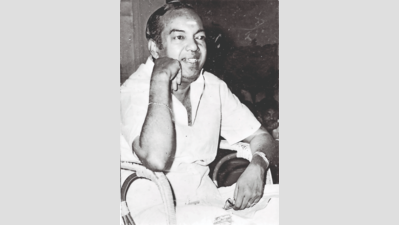
Despite competition through the 1960s and 1970s, Kannadasan’s songs became, for many Tamils, a prism through which life was interpreted — articulating longing, disappointment, romance, faith, despair and philosophical resignation in language at once simple and memorable.
VamananStanding well over six feet in height, Kannadasan often dictated his film songs while reclining against pillows like a maharajah. More than four decades after his death in a Chicago hospital in Oct 1981, the ‘kaviarasu’ (king of poets) still lives, his position as Tamil cinema’s lyricist par excellence unshaken in his birth centenary year, his songs drifting through tea shops and temple festivals, political stages and radio, carrying lines that generations can summon from memory with startling ease. Lyric writing was not Kannadasan’s chosen path in cinema. He entered the field almost by circumstance, seizing the first opportunity that came his way with ‘Kanniyin Kadhali’ (1949), an adaptation of Shakespeare’s ‘Twelfth Night’. His first song — ‘Kalangadhiru maname’ — belonged to a genre he would come to dominate: songs that offered philosophical consolation without sacrificing popular appeal.Reassurance was something Kannadasan repeatedly needed during the turbulent turns of his life.
One humiliation remained so etched in his memory that he recounts it in the opening of his autobiography ‘Vanavasam’. He writes that the derisive laughter of a magazine editor when he approached him as a teenager with a story had spurred him to prove himself. Though Kannadasan dropped out of school in Class VIII, he had a passion for literature. Before cinema claimed him fully, Kannadasan made his mark in journalism, writing for small publications that offered little money but considerable freedom.
An account he wrote on the Tamil Writers’ Conference held in Madras in 1946 for a little-known magazine called ‘Tamil Nadu’ displayed the prodigious memory, speed of observation and narrative sweep that would later distinguish his prose.After entering cinema as a lyricist, Kannadasan initially found it difficult to establish himself. Opportunities at Salem’s Modern Theatres — where he had joined as editor of the studio’s in-house magazine — did not alter his fortunes. It was there that he first met M Karunanidhi, becoming an ardent admirer of his acerbic dialogue steeped in the political rhetoric of the Dravidar Kazhagam, particularly in ‘Abhimanyu’ (1948).
Soon afterwards, Kannadasan received the opportunity to write most of the lyrics for ‘Panam’ (1952). Yet, despite the film being produced by his own elder brother, he found himself denied even an on-screen credit. In a telling irony, Karunanidhi’s dialogue in the film mentioned the reigning lyricist Udumalai Narayana Kavi.
Though ‘Panam’ failed, it brought out a partnership between music directors Viswanathan-Ramamurthy, for which it was the first film, and Kannadasan, which in the 1960s brought about the light music wave in Tamil music.In the early 1950s, as much because of the temper of the times as through his friendship with Karunanidhi, an avowed atheist, Kannadasan drifted away from the Hindu faith and emerged as a fiery platform speaker for DMK’s rhetoric of rationalism and self-respect. He launched propaganda journal ‘Thendral’, which became the literary face of the movement. Later, Kannadasan would return publicly to religion, move closer to the national mainstream, and write with candour about the personalities and internal culture of the movement he had once served with fervour.During a decade marked by political disappointments — including his unsuccessful contest from Tirukoshtiyur in the 1957 Assembly election and a growing disillusionment with the movement he had once embraced — Kannadasan consolidated his place in cinema. Alongside emerging as a successful dialogue writer, notably with MGR’s ‘Nadodi Mannan’ (1958), he began to discover that lyric writing was his true artistic domain.
He produced films such as ‘Maalai Itta Mangai’ (1958) and ‘Sivagangai Seemai’ (1959) to reveal the ease with which he could fuse literary sensibility with popular emotion. His ascent became unstoppable with the ‘Pa’ series of films in 1961, which established him as Tamil cinema’s pre-eminent lyricist. Despite competition through the 1960s and 1970s, Kannadasan’s songs became, for many Tamils, a prism through which life was interpreted — articulating longing, disappointment, romance, faith, despair and philosophical resignation in language at once simple and memorable. While producers, composers and directors marvelled at the speed with which Kannadasan could produce lyrics tailored to situation, character and melody — often dictating songs in a single sitting while conversation and visitors swirled around him — others were struck by the philosophical depth embedded within simple lines. For example, T T Krishnamachari, who had been disconsolate at having to resign a second time as finance minister in late 1965, experienced a cathartic healing on hearing Kannadasan’s ‘Ponaal pogattum poda’, a song that called for the stoic acceptance of life’s irreversible turns.In a career of 30 years in cinema, Kannadasan wrote 4,000 film songs. His poems encompassed seven volumes.(The writer is a historian of Tamil film music)




 English (US) ·