

 6 days ago
5
6 days ago
5
ARTICLE AD BOX
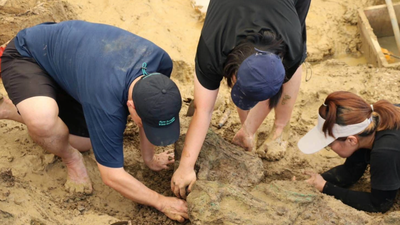
Image credit: (AP/The Fine Arts Department)
A pair of small gold rings, buried silently beneath the earth for nearly 2,000 years, are now telling a story that stretches across ancient trade routes, cultures, and civilizations.Archaeologists in Thailand recently uncovered two ancient gold rings during excavations at the Don Yai Thong archaeological site in Phetchaburi province, around 130 kilometres southwest of Bangkok. The discovery, announced by Thailand's Fine Arts Department, has sparked excitement among historians because one of the rings carries an inscription in Brahmi script, one of the oldest writing systems of ancient India.The rings may appear to be simple pieces of jewellery. But experts believe they are much more than ornaments. They are tiny time capsules that could offer fresh clues about how people lived, travelled and traded across Asia two millennia ago.
A discovery that began in a rice field
The story of the find is almost cinematic. Earlier this year, local residents stumbled upon fragments of ancient bronze drums in a rice field. Their discovery prompted archaeologists to investigate the area further.
What followed was the identification of an entirely new archaeological site known as Don Yai Thong.Since February, excavators have unearthed eight human skeletons, pottery, bronze objects and gold jewellery. The findings suggest that the site may have been a ceremonial burial ground reserved for wealthy individuals or members of the upper classes.Last week, archaeologists found the two gold rings beside one of the skeletons.
One ring is plain and unadorned. The second carries an inscription that has become the centre of attention.
The ancient Indian connection hidden in a ring
Experts believe the inscription is written in Brahmi script, an ancient writing system that originated in the Indian subcontinent.The text appears to read "pusarakhitasa," which translates to "the one protected by Pushya." In Indian astronomy, Pushya is considered one of the most auspicious lunar constellations or zodiac signs.
Even today, many Hindus regard Pushya as a favourable period for important life events and religious ceremonies.The inscription immediately raised intriguing questions. How did an Indian script appear on a ring found deep inside Thailand?Historians have long known that India and Southeast Asia shared extensive trade and cultural exchanges more than 2,000 years ago.According to Thailand's Fine Arts Department, the rings' owner may have been a merchant from the Vaishya community, a trading class in ancient India.
While this theory requires further study, it highlights the possibility that Indian traders may have lived, travelled or settled in parts of present-day Thailand.The gold rings provide fresh evidence that ancient Asia was deeply interconnected long before modern borders existed. Trade routes linked India with Southeast Asia, allowing people to exchange spices, metals, religious ideas and cultural traditions.This era witnessed significant developments in trade, metallurgy and social organisation across Southeast Asia.The excavation is expected to continue for another month, and experts believe more discoveries may still be hidden underground.
Sometimes history arrives in the smallest objects
It is easy to overlook a ring. It fits in the palm of a hand and can disappear inside a pocket.Yet these two gold rings have opened a window into a world that existed two millennia ago. They speak of ancient merchants, long sea journeys, cultural exchanges and communities that flourished long before the modern nations of Asia came into being.









 English (US) ·