

 31 minutes ago
5
31 minutes ago
5
ARTICLE AD BOX
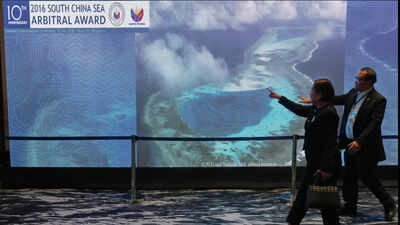
The United States, Britain and a dozen other countries issued a joint statement Sunday marking the ninth anniversary of a landmark 2016 international ruling that rejected China's sweeping territorial claims in the South China Sea, while Beijing again dismissed the decision as "null and void", reported by news agency AP.The statements commemorated a July 12, 2016, arbitration ruling by a tribunal established in The Hague under the United Nations Convention on the Law of the Sea, saying the landmark decision "is final and legally binding". The case was brought by the Philippines in 2013, a year after a standoff in which China seized a contested shoal. Beijing boycotted the proceedings and has never accepted the outcome.The 14 countries were the US, UK, Philippines, Japan, Australia, New Zealand, Canada, Germany, Italy, Estonia, Latvia, Lithuania, Romania and Slovenia.
In their joint statement, they said, "We reiterate our strong opposition to any destabilizing or unilateral actions including by force or coercion that threaten peace and stability in the region.”They specifically condemned the use of coast guard, military and militia vessels to "harass, obstruct, intimidate" other countries' lawful operations at sea and in the air, and called for freedom of navigation and overflight to be upheld.
The European Union, in a separate statement, described the ruling as a "landmark decision in the peaceful settlement of disputes."China's foreign ministry pushed back sharply, saying the tribunal and its findings "seriously contravene the general practice of international arbitration" and "gravely infringe upon China's legitimate rights." Beijing said it "neither accepts nor recognises" the ruling and "will never accept any claim or action based on those awards."The exchange comes amid a rise in confrontations between Chinese forces and vessels from the Philippines and Vietnam, including incidents involving water cannons, military-grade lasers and blocking maneuvers that have caused collisions and close calls in the air. Both the Biden and Trump administrations have said Washington is obligated to defend the Philippines, its oldest treaty ally in Asia, if Filipino forces come under armed attack in the contested waters.The South China Sea remains one of the world's busiest trade routes and one of Asia's most persistent flashpoints, with overlapping claims involving China, the Philippines, Vietnam, Malaysia, Brunei and Taiwan.
UNCLOS framework, tribunal findings, and geopolitical tensions
The 1982 UN Convention on the Law of the Sea, which underpins the arbitration ruling, is widely regarded as the treaty governing the world's oceans and seas. It took effect in 1994 and has since been ratified by more than 170 countries and parties, including both China and the Philippines, a point that supporters of the ruling say makes Beijing's rejection of the tribunal's authority especially significant, since China itself is a state party to the convention.The tribunal's 2016 decision specifically found that China could not claim historic rights to resources in the South China Sea outside of the regular territorial areas recognized under UNCLOS. This directly undercut the legal basis for Beijing's broader claims across the waterway, which China has continued to defend despite the ruling.







 English (US) ·