

 1 hour ago
7
1 hour ago
7
ARTICLE AD BOX
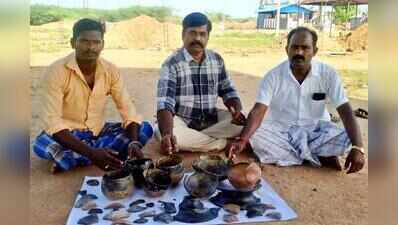
Burial urns and pottery bearing symbols, estimated to be around 5,000 years old, have been unearthed near Mudukulathur in Ramanathapuram district.
Madurai: Why would a burial urn be too small for a human body? That question has turned the muthumakkal thazhis, found by villagers last week near Mudukulathur in Ramanathapuram district, into more than another megalithic find.
At three feet, archaeologists say, the urns point to two readings: collected bones or infant burials.V Rajaguru, president of Ramanathapuram Archaeological Research Foundation, said three-foot urn was too small to hold a human body, pointing instead to a secondary burial practice. “During the early period, the dead were left in forest burial grounds. After jackals and vultures consumed the flesh, the bones were collected and placed inside these small urns with offerings,” he said.Archaeologist C Santhalingam said the small urns keep two possibilities open. One, what Rajaguru suggested — that bodies were left on the outskirts for scavengers. The other possibility is that these urns were used to bury infants,” he said.Along with urns, damaged goblets, a plate, a bowl, a kumbha and a small pot, all made of clay, were found around the site when villagers dug near a local temple for constructing a compound wall.
Also, fragments of black-and-red ware and red ware, some carrying symbols such as a multiplication mark, an inverted trident and a ladder-like sign, were also discovered.Rajaguru said urns are spread across nearly three acres near the temple and may extend over more than 10 acres. About 500 metres north, at Raja Kovil Thidal in Vikramapandiyapuram, he found similar pottery scattered across 30 to 50 acres. “This was the habitation site.
Valasai-Manakkulam was the burial ground,” he said.The pottery strengthens the settlement clue, said Santhalingam, “When pottery of different colours — black, pale grey, red and black-and-red — is found near urns, it usually indicates a nearby settlement.”No carbon dating has been done so far, and the archaeologists who assessed the find place it within different time frames. V Rajaguru places the site in the early phase of the megalithic burial tradition, citing Tamil Nadu archaeology department’s broad 4000 BCE to 1500 BCE range and findings in a book named Tholliyal Nokkil Sangakaalam (Sangam Age from an Archaeological Perspective) by renowned archaeologist K Rajan.Professor K Kaaliraja urged caution, saying the megalithic period is generally associated with around 2,000 years ago. “Such urns are often found in poramboke lands and irrigation tanks, and survive only when roads and buildings do not disturb them,” he said.Santhalingam placed urn burials within a recorded literary tradition, rather than directly dating the Mudukulathur find. “Manimekalai, written about 1,800 years ago, mentions four major burial practices in this region, one of which was urn burial,” he said. Some scholars, he added, argue there were nearly ten burial practices.







 English (US) ·