

 41 minutes ago
7
41 minutes ago
7
ARTICLE AD BOX
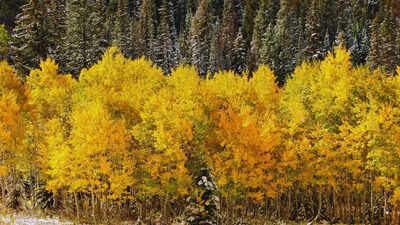
The world's largest living organism: Pando
At first glance, it looks like an ordinary grove of quaking aspens in Utah's Fishlake National Forest. If asked to name the world's largest living organism, most people would probably think of the blue whale.
But scientists say the title actually belongs to this seemingly unremarkable stand of trees. Known as Pando, it is a single living organism; the largest known tree on Earth by weight and one of the oldest living organisms ever discovered.Unlike a conventional tree with one trunk, Pando is a vast clonal colony. Every one of its estimated 47,000 stems is genetically identical and connected through an enormous underground root system, meaning the entire grove is, biologically, one giant tree. Its Latin name, Pando, means "I spread," a fitting description for an organism that spans about 106 acres and weighs roughly 6,000 metric tonnes, which is equivalent to 40 blue whales or three times the world's largest single-stem tree — California's General Sherman giant sequoia (Sequoiadendron giganteum).
One seed, thousands of trunks
Pando belongs to the quaking aspen (Populus tremuloides), North America's most widely distributed tree species. While aspens commonly reproduce through underground roots that send up new shoots, Pando has expanded this natural process over thousands of years into an organism unlike any other.The grove is believed to have originated from a single seed. As older stems died, new ones continuously emerged from the same underground root network, giving the appearance of an entire forest when, genetically, it is one tree.
Scientists first realised in the 1970s that the grove might be a single organism. Later DNA testing confirmed that every trunk is part of the same male clone. Although individual stems typically live for around 100 to 130 years, the shared root system keeps producing replacements, allowing the organism to survive for millennia.As the U.S. Forest Service explains, "what appears to be a forest is actually one tree," with thousands of trunks connected by a single living root system.
One of Earth's oldest living organisms
Exactly how old Pando is remains the subject of scientific debate because dating an underground root system is far more difficult than ageing an individual tree.Earlier estimates ranged from several thousand years to more than 80,000 years. A genetic analysis published as a preprint in 2024 suggested the colony could be between 16,000 and 80,000 years old, placing its origin sometime during the last Ice Age. Researchers caution that the estimate still awaits peer review, but agree that Pando is unquestionably among the oldest known living organisms on Earth.The Natural History Museum of Utah notes that unlike ancient bristlecone pines, whose trunks persist for thousands of years, Pando survives through continual regeneration. Individual stems die and are replaced, while the underlying root system endures, allowing the organism itself to persist across thousands of generations.
Why the giant is struggling
Despite surviving ice ages and dramatic environmental change, scientists say Pando now faces a very modern challenge.
Its survival depends on young shoots, known as suckers, growing from the root system to replace aging stems. But in many parts of the grove, those shoots are being eaten before they mature."The biggest issue with Pando is that it is not replacing itself," ecologist Paul C. Rogers, who directs the Western Aspen Alliance at Utah State University and has studied the grove for years, has said in explaining the colony's decline.
Without successful regeneration, older stems die faster than new ones can replace them.Researchers attribute much of the problem to heavy browsing by mule deer and, in some areas, cattle. The decline of large predators has allowed deer populations to grow, increasing pressure on young aspens. Pests and diseases are also attacking Pando, with root rot as well bacterial and fungal infections affecting the stems, according to the Forest Service.
"Another thought is that the Pando is just old and doesn't have the energy reserves to send up suckering [fresh new shoots]," Kurt Robins, a district ranger of Fishlake National Forest, said in a video.
The future of an ancient giant
Scientists say Pando is much more than a botanical curiosity. Aspen ecosystems support hundreds of species of birds, mammals, insects and fungi, making the grove an important ecological habitat as well as a natural archive of environmental change.The U.S. Forest Service and researchers have fenced parts of the colony to protect young shoots from grazing animals, while scientists continue monitoring its health through genetic studies, ecological surveys and even acoustic experiments that record vibrations travelling through the root network.American Forests describes Pando as "the heaviest organism on the planet," while researchers see it as a rare opportunity to understand how a single organism can survive and adapt for thousands of years. Whether the ancient giant continues to spread, however, will depend on whether conservation efforts can restore the natural cycle of regeneration that has sustained it since long before human civilization.









 English (US) ·