

 1 day ago
4
1 day ago
4
ARTICLE AD BOX

Ancient canid remains unearthed on Stora Karlsö reveal pure wolves. These wolves were transported by prehistoric people, not swimming across the sea. Image Credits: Wikimedia Commons
Humans' association with canines has always fascinated researchers. The historical account of history over generations was always about how wolves evolved into dogs through interactions with humans, giving up their wild nature in exchange for food while living at the periphery of ancient human camps.
An amazing archaeological find from a remote location in the Baltic Sea is set to change the old ways of seeing things. Before any breeds of dogs existed, there could be intentional associations between humans and wild wolves.The setting for this discovery is Stora Karlsö, a tiny, rugged island located off the coast of Sweden. Measuring just two and a half square kilometres, this isolated landmass possesses no native land mammals of its own, meaning any four-legged creatures found there had to cross the deep, treacherous ocean waves by other means.
Centuries ago, during the Late Neolithic and Bronze Age periods, prehistoric seal hunters, fishers, and gatherers used the island as a seasonal base.
When modern researchers began excavating the deep limestone chambers of the Stora Förvar cave on the island, they expected to find the usual marine animal remains. Instead, they unearthed something entirely unexpected: the perfectly preserved skeletal remains of two ancient canids.
To identify what exactly these animals were and how they reached this remote island, a scientific study called Gray wolves in an anthropogenic context on a small island in prehistoric Scandinavia was conducted. A thorough genetic and physical study done by a team of researchers found that these animals were entirely pure wolves without any domestic dog blood in their veins. Nevertheless, as the island is too far from the mainland to reach it for a terrestrial mammal without drowning, this study implies that prehistoric people could transport the wolves using a boat.Sharing food and care in the ancient settlementThe findings discovered in the cave prove that the wolves co-existed with the prehistoric people. The research used a stable isotope analysis to find out exactly what the animals had been consuming during their lifetime. It was found that their diet consisted of a high amount of marine proteins, including almost only seals and sea fish. Such an identical diet is typical for the human hunting communities who lived on this island at the time, which means that the wolves had not hunted for themselves but had been taken care of by people.Moreover, the physical structure of the skeleton made it clear that these were no regular, wild wolves from the mainland. These skeletons were smaller than usual, represented the lower part of the size spectrum of wolves, and had a low diversity of genes, which could be interpreted as signs of a closed group, managed by humans. One of the wolves suffered from serious bone pathology and was probably limited in his ability to move around.
A weak wild predator would find it hard to survive. Therefore, the fact that this wolf lived a very long life shows that the human community did not mind taking care of it.
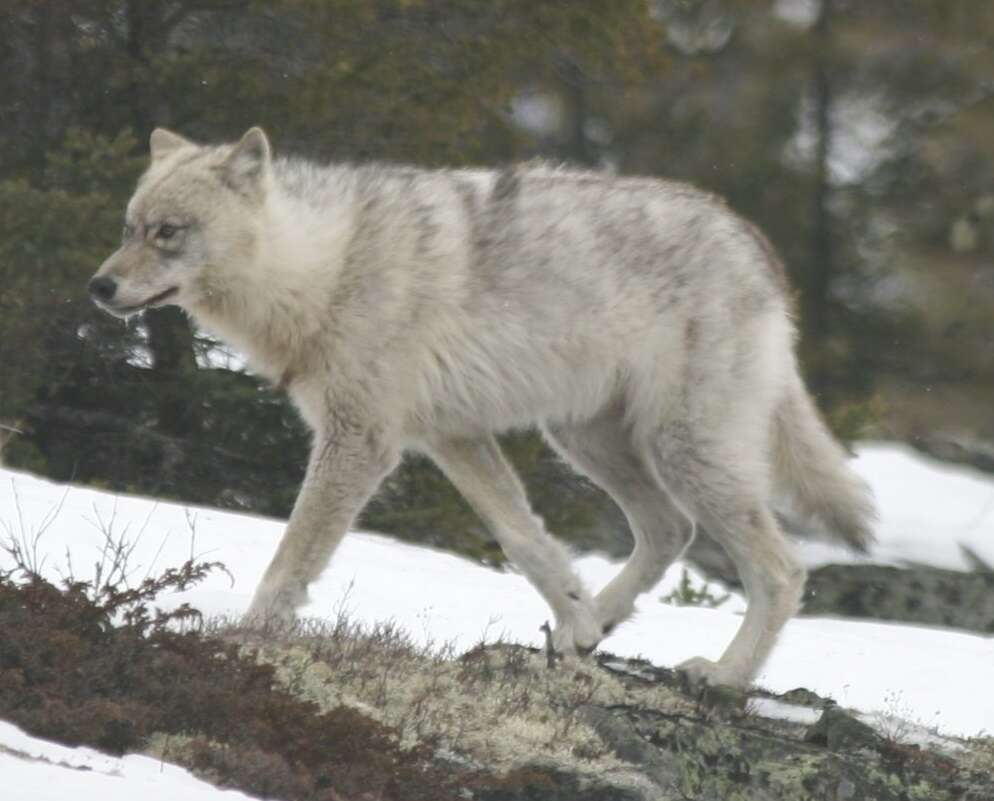
Their diet of marine proteins indicates human care and shared resources. Skeletal evidence suggests managed populations and human intervention. This discovery challenges previous understandings of early wolf domestication processes. Image Credits: Wikimedia Commons
Ancient reconsideration of the way of domesticationThis finding proves previous assumptions about the ancient people-wolf relationship wrong. Instead of being just a passive adaptation to the surroundings of human civilisation, evolution into dogs from wolves implies the will and ability of early humans to capture, transport, and breed the pure wolves.
Why exactly these early island communities chose to share their space on small boats with predators and feed them with the precious seal meat is still unclear but can be explained in many ways.The management of these animals on such an island would have needed a lot of daily care. With the ongoing research into the ancient DNA found inside the Baltic Cave by scientists, it is becoming clear that the process through which the evolution of wolves into dogs occurred was far from simple.









 English (US) ·