

 58 minutes ago
4
58 minutes ago
4
ARTICLE AD BOX
Your annual blood test was never wrong. It was just never the whole story. Mira One is filling in that gap. Every January, like a clockwork piece of urban-Indian wellness theatre, the annual full-body checkup happens.
You fast for twelve hours. You go to the diagnostic centre at 7am. You give blood.
You walk on a treadmill while strapped to an ECG. And a week later, a 32-page report lands in your inbox, full of green ticks and the occasional yellow asterisk, and you exhale and tell your spouse: "All clear."Except, increasingly, it isn't. The test is fine, though. But because it is, by design, only one slice of a much larger picture, the slices it leaves out are increasingly the ones that matter most.We spoke to four leading physicians across cardiology, oncology, pharmacogenomics and integrative medicine, and asked a simple question: when a patient walks in with a clean annual checkup, what are you not seeing in that report that you wish you were? Here are the five answers that came up, over and over again.1. Whether your medications will actually work for your bodyThis is the one almost everyone is sleeping on. The cytochrome P450 family of enzymes, and specifically a gene called CYP2C19, determines how your body metabolises a long list of common medications, including clopidogrel (the blood thinner given after a heart attack), some antidepressants (like citalopram), and certain proton pump inhibitors (like omeprazole).
Recent research from a UK cohort of 44,000 South Asians found that 57% of the cohort were intermediate or poor metabolisers, meaning the standard dose of these drugs is sub-therapeutic, or in some cases barely working at all. Indian-specific studies show similar numbers. Your annual blood test will not measure this. A pharmacogenomic test will.2. Your inherited cancer riskBRCA1 and BRCA2 are the famous ones (the breast and ovarian cancer genes), but the relevant list extends to Lynch syndrome (colorectal cancer), TP53 (Li-Fraumeni syndrome, a range of cancers), MUTYH (colorectal), and several others.
The Indian population has a meaningful number of carriers of these variants, but most are diagnosed only after a cancer has been detected, at which point screening is reactive, not preventive.
Whole-genome sequencing, done once, surfaces these variants while you still have decades of preventive runway.3. Whether your "good cholesterol" is genuinely goodThis is the subtle one. We typically look at HDL, LDL, and triglycerides in a normal blood report. But what we really need to look at is apolipoprotein B (apoB) and lipoprotein(a), both of which are increasingly considered superior predictors of cardiovascular risk.
We also don’t know whether the cholesterol numbers look the way they do because of our lifestyle, or because of a genetic variant that is masking what our lifestyle is actually doing to us.
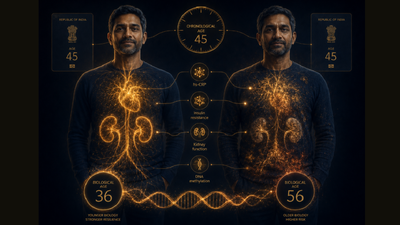
The second is much more common than most Indians realise. And the only way to tell the difference is to combine a blood panel with a genetic one.4. Your real biological ageYour chronological age is on your passport. Your biological age i.e. the actual rate at which your cells are ageing, measured through markers of inflammation (like hs-CRP), insulin resistance, kidney function, and DNA-methylation patterns, is a separate number entirely.
People with identical chronological ages can have biological ages a decade apart. Your annual blood test gives you fragments of this picture (perhaps three or four markers).
But you can reasonably deduce an estimate of your biological age when you have more information than a blood test. 5. The conversation your doctor wishes they could have with youThis is the meta-point, and arguably the most important. Most Indian doctors are working with incomplete information. They are making the best call they can with what they have. A comprehensive preventive panel (blood, pharmacogenomic, and whole-genome together) does not replace your doctor. It gives your doctor the data they need to actually do the job you are paying them to do. “For me, when a patient walks in with a Mira One report, the consultation gets twice as good,” one Pune cardiologist told us.
“For the first time, we are looking at the same information.”So what should you actually do?Three things, in order of priority. One: keep doing your annual blood test. It catches the basics, and the basics matter. Two: if you have a family history of heart disease, cancer, diabetes, or autoimmune conditions, or you are on a chronic medication that does not seem to be working as advertised, consider a one-time integrated genomic panel. Mira One is the new entrant. Three: bring the report that your doctor can understand, with you.Mira One is an integrated diagnostic that brings blood biomarkers, pharmacogenomics, and whole genome sequencing together into a single easy-to-read report. This helps your doctor understand not only what may be going wrong but also how your body is likely to respond to specific medications. It only needs to be done once. More info here.









 English (US) ·