

 1 hour ago
5
1 hour ago
5
ARTICLE AD BOX
Mumbai records 523 tree-fall incidents in just 24 hours, leaving one dead and eight injured. While the BMC blames extreme weather, experts point to deeper structural issues that may be worsening the crisis.
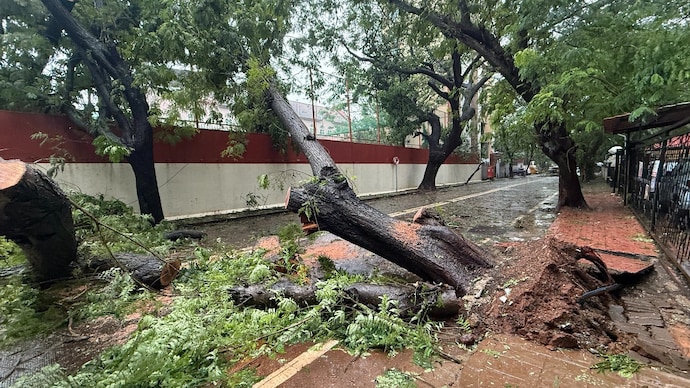
Mumbai tree-fall surge sparks debate over road concretisation project.

UPDATED: Jul 6, 2026 22:32 IST
Maharashtra's Mumbai witnessed an unprecedented 523 tree-fall incidents within 24 hours as heavy rain and strong winds battered the city, leaving one person dead and eight others injured. While the Brihanmumbai Municipal Corporation blamed extreme weather for the surge, experts say widespread road concretisation and poor tree management may also be contributing to the growing number of collapses.
According to civic data, the incidents were reported between 8 am on July 5 and 8 am on July 6 across south Mumbai, the eastern suburbs and the western suburbs. The latest incidents have pushed the death toll from tree collapses to three in the past week alone.
The spike has reignited questions over whether the increasing number of tree collapses is solely the result of severe weather or whether civic infrastructure projects are weakening trees across the city.
BMC BLAMES HIGH WINDS
The BMC attributed the unusually high number of tree-fall incidents to strong winds accompanying the monsoon.
According to the civic body, wind speeds touched 72-79 kmph on Sunday, more than three times the average wind speed usually experienced during the monsoon season.
BMC officials said the extreme weather conditions were primarily responsible for the large number of trees uprooted across Mumbai.
EXPERTS FLAG CONCRETE ROADS, POOR TREE MANAGEMENT
Arborist Vaibhav Raje, who is carrying out a scientific survey of around 5,000 trees in Mumbai, said the recent rise in tree collapses cannot be explained by weather alone.
"Cement and trees are not something which can coexist. Tree roots need to firmly anchor themselves to the soil. When the root zone is covered with concrete, the roots gradually lose their grip and the tree's foundation weakens. As a result, trees can collapse even after a short spell of heavy rain," he said.
Raje also blamed unscientific pruning practices.
"Unscientific pruning of trees also makes them unstable and results in falls. Decay is another reason why trees that appear to be strong also collapse," he said.
He said modern technologies, including LiDAR and artificial intelligence, are now being used to identify trees at risk before they fall.
"Tree risk assessments reduce the risk of tree collapse," he added.
A reality check at several locations found trees surrounded by concrete boundaries, leaving little exposed soil around their trunks. Experts also pointed to uneven trimming, with branches extending towards roads often cut disproportionately, making trees top-heavy and more vulnerable during strong winds.
ROAD CONCRETISATION UNDER SCRUTINY
The latest incidents have also renewed scrutiny of Mumbai's large-scale road concretisation project, launched in January 2023 after Prime Minister Narendra Modi performed the groundbreaking ceremony. The project is considered a flagship initiative of Maharashtra Deputy Chief Minister Eknath Shinde.
According to civic records, tree-fall incidents have remained consistently high since the project began, with 687 cases reported in 2023, 653 in 2024 and 855 in 2025.
Between 2023 and July 5, 2026, at least 11 people have died in tree-collapse incidents in Mumbai, compared with four deaths recorded between 2020 and 2022.
Two of the three fatal tree-collapse incidents reported during the past week occurred along roads that had recently undergone concretisation, adding to concerns over the project's impact on tree health.
BMC SAYS DECAY, NOT JUST CONCRETE, IS A FACTOR
Responding to concerns, BMC Markets and Gardens Committee chairperson Hetal Gala said tree collapses have increased but rejected suggestions that road concretisation alone is responsible.
"It's true that tree-collapse incidents have increased. But trees are falling due to high wind speed and heavy rainfall. It's not necessary that only trees where concrete works are happening are falling," she said.
Gala added that decay remains one of the biggest reasons for tree failures.
"Decay in trees is one of the biggest reasons for collapse. Such trees should be identified through detailed surveys and treated," she said.
The remarks come even as the BMC's Tree Authority issued 428 notices between October 2023 and March 2026 to the Roads Department and utility agencies over damage to tree roots during infrastructure works.
With the monsoon intensifying, the debate over whether Mumbai's rising tree-fall incidents are driven by extreme weather, urban development or a combination of both is expected to remain under close watch.
- Ends
Published By:
Sonali Verma
Published On:
Jul 6, 2026 22:32 IST






 English (US) ·