

 20 hours ago
4
20 hours ago
4
ARTICLE AD BOX
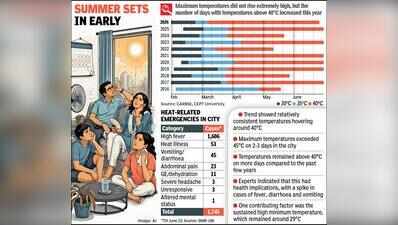
Ahmedabad: Even after the onset of the southwest monsoon in Gujarat, Ahmedabad remains gripped by relentless heat. Since March, the city has recorded maximum temperatures of 40 degrees Celsius or higher on 71 of the last 76 days, underscoring one of its most prolonged spells of extreme summer weather in recent years.
On Thursday, Ahmedabad logged a maximum temperature of 40.5°C — the highest in Gujarat and 3.7 degrees above normal — as residents continued to await meaningful relief from both scorching temperatures and rising humidity.Of the first 25 days of June, 23 recorded maximum temperatures of 40 degrees celsius or higher. Only June 2 (37°C) and June 18 (39.3°C) saw temperatures dip below the 40-degree mark, aided by rainfall.A previous analysis by TOI based on India Meteorological Department (IMD) data showed that between April 11 and June 4, Ahmedabad recorded temperatures above 40°C on 53 of 56 days. Adding the subsequent 20 days takes the tally to 71 days above 40°C out of the last 76 days.Data from the Centre for Advanced Research in Building Science and Energy (CARBSE) at CEPT University indicates that the city experienced an unusually early onset of extreme heat this year.
Based on readings from automatic weather stations, Ahmedabad crossed the 40°C mark in the first week of March, much earlier than the typical onset by the end of March observed in most years since 2016.The CARBSE analysis of air temperature and Wet Bulb Globe Temperature (WBGT) trends over the past decade showed a rapid progression from temperatures in the 30°C range during Feb to 35°C by early March, before crossing 40°C shortly thereafter.
The WBGT, a measure that accounts for heat stress from temperature and humidity, also briefly touched 30°C by the end of April.Prof Rajan Rawal, senior adviser to CARBSE, warned that the combined impact of heat, humidity and warmer nights poses a public health challenge.“It is not just high temperatures — high-humidity conditions also present greater lethality than isolated extreme heat events. Furthermore, the absence of nighttime thermal cooling prevents physiological recovery and disrupts sleep, culminating in cumulative, long-term degradation of both physical and cognitive health," he said.Meanwhile, the southwest monsoon made little progress in Gujarat on Thursday, with its northern limit remaining around Surat. The IMD has forecast light to moderate rainfall in parts of the state, particularly south Gujarat, over the next few days. However, only three talukas recorded 1 mm or more rainfall on Thursday. The weather agency has also indicated that high temperatures are likely to persist across Gujarat for at least the next seven days, delaying any significant respite from the heat.






 English (US) ·