

 2 days ago
4
2 days ago
4
ARTICLE AD BOX
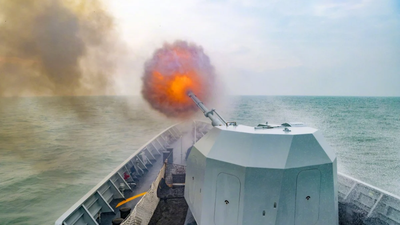
(Image credits: X @SCMPNews)
Chinese scientists and engineers are developing an ultra‑small hypersonic glide missile that can be fired from a standard 80mm anti‑aircraft gun, according to a recent peer‑reviewed study.
Once it exits the barrel, the projectile can reach speeds close to Mach 6, far exceeding the velocity of conventional anti‑aircraft shells.
Long range and high altitude
At such speed, the missile could strike fighter jets or drones at distances beyond 20km and at altitudes of around 10,000 metres. Because of its small size and extreme velocity, an enemy aircraft may only detect the projectile when it is about 3km away, leaving only seconds to respond.
Even at that point, the missile would still be travelling at around Mach 3.6. Computer simulations show that the weapon can adjust its trajectory even if a target makes a near‑90‑degree turn, achieving a reported 99 per cent kill probability, reported South China Morning Post.
High rate of fire and strategic advantage
A typical anti‑aircraft gun can fire about once per second. With low cost and near‑unlimited supply, these hypersonic projectiles could significantly alter air defence strategies if widely deployed to replace medium‑ and short‑range missiles.
Researchers say the system could blur the boundary between traditional gunfire and missile‑based air defence by combining the rate of fire of guns with the reach and guidance of missiles.
Advanced guidance technology
Using multi‑objective optimisation and an advanced sliding‑mode variable‑structure guidance law, the missile reduces manoeuvre load at the terminal phase by more than 90 per cent compared with conventional approaches, while keeping the flight path smooth.
Simulations suggest this system achieves minimal miss distance, strong resistance to interference, and high reliability.“Hypersonic guided projectiles represent a new generation of precision‑strike weapons,” wrote a research team led by Wang Xugang, a professor at Nanjing University of Science and Technology, in a paper published last month in the Journal of Naval Aviation University. “With advantages such as rapid strike, precision guidance and high lethality, they are profoundly reshaping traditional firepower combat models and have broad application prospects in future air warfare.”
Technical challenges
The researchers also acknowledged that extreme speed presents challenges. During sharp or serpentine manoeuvres, traditional guidance methods can struggle, leading to potential misses. To address this, the team developed a two‑stage guidance system. It begins with a mid‑course phase that plans an efficient flight path and ends with a terminal phase that makes precise adjustments to lock onto the target.
Supersonic vs Hypersonic speeds
Supersonic:
Supersonic refers to speeds between Mach 1 and Mach 5, meaning one to five times the speed of sound. Weapons or aircraft in this range, such as fighter jets like the Su-30 or missiles like the BrahMos (Mach 2.8–3), are significantly faster than subsonic systems. They provide quicker response times and are harder to intercept, but they are still slower and easier to track compared with hypersonic systems.Hypersonic:
| Category | Mach Range | Approx Speed (km/h) | Typical Use |
| Subsonic | < Mach 1 | < 1,235 | Cruise missiles, transport aircraft |
| Transonic | Mach 0.8–1.2 | ~990–1,480 | Fighter jets during acceleration |
| Supersonic | Mach 1–5 | ~1,235–6,175 | Fighters, supersonic missiles |
| Hypersonic | Mach 5+ | 6,175+ | Advanced missiles, glide vehicles |
| Ultra-hypersonic | Mach 10+ | 12,350+ | Experimental systems, extreme-speed missiles |









 English (US) ·