

 1 hour ago
4
1 hour ago
4
ARTICLE AD BOX
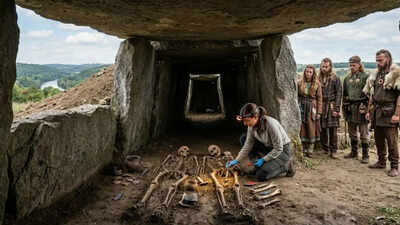
A new genetic research study has demonstrated the existence of a distinct local community of Stone Age farmers that disappeared and were replaced by immigrant groups approximately 5000 years ago near the Paris Basin (specifically at Bury, France).
Based on the DNA data retrieved from the teeth of 132 individuals buried in a megalithic tomb in Bury, France, this research confirmed that two distinct genetic populations existed and were separated by an era of abandonment. This ‘Neolithic decline’ represents a dramatic decline in the northwestern European population throughout the northwestern portion of Europe due to a catastrophic and rapid decline of the Neolithic population, possibly caused by a combination of social, environmental, and disease-related factors.
These findings likely provide the best example of an abrupt end to the Neolithic era of monumental, large-scale construction due to this type of transformative demographic shift.
DNA analysis shows migration replaced the earlier population near Paris
According to the University of Gothenburg, the genetic data analysis of 132 individual remains indicates that there was a marked, distinct break in ancestry between the two types of burials (i.e., people who were buried before 3000 BC and those who were buried after this time).
Specifically, individuals in the first period, before 3000 BC, appeared to be genetically similar to populations from northern France and Germany. By comparison, individuals of the second group were genetically similar to individuals in southern France and the Iberian Peninsula, indicating that there was a dramatic turnover in terms of population, and that a community in the area of Paris disappeared as a result of human migration from regions to the south of this area northward toward the area of Paris.
The factors behind lost people
According to the University of Copenhagen, the research team employed state-of-the-art DNA approaches for identifying human remains with evidence of ancient pathogens and found two strains of pathogen, Yersinia pestis (the bacteria responsible for plague) and Borrelia recurrentis (the organism that causes louse-borne relapsing fever), but it is important to note that the researchers do not believe these infections contributed solely to the demise of individual members of the population.
Instead, the researchers noted that there were significant elevations in mortality, particularly among younger members of the population, which are indicative of an extended period of crisis during which members of the population endured tremendous stress, for example, possibly through the effects of famine or warfare, on the existing population before these individuals were replaced by a new population.
Evidence of new social hierarchies in Stone Age tombs
Beyond the genetic replacement, the researchers observed a fundamental change in how these communities organised themselves. According to the study published by the University of Copenhagen, during the earlier phase, the tomb was used by tightly knit, multi-generational family groups. In contrast, the later phase showed a shift toward more selective burials dominated by a single male lineage. This transition suggests that the population change was not merely a migration of people, but a complete reorganisation of social and funerary practices that coincided with the broader, Europe-wide end of megalithic tomb construction.









 English (US) ·