

 1 hour ago
4
1 hour ago
4
ARTICLE AD BOX
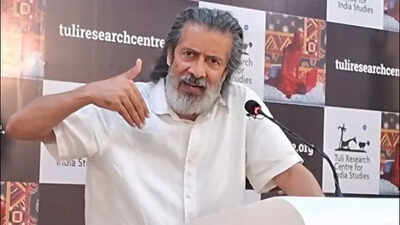
Cinema’s greatest legends and icons come together in a rare visual celebration as the Tuli Research Centre for India Studies (TRIS) presents an extraordinary series of exhibitions at the International Film Festival of Delhi (IFFD).
Curated by arts archivist, author and institution-builder Neville Tuli, the showcase brings together towering figures of world and Indian cinema alongside rare film art, memorabilia, posters and archival material that trace the visual history of the medium. From the quiet genius of Satyajit Ray to the mass appeal of Raj Kapoor, Dilip Kumar, Dev Anand and Shakti Samanta, to the enduring charm of Dharmendra and Sharmila Tagore, the exhibition spans decades of cinematic storytelling. It moves into the grandeur of Mughal-e-Azam and the contemporary superstardom of Shah Rukh Khan, Salman Khan and Aamir Khan, capturing multiple eras of imagination under one roof. One of the key highlights, The Golden Age of Hollywood, 1910–1960s, explores the evolution of cinema from the silent era to the rise of global stardom. Positioned within a larger Indo-American cinematic dialogue, it also serves as a learning module within India Studies. Another major showcase, Highlights of Indian Cinematography, 1913–1973, celebrates pioneers behind the camera. Featuring the works of Faredoon A Irani, Josef Wirsching, the Mistry Brothers, Radhu Karmakar, RD Mathur, VK Murthy, Dilip Basu and Subrata Mitra, it foregrounds the visual craft that shaped Indian cinema.
The exhibition The Heart of Cinema as a Critical Educational Resource – The Song-Synopsis Booklet revisits a unique film artefact that once doubled as publicity material and audience guide. Today, these booklets stand as cultural documents reflecting how music and storytelling became inseparable from Indian cinema. A visually striking display, Significant Artworks of Landmark Films of Bombay Cinema, 1940–80s, presents original artworks, hoardings and rare posters that once dominated urban visual culture. Classics such as Sholay, Guide, Azaad, Pakeezah and Deewaar are represented through powerful imagery. Among the most evocative showcases is The World of Satyajit Ray through the Lens of Nemai Ghosh, 1969–1990, offering an intimate glimpse into the filmmaker’s creative life through rare still photographs. The global influence of film publicity is explored in Vintage Polish & Japanese Designed Posters, 1950–70s, highlighting graphic traditions that shaped international cinema aesthetics. A tribute titled The Greatest Epic Indian Film – Mughal-e-Azam presents memorabilia and visual material connected to the iconic film, underlining its enduring impact. One of the most engaging conceptual displays, From Trinity to Trinity to Trinity | Dev-Raj-Dilip to Ray-Ghatak-Sen to Salman-Aamir-SRK, traces how different cinematic trios have defined successive eras. Additional exhibitions pay homage to key figures, including Dharmendra, Shakti Samanta (1926–2026) and Sharmila Tagore, while also presenting a showcase of Film Jubilee Trophies spanning the 1950s to the 1990s. Together, these exhibitions bring alive a vast collection of film objects — posters, lobby cards, still photographs, booklets and memorabilia — showing how cinema’s life extends beyond the screen into cultural memory. The initiative is anchored by the Tuli Research Centre for India Studies (T.R.I.S.), an independent charitable trust dedicated to advancing Contemporary India Studies. Through its digital platform, the centre offers an open-access knowledge base structured across sixteen research categories spanning the arts, humanities, and social and ecological sciences. TRIS combines digital scholarship with physical archives, exhibitions, library collections and live interactions with creative practitioners. It also connects with the Vanraja Sanctuary and Hospice, reflecting its broader ecological and cultural engagement. Through institutional collaborations, the centre is working towards building a structured Contemporary India Studies curriculum, where visual, textual and audio materials are treated as equal sources of knowledge. Neville Tuli says, “Cinema has always been far more than the films we watch. It is a vast universe of visual memory — posters, publicity art, photographs, booklets and objects that carry the spirit of their time. Through these exhibitions, we hope to reintroduce cinema as a powerful educational resource, where the visual becomes a serious source of knowledge and dialogue across disciplines.”







 English (US) ·