

 1 hour ago
3
1 hour ago
3
ARTICLE AD BOX
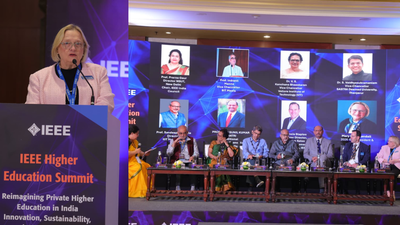
Mary Ellen Randall, 2026 IEEE President, addresses delegates at the IEEE Higher Education Summit 2026, highlighting the future of innovation and education
The question facing students today is no longer whether artificial intelligence (AI) will change jobs. It already is. The bigger question is what skills will remain valuable when technology can increasingly perform routine tasks.At the recent IEEE Higher Education Summit in New Delhi, that question surfaced repeatedly as academic leaders discussed how universities can prepare students for a technology landscape being reshaped by AI, advanced computing and emerging technologies.Speaking to Times of India on the sidelines of the summit, IEEE President and CEO Mary Ellen Randall said adaptability, networking and continuous learning are three skills students cannot afford to ignore."Learning is core," Randall said, stressing that graduates entering the workforce today must be prepared to keep updating their skills throughout their careers.
The half-life of skills is shrinking
The emphasis on continuous learning was not limited to her interaction with TOI. Throughout discussions at the summit, speakers repeatedly pointed to the pace of technological change and the need for universities to move beyond static curricula.The event, themed "Reimagining Private Higher Education in India: Innovation, Sustainability, and Competitiveness", brought together academic leaders to discuss how universities can respond to developments in AI, semiconductors, sustainability and advanced technologies.
Randall also spoke about the importance of ethics and honesty in a technology-driven world. As AI tools become more capable and learning experiences become increasingly personalised, she suggested that human judgement and ethical standards will become more important, not less.
AI may personalise learning, but judgement remains human
That view mirrors a broader shift taking place across higher education. For years, technical knowledge was often seen as the primary requirement for employability.
Today, employers are increasingly looking for graduates who can learn new tools quickly, collaborate across disciplines and adapt to changing environments.At the summit, discussions focused on how private universities can align academic programmes with emerging technologies while ensuring students remain industry-ready. Participants also examined opportunities in research collaboration, innovation and technology-enabled learning.
Universities are being asked to prepare students for constant change
Prof. Bhim Singh, ANRF National Science Chair and Emeritus Professor, described IEEE as a platform that enables researchers, academics and students to exchange knowledge and contribute to solving real-world problems.As AI continues to alter how people learn and work, the message emerging from the summit was straightforward. Technical skills will continue to matter, but they may not be enough on their own. The ability to adapt, build professional networks and keep learning could prove just as important in determining which students remain relevant in the years ahead.







 English (US) ·