

 6 days ago
7
6 days ago
7
ARTICLE AD BOX
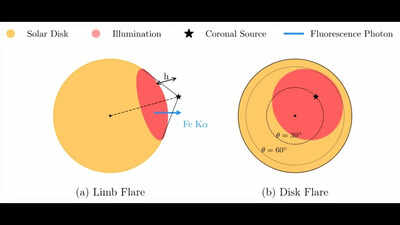
An illustration showing how a solar flare (represented by the black star) high in the corona emits X-rays down onto the Sun's surface (the red area). When iron atoms on the surface absorb these X-rays, they emit a characteristic fluorescence (blue arrow). SoLEXS confirmed that this fluorescence is much stronger when the flare happens near the center of the Sun's disk (right) compared to the edge or "limb" (left). | Credit: Isro
BENGALURU: India's first solar observatory, Aditya-L1, has captured a rare X-ray phenomenon during some of the most powerful solar eruptions ever recorded, giving scientists a new way to study where these explosive events originate high above the Sun's surface.As per Isro, the spacecraft, in its first year of operations from the Lagrangian Point 1 (L1) in 2024, observed photospheric iron fluorescence during 47 X-class solar flares, the strongest category of solar eruptions, Isro said.The observations, made using the Solar Low Energy X-ray Spectrometer (SoLEXS) aboard Aditya-L1, have been published in the peer-reviewed journal Solar Physics.The findings come at a time when the Sun is passing through the most active phase of its roughly 11-year cycle, producing frequent and intense flares that can disrupt satellite operations, radio communications and navigation systems on Earth.“Iron fluorescence occurs when high-energy X-rays produced during a solar flare travel back towards the Sun instead of escaping into space. These X-rays strike neutral iron atoms in the Sun's visible surface, or photosphere, causing them to emit X-rays of their own at a characteristic energy of 6.4 kiloelectronvolts (keV),” Isro said.While the phenomenon has been predicted and observed before, Aditya-L1 has now carried out what Isro described as the “first comprehensive analysis” of the effect during a large number of powerful solar flares from its uninterrupted vantage point nearly 1.5 million kilometres from Earth.
The study found that the brightness of the iron fluorescence depends strongly on where a flare erupts on the Sun. Flares occurring near the centre of the Sun's visible disc produced a much stronger fluorescence signal, while those near the edge, or limb, showed a much weaker signal.According to Isro, this “centre-to-limb” variation closely matches theoretical predictions. Scientists say this behaviour could turn iron fluorescence into a valuable diagnostic tool.
By measuring how the fluorescent signal changes, researchers can estimate the height of the X-ray source in the Sun's corona and better understand the geometry of solar flares.That could improve models of how these violent eruptions develop and release energy. The observations were made by SoLEXS, an instrument developed indigenously at the UR Rao Satellite Centre (URSC) in Bengaluru. Besides recording X-rays directly from solar flares, it is sensitive enough to detect the weaker fluorescent X-rays produced from the Sun's surface.Launched in Sept 2023, Aditya-L1 is India’s first dedicated mission to study the Sun. Operating from the L1 point, where the gravitational pull of the Earth and Sun balance, the spacecraft enjoys an uninterrupted view of the Sun without regular eclipses, allowing continuous monitoring of solar activity.









 English (US) ·