

 12 hours ago
4
12 hours ago
4
ARTICLE AD BOX
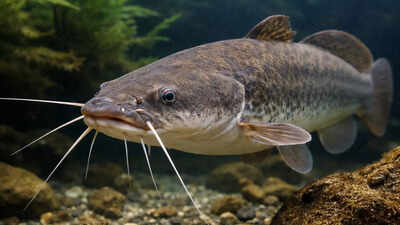
In the quiet darkness of night, while all appears still and quiet in most water bodies, there can be interesting things happening out of our sight. There has been a recent camera trap sighting in South Africa, where there has been an interesting sighting of fish coming out onto dry land.The video shows African sharptooth catfish coming out of a water pond and squirming across wet ground for several minutes, which looks almost unnatural to our eyes. But this is no anomaly, and this is no unnatural act, as one might initially be inclined to believe. This, in fact, is evolution in action, as this is one way in which these creatures survive in nature.What may appear unnatural is, in fact, a reminder to us that nature is always full of surprises, forcing us to question our assumptions.
Watch: African sharptooth catfish leave water and ‘walk’ on land
The video, taken by an Africam Live Cam at Naledi Bush Lodge in South Africa, depicts groups of African sharptooth catfish collecting at the water’s edge before proceeding to push themselves onto land. The catfish are seen crawling across the mud using side-to-side movements.The uniqueness in this occurrence is not only in this behaviour but also in how clearly this behaviour is captured. Although scientists are aware that this catfish species is capable of this behaviour, camera traps are now providing us with evidence of this behaviour in real-time.
Watch
Catfish 'Walk' on Land in Search of Food
Why do these fish leave the water
The movement of the catfish onto land is not haphazard. It is normally a response to certain conditions in the environment that make survival on the water less certain or provide new opportunities off of it.As for the particular case, it is most likely that the recent flooding was a major contributing factor. This is because the moist environment minimises the chances of the catfish drying out while on the move. Additionally, new sources of food are also provided for them on the land.These catfish are opportunistic feeders. They feed on insects, other fish, plants, and other animals. Moving onto the land would provide them with access to food that would otherwise be out of their reach.
Built for survival beyond water
The African sharptooth catfish is not your average fish. The most impressive adaptation of this fish is the development of an organ to breathe air, which is found in the chamber of its gills.As a result of this, this fish can live out of water for hours or even days, provided its body is moist.
Another adaptation this fish uses to cross water is the use of its pectoral spines and muscles to move forward out of water. Although it looks very awkward, the fish can manage to cross water bodies.
Movement as a survival strategy
This species has been noted to move from the water during the dry season when the ponds start to dry up. In such cases, the movement becomes a necessity.By moving at night, the fish minimises the chances of dehydration as well as predators.
The combination of darkness and moisture makes the environment safe.This movement also enables the species to spread. Temporary pools, as well as other areas, provide the species with more opportunities.
Ecological impact of a highly adaptable species
However, despite the African sharptooth catfish’s adaptability, this is also something that is causing concern. The South African National Biodiversity Institute and Cape Nature have mentioned that despite this catfish being a native species to this region, it has also exhibited invasive characteristics in some areas.
The catfish’s adaptability to eat almost everything and its ability to travel to different bodies of water enable it to compete aggressively with other species. What may seem to the average viewer to be an unusual and even eerie occurrence, such as a fish “walking” on land, is actually something much more important to those in the ecological world. It is important because it shows how there is much life in the world of fresh water that is constantly adapting to changes such as flooding and droughts, as well as man-made changes such as canals and farm ponds. This species, and this behaviour, serve as a reminder to the world that even though water may seem calm and serene, there is much activity and adaptation going on beneath the surface, and even along the banks. The footage, as presented by Compass Media, helped bring this unusual behaviour to the forefront.








 English (US) ·