

 1 hour ago
4
1 hour ago
4
ARTICLE AD BOX
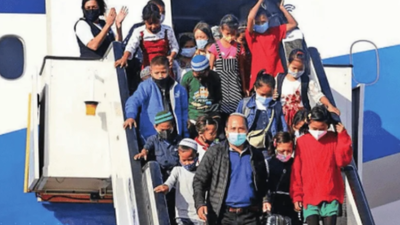
File picture of a group of Bnei Menashe from Mizoram arriving in Israel
For more than two decades, W L Hangshing, a retired Indian Revenue Service officer, has carried a dream — not of career advancement or recognition, but of spiritual return. At 68, the Kuki-Zo leader from Manipur awaits the fulfilment of his long-held aspiration to “make aliyah ” — the Hebrew phrase meaning “to go up”, which represents a sacred journey, or migration, to Israel.His story is emblematic of a community’s collective longing. Hangshing is among the 5,800 members of the Bnei Menashe in India. Spread across Manipur and Mizoram and part of the larger Kuki-Zo group, the community identifies itself as descendants of one of Israel’s 10 lost tribes.Last Nov, the cabinet of Israeli PM Benjamin Netanyahu announced that it would facilitate the immigration of all remaining Bnei Menashe from India, allocating $27 million to bring them to Israel by 2030, covering flights, Hebrew instruction, housing, integration, and religious conversion, or formal initiation into Judaism.The decision formally recognises the community and outlines a five-year programme for them to complete their aliyah . The immigrants are to be settled in the Galilee region of northern Palestine, an area that has seen significant depopulation over the last two years amid security concerns linked to Hezbollah missile threats.Finding home, livelihood
Language comes first, said Hangshing. “Without Hebrew, you cannot find a job. The ministry then assesses skills — carpenters are placed in carpentry, the academically inclined are guided towards schools or universities — hence the emphasis on ‘absorption’, or full social integration,” he added.Most Bnei Menashe families settle in regions where living costs are lower, often near conflict zones like the Gaza border or Hebron.
While critics argue that they are being pushed to the margins, Hangshing said it’s economics that drives the choice. “They can’t afford land in Tel Aviv. Even a single room there is beyond reach.” Many, however, have found stability in the Negev Desert, where orchard farming suits their agrarian background and provides a steady livelihood.
Miriam Winchester Zoluti, who migrated to Israel in 2020, said many migrants who once tilled paddy fields in Mizoram are now factory workers, earning a minimum of 34 shekels (about Rs 990) an hour.First batch this year
Today, nearly 5,000 Bnei Menashe live in Israel across more than a dozen localities.Hangshing, who chairs the Bnei Menashe Council of India, said around 1,200 people — the names of those in the first batch are yet to be announced — have been cleared for migration in 2026, with the rest expected to follow in phases over the next few years. Nearly 3,000 applicants were screened, with priority given to families split between India and Israel.
That criterion places Hangshing himself further down the list.
“My uncles are in Israel, and my father is buried there,” he said. “But I don’t have a first-degree relative who is currently living there.”Hangshing said his father, Aviel (Tongkhohao) Hangshing — a former Manipur govt commissioner — migrated to Israel in 2014, when he was 80 years old, remaining there until his death in 2021. “People asked what he would do there at that age.
He said he wanted to be buried in the Holy Land. Like Hindus wanting to spend their last days in Varanasi.”The lost tribes
Scattered across Asia, most of these tribes assimilated and gradually lost their religious identity.
The Bnei Menashe believe they preserved fragments of that past — rituals, songs, oral traditions — over nearly 2,700 years.“There is a difference between displaced Jews and the lost tribes,” Hangshing said. “The Jewish Agency was created for Jews who were scattered, not for tribes that disappeared... Many scattered to places like China, Afghanistan and Persia, where they eventually converted or lost their identity.
Today, the Jewish population of about 15 million worldwide — in Israel, America and Europe — represents only two of the original 12 tribes.
The remaining 10 were lost. That is what makes the recognition of the Bnei Menashe so significant.”“Without funding from the Israeli govt, there was no formal recognition of the Bnei Menashe as one of Israel’s lost tribes,” he added. “We had been lobbying for years. The Jewish Agency recognised us, the rabbis recognised us, but govt policy was not there.
In Nov last year, the govt finally did.”Screening and selection
Final approval, he said, takes place in Israel, where rabbis conduct a more intensive review before citizenship is granted. Applicants found lacking in religious knowledge are not rejected outright; instead, they may be placed in a yeshiva (religious school) to strengthen their understanding.Hangshing also ruled out DNA tests. “There is no such thing as DNA matching in this context,” he said. “Some groups have tried it, but they have no connection to the Jewish Agency or immigration authorities. There is no standard ‘Semitic’ or ‘Israeli’ gene. Jews have mixed over centuries — European, African, Caucasian. Everyone is mixed. There is no fixed benchmark.”




 English (US) ·