

 2 days ago
3
2 days ago
3
ARTICLE AD BOX
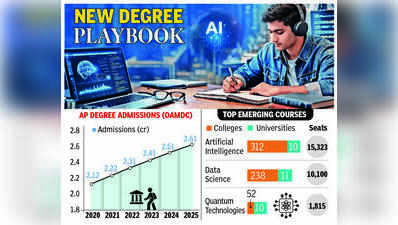
Vijayawada: Andhra Pradesh has significantly expanded emerging, industry-oriented undergraduate programmes, with BSc Honours in Artificial Intelligence (AI) now being offered in 312 colleges across 10 universities with a sanctioned intake of 15,323 seats.
Data science is available in 238 colleges across 11 universities with 10,100 sanctioned seats, while quantum technologies have been introduced in 52 colleges affiliated to 10 universities with a sanctioned intake of 1,815 seats, reflecting the growing demand for technology-driven and employment-oriented degree programmes.The expansion comes amid a visible shift in students’ academic preferences, with programmes related to Artificial Intelligence, Data Science, Computer Science, Computer Applications and Data Analytics emerging as the most sought-after courses during the 2025-26 admissions, according to APSCHE chairman Prof K Madhu Murthy.
While conventional programmes such as BA, BCom and traditional BSc continue to remain relevant, students are increasingly preferring courses that integrate technology, skill development and employability-oriented learning.According to the Online Admission Module for Degree Colleges (OAMDC), admissions increased marginally to 1,79,926 during the 2025-26 academic year from 1,79,426 in 2024-25. The total sanctioned intake in degree colleges also rose to 4,57,377 seats this year from 4,55,542 in the previous academic year, indicating a steady recovery in admissions over the past three years.
Explaining the trend, Prof. Madhu Murthy said students today are able to see a direct connection between these programmes and future career opportunities. Artificial Intelligence, Data Science, Quantum Technology and Cyber Security are no longer confined to research laboratories or technology companies but are becoming relevant across sectors such as banking, healthcare, agriculture, governance, education, logistics, manufacturing, media and public services.
He said the programmes also attract students because they combine classroom learning with practical exposure through projects, internships, digital tools, industry certifications and real-world problem-solving, giving them confidence that their degrees will translate into employable skills.The APSCHE chairman said the decision to introduce and expand emerging programmes was driven by industry requirements, national priorities and changing employment trends.
Industries now expect graduates to possess technology, analytics and problem-solving skills in addition to academic knowledge. The council has therefore aligned several programmes with employability, internships, skill enhancement, digital certifications and industry-linked learning to prepare students for future careers.Apart from AI, Data Science and Quantum Technologies, students can now enrol in specialised programmes such as Cyber Security, Cyber Forensics, Cloud Computing, Internet of Things (IoT), Machine Learning, Information Technology, Computational Mathematics, Applied Computer Statistics, Bioinformatics, Digital Electronics, Material Science, Pharmaceutical Manufacturing and Quality, Animation, Renewable Energy Management, Food Science and Technology, Agriculture and Rural Development, Business Analytics and Digital Marketing.
Overall, 1,137 colleges are offering emerging single-major programmes with a combined sanctioned intake of 56,908 seats across Andhra Pradesh.“There is a very visible shift. Students today understand that a degree alone may not be enough unless it is supported by relevant skills. Parents are also increasingly asking about employability, internships, industry certifications and long-term career opportunities while choosing programmes,” Prof. Madhu Murthy said. He added that APSCHE plans to introduce more future-ready programmes in areas such as FinTech, Robotics, Semiconductor Technologies, Green Technologies, Health Informatics and Sustainability, depending on industry demand and academic preparedness, with the larger objective of producing globally competent and employment-ready graduates.









 English (US) ·