

 1 hour ago
6
1 hour ago
6
ARTICLE AD BOX

BENGALURU: The IT industry is undergoing one of its deepest structural shifts in decades as AI reshapes talent needs across the delivery chain. The traditional pyramid model with large teams of junior coders supervised by layers of managers-is giving way to a capability-dense, AI-augmented structure.
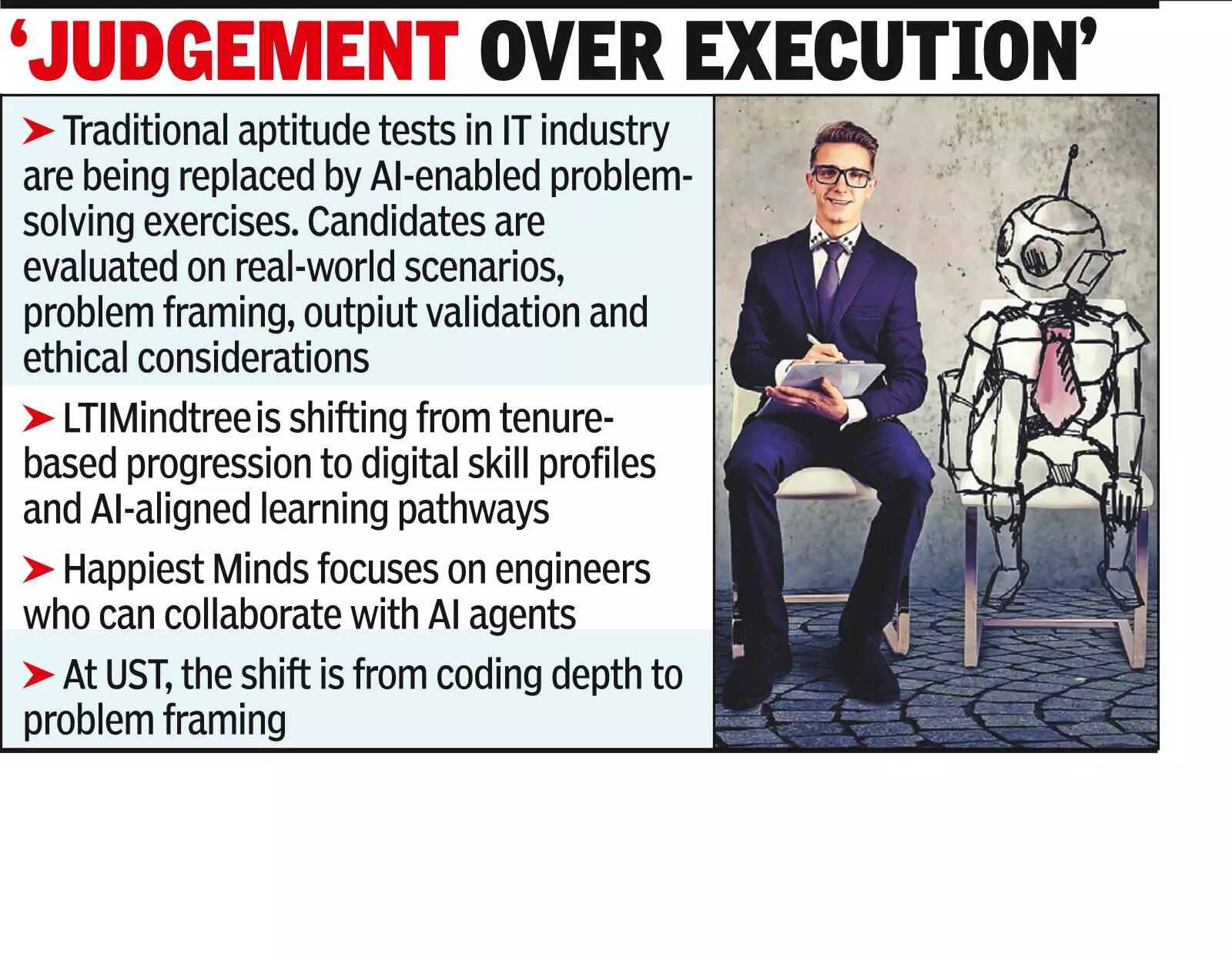
"The shift is from coding depth to problem framing," said Gilroy Mathew, COO of UST. Instead of testing whether candidates can write a Java function, firms now ask whether they can define business problems, break them into AI-executable steps, and validate outputs for bias, risk and completeness. Access to AI tools is narrowing the gap between freshers and mid-level engineers. A well-trained entry-level hire is expected to become productive faster than before.
.
LTIMindtree describes the emerging structure as a "diamond" rather than a pyramid. At the base is a smaller layer of AI-fluent engineers, supported by automation and AI agents handling routine execution. In the middle, architects and managers are evolving into orchestrators-designing AI-first workflows, integrating systems and aligning delivery with business goals. "It's not about fewer people; it's about fewer people doing low-judgement work," said Gururaj Deshpande, chief delivery officer at LTIMindtree, arguing that AI-led productivity gains will help clear larger project backlogs rather than simply reduce headcount.
One clear shift is the shrinking space for purely supervisory managers. In an AI-led environment, managers are expected to redesign processes around automation, understand agent-based workflows, ensure AI governance and tie execution to business KPIs.
Hiring models are changing in parallel. At UST, screening moved from "employability" to "adaptability". Candidates are given real-world business scenarios and evaluated on how they frame problems, use AI tools, validate outputs and factor in ethical considerations.









 English (US) ·