

 1 hour ago
6
1 hour ago
6
ARTICLE AD BOX
By: Dr Neil JainIn a well-documented case, musician Samuel Smith lost his ability to play due to the onset of Parkinson’s disease.At first, he thought that this was the end to not only his career but also to the joy of creating music.
Then AI came along. He now hums his melodies into a phone, lets AI generate demos, and sends them to musicians who record the album.
His second album was released this year.This would have been unthinkable a century ago. The creativity that history records — the painted portrait, the published book, the composed symphony — was the preserve of the privileged.
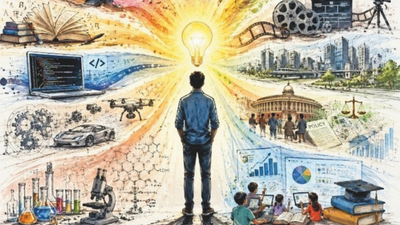
One either commissioned sculptors and painters to create, or possessed the rare combination of talent, tutors, patronage, and luck needed to create masterpieces.The rest carried their creativity to the grave.Not surprisingly, Generative Artificial Intelligence — the ability to generate entirely new pieces of information, code, literature, music and visuals — has taken the world by storm. Victor Hugo wrote that nothing is more powerful than an idea whose time has come. Artificial Intelligence is that idea, the most significant invention since the Industrial Revolution and nuclear warheads.
Machines may have redefined economics while deadly weapons brought new dimensions to geopolitics. However, AI has the potential to have implications that are wider and deeper than the other two.In another live example, our team did not know how to code. Yet last month, we built a hostel management portal with AI coding tools. The only ingredients were the problem case, a process flow, imagination of outlay, iteration and testing.
All in-house. No developers or vendors.Generative AI is turbo-charging the ability to translate thought into action. It analyses, bridges complex connections, provides possibilities hitherto unknown and generates an entirely new output. Outcomes of scientific research are now being measured in months instead of decades.There was a time when texts were written in ink with quills. Then came the pens which dispensed with messy ink.
Still, the handwriting could range from calligraphy to scribble.Old-timers may recall the typist faithfully printing texts in neat, legible words albeit having to retype for mistakes or using ugly fluid to cover them. Multiple drafts meant that form took as much time as substance.The computer with its backspace, delete and spell check improved efficiency to an extent. A lot of time and effort was wasted in getting the right form at the expense of the substance.
AI can now generate flawless drafts in a manner and form as desired just with a few prompts. More time at hand to concentrate on the substance.AI can generate original solutions for complex problems, a doctor wanting to evaluate all possibilities of diagnosis and cure; policymakers using AI to analyze complex and copious amounts of data and suggest creative policies.Educationists are using AI to teach complex issues in a novel manner.
Is it the end of jobs? In my humble opinion, no. The industrial revolution brought more jobs after initial disruption and displacement. Similarly, it was feared that information technology would lead to more unemployment. India’s meteoric rise as an IT superpower proved how misplaced those fears were.It is just the nature of the job that changes. Upskilling the worker means better efficiency and improvement in quantity and quality of output. The calligrapher turned into a typist, then into a computer operator, and now could be a creator using AI to produce effective and efficient outcomes on a humongous scale. Cognitive skills may be replaced by AI, but new opportunities will emerge. Is not there a man behind every machine?Already we are seeing an enthralling bloom of creativity on social media platforms.
Instagram posts, cooking shows and travelogues on a plethora of YouTube channels to name a few.Even PowerPoint presentations are getting more creative. AI is already spawning a new class of entrepreneurs whose creativity is not constrained for want of resources or extreme technical skills.Nevertheless, educational institutions would need to rejig their curriculum to provide students with cutting-edge AI skills and be future-ready.
Businesses and services will also eventually see a reset after some initial disruption. Jobs will be created in a different dimension with requirements of different skill sets. In many ways, Darwin’s theory of natural selection is playing out. The fittest will continue to survive.
The rest will perish. However, this power, like any power, will need responsible use — guardrails of law and ethics, the same way democracy is distinguished from anarchy.The light we see from stars today may have been emitted thousands or millions of years ago. At present, there is no way of knowing what is happening in these galaxies today. That is the fear of the unknown. We may not know what AI has in store for the future, but the way forward is to work with it constructively. We should be prepared for the future. Let AI be a cradle of creation. The world will benefit immensely.(Writer is an IRS officer. Views are personal)





 English (US) ·