

 1 day ago
5
1 day ago
5
ARTICLE AD BOX

The Aleutian Islands sit on one of Earth's most active geological boundaries. Image Credits: Anahi Carrera
Think of a remote arc of volcanic islands that extends nearly 1,000 miles from the tip of Alaska towards Russia’s Kamchatka Peninsula. Battered by storms, enveloped in fog, and perched on some of the most geologically active ground on Earth, that's the Aleutian Islands.
For decades, geologists had suspected that something dramatic had once heaved the whole chain up. Now they have proof at last.Researchers at Brown University published a study titled ‘Synchronous arc exhumation of the central and western Aleutian Islands at 7–5 Ma, Alaska, USA’ that shows that between 5 million and 7 million years ago, the Aleutian Islands underwent a massive geological uplift, a rising of the Earth's crust that physically pushed the islands upward and changed their topography. The research provides what the authors claim is the first direct evidence of a dramatic episode of uplift and erosion that affected the whole archipelago, caused by a change in the motion of the Pacific tectonic plate.How an island chain is born and remadeTo understand what happened, it's helpful to know where the Aleutians came from. The islands were formed by ancient volcanic activity that began about 55 million years ago, when the Pacific tectonic plate began to subduct beneath the North American plate. One of the most powerful geologic forces on the planet is subduction. It’s what happens when one tectonic plate slides under another.The study shows that when one plate is forced under another, water and other volatile materials trapped in the subducting plate cause melting in the mantle just below the crust, leading to intense volcanic and earthquake activity along the boundary.
That’s how the Aleutians were built, and that’s why they’re part of the Ring of Fire, the arc of frequent seismic and volcanic activity that circles the Pacific Ocean, with the Aleutians forming the northern boundary.
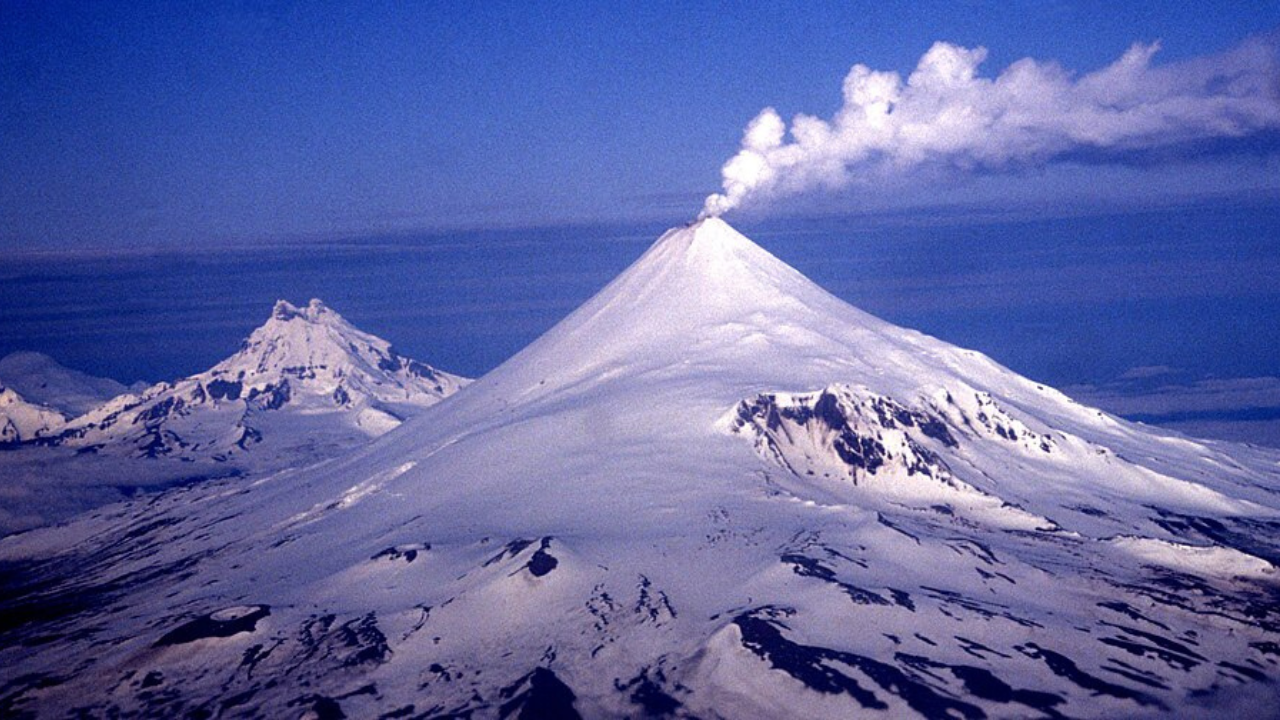
Shishaldin Volcano, one of the most active in the Aleutian chain, seen here with Isanotski and Roundtop. Image Credits: Wikimedia Commons
The Aleutian subduction zone may be older than previously thought, with traces of subduction dating back at least 56 million years, placing its formation at the start of a major reorganization of plate motions across the Pacific, according to a 2026 study published in Nature Communications.The clue hiding in ocean sedimentThe first indication that an Aleutian uplift event had occurred came in the 1970s. The Geology study reports that oceanographers sampling sediment cores from the ocean floor surrounding the islands found an unusual layer of land-derived clay minerals and other sediment deposited over a relatively short geological window, several million years ago. One explanation was that the islands had been thrust upward, exposing more of their surface to stronger winds and heavier rains, which then carried sediment into the surrounding sea.But a layer of sediment is circumstantial evidence at best. Something more direct was needed to prove that the whole island chain had risen at once.Reading time inside a crystalUsing a technique called apatite thermochronometry, researchers Anahi Carrera and Emily Cooperdock studied rock samples from throughout the Aleutian archipelago. According to the Geology study, this method works by measuring how much helium gas is trapped inside crystals of the mineral apatite.
Apatite contains small quantities of the radioactive elements uranium and thorium that decay, producing helium.
Helium escapes when the rock is deep underground at high temperatures. But as the rock reaches the surface and cools, the helium is trapped. Scientists can estimate when the rock cooled by comparing the amount of helium left with the amount of uranium and thorium left, which tells them roughly when it reached the surface.

The Aleutian Islands stretch across the North Pacific as part of the Ring of Fire. Image Credits: Wikimedia Commons
The study found that 77% of the rock samples cooled at nearly the same time, between 5 million and 7 million years ago, even though they came from islands spread across nearly the entire chain. The homogeneous cooling age over such a great distance leads to one conclusion: a single, great uplift event that affected the entire island arc at the same time.What moved the islandsThe timing of this uplift corresponds with a known Pacific Plate rotation event that the Geology study says was associated with deformation and uplift along the Ring of Fire.
The slow churning of the mantle deep within the Earth, many kilometers below the surface, caused this plate rotation, and the Aleutians were pushed upward as a result.Why this mattersIsland arcs like the Aleutians, the study notes, are some of the least understood places on our planet. Understanding what causes their uplift and erosion is important for understanding earthquake and volcanic hazards, risks that are very real for Alaska, which has some of the most frequent seismic activity in the United States.
The Aleutians are also an important ecosystem for marine life and home to Indigenous Unangan communities with thousands of years of history on these islands.If you’ve ever looked at a remote island chain and wondered what forces created it, the Aleutians now have a more straightforward answer: a single, ancient roll of an entire tectonic plate, working from deep within the Earth to reshape the surface world above.









 English (US) ·