

 1 hour ago
7
1 hour ago
7
ARTICLE AD BOX
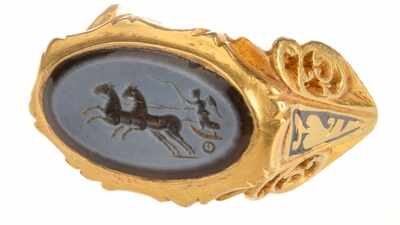
A Roman gold ring, dating back to AD 297 and featuring a detailed depiction of Victory, was unearthed by an amateur detectorist in an English field. Image Credits: South West Heritage Trust
A closer look below the British countryside topsoil reveals a completely different narrative of hidden wealth and ancient secrets. Beneath the surface of these fields lies a rich archaeological record waiting to be uncovered.
For patient detectorists, a single find can uncover a world of ancient history.This incredible collision between the modern world and the ancient past is highlighted in a report published by the South West Heritage Trust, under the title Extraordinary Roman Gold Ring Acquired. The institutional account describes how an amateur detectorist named Kevin Minto was exploring an ordinary field near the town of Ilminster when his equipment picked up a powerful signal.
Expecting scrap metal or a modern coin, the hobbyist dug into the red soil and uncovered a gold ring that had been hidden for 17 centuries.The article says the ring dates to around AD 297 and is set with a finely engraved nicolo gemstone showing Victory with wings and a helmet, her chariot and two horses rendered in striking detail. It was acquired for £78,010 alongside the hoard, after conservation work and support from the Arts Council England/V&A Purchase Grant Fund, Art Fund and the Wolfson Foundation.
Unearthing a masterpiece of imperial craftsmanshipTo fully understand why this particular discovery has caused such a massive wave of excitement among historians, it helps to look at the sheer scale of the artefact. Weighing a massive forty-eight grams, the gold band is exceptionally large and heavy compared to standard ornamental jewellery from that era. At the centre of the gold setting is a dark blue and light grey gemstone carved in intaglio.
The delicate engraving shows a detailed image of Victoria, the Roman goddess of victory, outfitted in a helmet and wings while confidently driving a swift chariot pulled by two powerful horses.The extraordinary rarity of this item was further explored in a separate historical report published by The Guardian, under the title Somerset detectorist strikes gold with spectacular Roman ring find. In the report, museum experts point out that finding an object containing such a lavish amount of pure gold is an incredibly unusual event for the region.
During the late Roman occupation of Britain, the vast majority of local jewellery was crafted out of far more modest materials like silver or bronze. The ring survived in unusually good condition, suggesting it was carefully kept.The Guardian report adds that the ring was found in 2018 by Kevin Minto, a lorry driver and former soldier, after he had already been returning to the site for Roman coins since 2017. It was later acquired with 297 Roman coins for £78,000, and the trust’s curator said the piece may have been worn on important occasions or had a ceremonial function.The incredible preservation of the ring is so absolute that scientists did not even need to clean the metal after extracting it from the earth, as small flecks of the original red Somerset dirt are still visible inside the crevices of the gemstone. Local historians believe the ring may have been reserved for ceremonial use or major public occasions. The ring suggests its owner was likely a person of high status, such as a governor, merchant or estate owner.

Amal Khreisheh, Senior Curator at South West Heritage Trust with the Ilminster Ring and coins from the hoard .Image Credits: South West Heritage Trust
Piecing together the story of an ancient political crisisThe practical insights gained from studying the spot where the ring was discovered offer a fascinating look into the mind of a wealthy Roman citizen facing an emergency. Minto did not just find the ring by itself, as the spectacular piece of jewellery was buried directly alongside a massive hoard of two hundred and ninety-seven ancient coins. Over the course of several visits to the same farm field, the detectorist also uncovered pottery fragments, lead objects, and even a heavy lead-lined coffin scattered across the immediate area by centuries of agricultural ploughing.According to the South West Heritage Trust, the coin dates help researchers estimate when the treasure was hidden. Between the years AD 286 and AD 296, Roman Britain had split away from the main empire under Carausius and later Allectus, turning the countryside into a dangerous zone of political uncertainty and military conflict.The owner may have buried the valuables for safekeeping, intending to return later. For reasons that we will never truly know, the owner was never able to make it back to the field, leaving the gold to sit undisturbed while centuries of history rolled over the site. Now, the South West Heritage Trust has acquired the treasure for more than £78,000, and it will be displayed in a museum.









 English (US) ·