

 1 hour ago
7
1 hour ago
7
ARTICLE AD BOX
Whether you type a website address, video-call a distant friend, or unlock a phone with your face or fingerprint, many everyday digital tools trace back to discoveries made decades ago. However, a newly released animated stamp series aims to pay homage to the engineers and computer scientists behind some of these inventions.
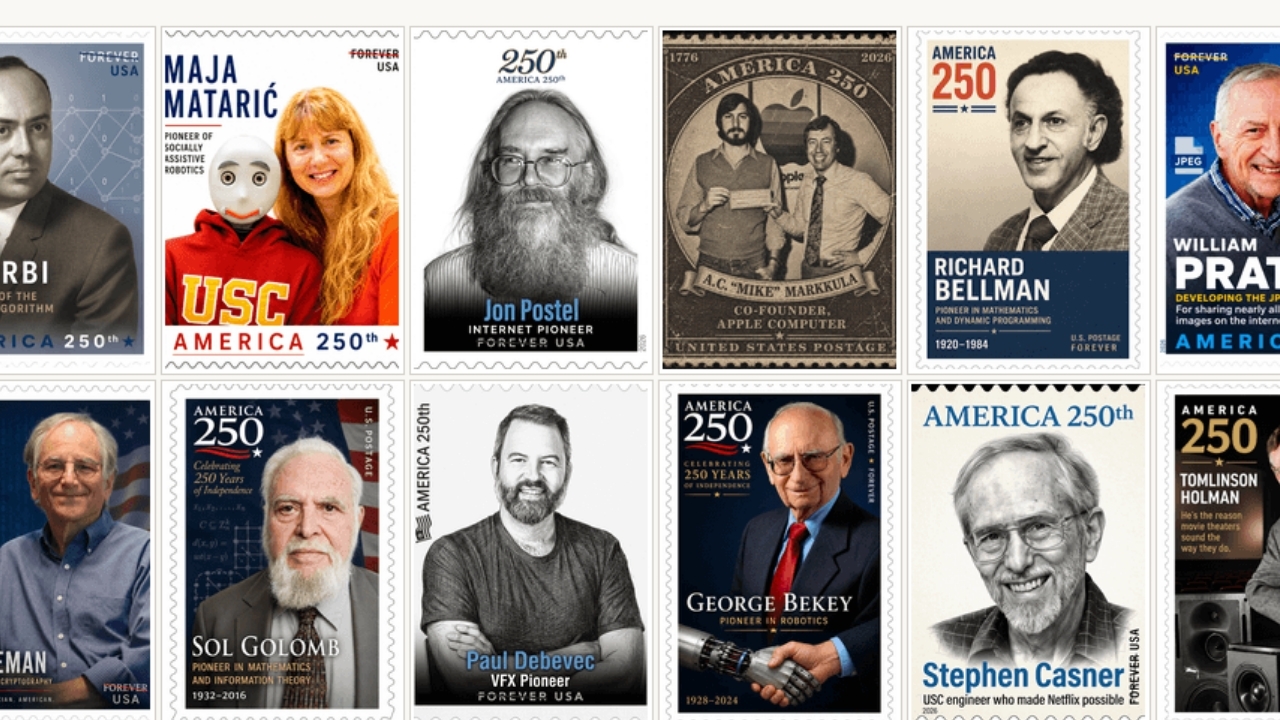
In light of the 250 years since America's formation, the University of Southern California (USC) is releasing a series of 14 animated digital stamps to commemorate the researchers, alumni, and professors whose inventions played a crucial role in shaping the contemporary computing environment. These stamps will not be official US Postal Service stamps.
Another way to mark the United States’ 250th anniversary is through USC's animated stamp series
In this time of the US Postal Service celebrating the nation’s semiquincentennial through their own official stamps that have been recently released as the American Icons series curated by fashion designer Ralph Lauren.
Congratulations!
You have successfully cast your vote
USC's version takes a different approach. The stamps honor scientists whose innovations became embedded in modern technology, often without users realizing it.
The inventions that make everyday internet possible
Among the best-known names mentioned is Jon Postel, described as an architect of the early Internet. At USC's Information Sciences Institute, Postel managed internet address assignment and edited the Request for Comments (RFC), which still defines internet protocols today.
Another honoree is Paul Mockapetris, who created the Domain Name System (DNS), introduced in 1983 at USC's Information Sciences Institute. The technology lets users reach websites by typing easy-to-remember names instead of long numerical IP addresses. The Internet Society describes DNS as one of the basic building blocks of the Internet.
Eve Schooler, the inventor of the Session Initiation Protocol (SIP), also known as the 'voice of the internet,' is included in the series. The protocol is extensively used in setting up and controlling internet voice and video calls.
Technological innovations extending further than the computers
The series also highlights technological innovations that go well beyond the internet.
William Pratt is credited with inventing transform coding, which became a basis for JPEG image compression and MPEG video compression. Both greatly reduced file sizes while preserving quality, helping make digital photography and video practical on the internet. Another invention highlighted is Andrew Viterbi's Viterbi algorithm, which plays an important role in decoding digital signals used in wireless communications.
Cybersecurity is also represented by Leonard Adleman, who co-invented RSA, one of the most widely used public-key cryptography systems. The invention is behind today's secure internet banking, communications, and many other internet security systems. Adleman won the 2002 ACM A.M. Turing Award for these achievements.
Algorithms behind modern-day artificial intelligence
Also honored is Richard Bellman, whose work on dynamic programming remains important in optimization and reinforcement learning. Bellman's dynamic programming methods continue to be widely used in artificial intelligence, robotics, and economics for decision-making problems. Reportedly, dynamic programming is one of the most important optimization methods in computer science.
Other honorees include robotics researcher Maja Matarić, who developed socially assistive robots for healthcare, and George Bekey, who helped establish robotics as a major field of study.
Unrecognised pioneers of commonly used technology
Although well-known figures such as Apple co-founder Mike Markkula are included, most of the recognition goes to scientists whose achievements happened behind the scenes.
From DNS managing the internet traffic, RSA securing monetary transactions, JPEG reducing photos, to algorithms used in phones for the processing of wireless signals - all of these inventions are so ingrained in the modern reality that people do not usually give any thought about the creators of such technologies.
USC's animated stamps show how decades of work by engineers and computer scientists produced technologies that are now widely used, even if the scientists themselves remain little known.









 English (US) ·