

 1 hour ago
7
1 hour ago
7
ARTICLE AD BOX
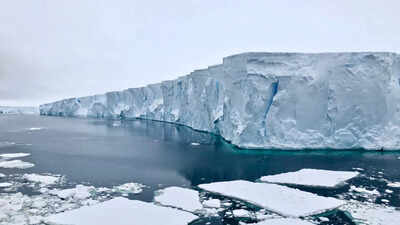
Go to the frozen edge of West Antarctica (or just Google it), and you’ll find Thwaites Glacier — a giant wall of ice, cracking and creaking where it meets the sea. Scientists have called it the “Doomsday Glacier” for years, and right now, researchers say a key part (the eastern ice shelf) could break apart before the year’s up.However, to be clear, according to Live Science, that doesn’t mean the glacier itself is about to vanish overnight. But the loss of its ice shelf would be a dangerous turning point for the world’s coastlines.
‘Doomsday Glacier’ melting away?
For the unversed, located on the coast of West Antarctica, Thwaites is the widest glacier on Earth. It’s about the size of Great Britain. And what makes it even scarier is what it’s holding back: a huge chunk of the West Antarctic ice sheet.
For decades (since the 1980s), warm ocean water has been gnawing away at its belly, melting the glacier from beneath and forcing it to retreat mile by mile. Since the early 1990s, researchers estimate that it’s lost more than 12 miles (20 kilometers) of ground.The trouble now focuses on the floating ice shelf that helps hold Thwaites in place. Think of it as a buttress propping up a wall. As long as it’s there, it slows the flow of ice into the sea.
Without that support, the glacier can flow more rapidly into the Southern Ocean.According to scientists involved in the International Thwaites Glacier Collaboration, climate-driven changes in ocean circulation are bringing warmer water into contact with the glacier's underside — cracks are spreading, the shelf is weakening, and satellite images show it’s nearly at the breaking point.
What happens if Thwaites Glacier is lost?
If the shelf shatters, will sea levels jump overnight? No. The ice shelf is already floating, and its breakup doesn’t flood the world by itself.But the real danger is what happens next: Thwaites speeds up, dumping more land ice into the ocean and raising global sea levels bit by bit. That’s where the “doomsday” part comes in.If Thwaites goes, seas would rise by around 2.1 feet (65 centimeters or 26 inches), which is enough to flood parts of cities from Miami to Mumbai. The full collapse could take centuries, and the timeline is fuzzy. But the signs aren’t good.
What do experts say?
Researchers say that satellite images reveal that the Thwaites eastern ice shelf is about to detach from the glacier, per a New Scientist report.
The eastern ice shelf is cracking where it’s pinned by a ridge on the seafloor, and ice is peeling away twice as fast as it was just a year ago.Robert Larter, a British Antarctic Survey glaciologist working with the International Thwaites Glacier Collaboration, put it simply: “The last bit of ice shelf in front of the glacier is poised to disintegrate. We don’t know exactly how it will break up, but it’s definitely going to go.”
Why is this happening?
Warm, salty water from the deep ocean is being driven up underneath the shelf; likely because winds in the Southern Hemisphere are changing, a trend linked to climate change. “There’s debate about the details, but there’s little doubt that human-driven climate change is a big part of what we’re seeing,” Larter explained.
What’s next, then?
Thwaites' melting away is no small feat. It’s the widest glacier on Earth, with over 75 miles across and more than 6,500 feet thick in places.
It’s already losing hundreds of billions of tons of ice every year, and if it finally collapses, neighboring glaciers could follow — the whole West Antarctic ice sheet would be in play. That would mean another massive jump in sea level, over 10 feet (3.3 meters), enough to redraw coastlines completely.Scientists don’t know exactly when this might happen. Glacier modeling is a tricky business, and every year brings new data.
One recent study estimated Thwaites could be losing as much as 200 billion tons of ice per year by 2067 — staggering numbers that hint at the speed of what’s changing.
What does this all mean for the rest of us?
If the glacier picks up speed, the effects won’t stay locked in Antarctica. Low-lying nations, such as Bangladesh, the Maldives, and Pacific island states, face flooding, ruined freshwater, and mass displacement. Major cities are in trouble, too: more floods in New York and Shanghai, higher storm surges in Miami and Jakarta, tougher challenges for places with even the best sea walls, like the Netherlands.But it won’t happen overnight. Even if the shelf breaks soon, Thwaites might take a while — decades, centuries, even longer — to collapse fully. Much depends on how the glacier and the rest of West Antarctica respond, and scientists are still working hard to understand those unknowns.Still, the clock’s ticking. Every new fracture and every temperature reading is a signal: the world’s systems are connected in ways we can’t ignore. What’s happening at the bottom of the planet will shape the lives of people thousands of miles away — in the near future or not far enough from now.









 English (US) ·