

 6 hours ago
7
6 hours ago
7
ARTICLE AD BOX
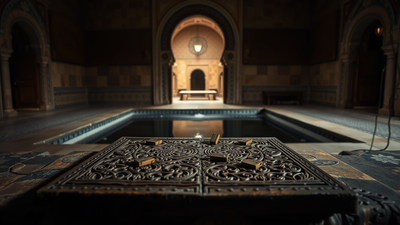
Carved into the top step of a cold plunge pool inside a medieval bathhouse in Morocco, a small pattern of holes has been sitting unnoticed in published archaeological records for years.
Now, researchers have formally identified it as a game board and not just any game board. According to a study published in Libyan Studies by Tim Penn of the University of Reading alongside co-authors Corisande Fenwick and Hassan Limane, this carved stone surface is the earliest known evidence of the strategy game tāb/sīg in North Africa, pushing the documented history of a game still played across the region today back by several centuries, and offering a rare, securely dated window into everyday social life in the early Islamic world.
Where the game board was found and why Walīla makes it datable
The site is Walīla, the medieval Islamic settlement built over and around the ruins of Roman Volubilis in northern Morocco. The bathhouse a hammam, was constructed sometime in the late eighth or early ninth century under the Idrisid dynasty, the earliest Islamic ruling family in North Africa, and was abandoned by the tenth or eleventh century. That relatively narrow window of occupation is what makes this particular game board so significant from an archaeological standpoint.
Most carved game boards found at ancient sites are nearly impossible to date with confidence. They tend to appear on loose stones, reused building materials, or floor surfaces that were in continuous use across multiple centuries. The Walīla board has none of those problems. It was carved into a fixed architectural element of a building whose construction and abandonment can be tied down through coins, medieval pottery, and radiocarbon dating of extension layers all pointing to the eighth through eleventh centuries.
That makes it one of the few securely dated early Islamic game boards anywhere in North Africa.
What the board looks like and why researchers ruled out mancala
The board itself is modest in size, approximately 34 centimetres long by 9.5 centimetres wide. Its main pattern consists of three rows of at least thirteen small, shallow holes, with a fourth more irregular row set a few inches back that may have functioned as a scoring track or represents the start of an unfinished secondary board for a different game altogether.The holes are small and shallow, likely made with a chisel and mallet. The carving is uneven enough that it does not appear to be the work of a professional stonemason, but deliberate enough requiring tools and effort, in a prominent location that the Libyan Studies paper argues it was almost certainly made with the permission of whoever controlled the hammam. This was not hidden graffiti scratched in a corner. It was a visible, socially accepted addition to a public building.At first glance, a grid of holes might suggest mancala a family of games played by moving pieces through pits carved into a surface. But the Walīla board does not fit the typical mancala template. Mancala holes need to be large enough to hold multiple counters at once, and the game usually requires an even number of holes per row to function. The Walīla holes are too small and shallow for standard mancala play, and each row has an odd number.
Penn and colleagues do not rule mancala out entirely, but the physical evidence points more convincingly elsewhere.
Why the board most likely represents the game Tāb/Sīg
The game the team identified as the most probable match is tāb, known in the Maghreb and Saharan regions as sīg a two-player running-fight strategy game in which each player moves pieces across the board from opposite ends, attempting to capture the opponent's pieces. It is still played today across parts of North Africa and the Middle East, and its basic mechanics are well documented in both historical texts and living tradition.Similar boards from the early Islamic period have been found in Arabia, Jordan, Syria, and elsewhere in the Near East. Finding one in Morocco at this date suggests the game arrived in the western Islamic world considerably earlier than the existing evidence had indicated, most likely carried by people travelling along the trade and political networks that connected the Idrisid court to the broader Islamic east. Researchers note that the Walīla hammam itself already shows strong architectural ties to the Levant rather than to local North African or Roman bathing traditions its dry-heat channel system and raised washing basins are far more consistent with eastern Mediterranean bath design than with the immersion-pool tradition of the Roman baths that preceded it at the same site.
What the hammam's social role reveals about gaming in early Islamic society
The location of the board within the bathhouse is as telling as the board itself. It sat at the very centre of the top step into the cold plunge pool visible from the changing room, positioned so that two players could sit facing each other on either side of the step while other bathers continued to enter and exit the water around them. This was not a private game tucked away out of sight. It was played in full view of other visitors as a normal, openly accepted part of the hammam experience.That matters because, as the Libyan Studies paper points out, board games appear frequently in early medieval Arabic literature in poetry, in storytelling, in accounts of daily social life but the archaeological evidence for gaming in early Islamic contexts has received far less scholarly attention than the textual record. Game boards are routinely left out of excavation reports, either because they go unrecognised or because they are considered marginal finds.
Bone dice recovered from buildings elsewhere at Walīla confirm that a range of games, including games of chance, were also part of life at the site during this period.Penn and his co-authors argue that this systematic neglect means the archaeology of Islamic gaming is almost certainly more extensive than current records suggest, and they call on researchers working across North Africa and the broader Mediterranean to document carved game boards more carefully in future excavations. A pattern of holes cut into a stone step over twelve hundred years ago has survived to tell a small but specific story about how people unwound, competed, and socialised in one of the earliest Islamic settlements in the western world.







 English (US) ·