

 1 hour ago
6
1 hour ago
6
ARTICLE AD BOX
5 min readJul 9, 2026 08:37 PM IST
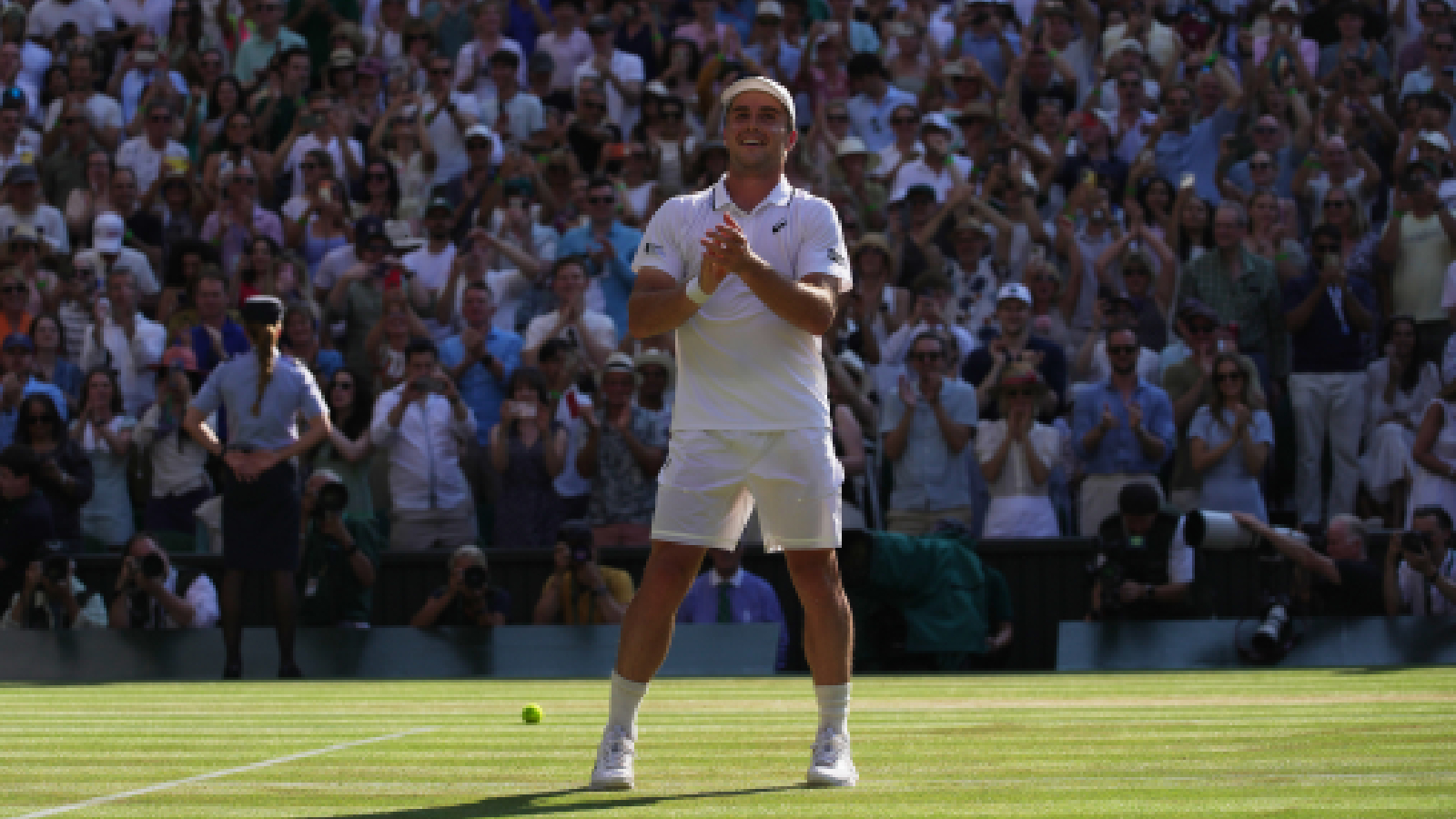 Arthur Fery of Britain reacts to winning against Flavio Cobolli of Italy in their quarter-final men's singles match at the Wimbledon Tennis Championships in London, Wednesday, July 8, 2026. (AP Photo/Brian Inganga)
Arthur Fery was seven years old when he sat on Court 18 and watched John Isner and Nicolas Mahut play the longest match in tennis history, eleven hours spread across three days. He didn’t know yet he’d spend his own career on that same court, in shorter but no less stubborn instalments, one of them four hours and thirty-nine minutes long, ending with him still standing.
That one came in the third round, against Zizou Bergs: down two sets to one, a double break gone in the fourth, 1-4 again in the decider. Fery won it 2-6, 7-5, 2-6, 7-6(3), 7-6(10-5), breaking into the world’s top 100 in the process. “It’s a really special moment,” he said afterward. “Doing it here is incredibly special for me. It’s my home tournament. It’s where I grew up.”
That last part is not a figure of speech. Fery picked up a racket at five, at Westside Tennis Club fifty metres from his childhood home, then attended King’s College school, a serve and volley from Henman Hill. Born in the Parisian suburb of Sèvres, he played for France at under-12 level before the family settled in London; his mother Olivia competed at Roland Garros in 1991 and remains a long-time All England Club member, his father Loïc a multimillionaire investor and former owner of Ligue 1 club Lorient. None of it made him a guaranteed pro. He shelved tennis for two years as a teenager to focus on school, split his training between an English coach and a French one at Roehampton, and only in 2020 emailed Stanford’s Paul Goldstein to ask about a scholarship.
Goldstein remembers the transition landing softer than anyone expected. “He got to campus at 18 years old, really unfazed by the transition of coming from the UK, nine thousand miles away, to a college campus for the first time. He just managed it seamlessly.” Three years and two All-American selections later, Fery turned pro early, on the strength of results good enough that Taylor Fritz, then sixth in the world, spent a week training alongside him in 2024 and came away rattled.
“He was beating me, like, every day,” Fritz said. “I was like, yeah, this guy’s really good. This guy can play. He had a good forehand for his size.”
It has, evidently. Fery beat Otto Virtanen on Court 18 in round two and asked to stay there for Bergs, “because it’s awesome.” He beat Grigor Dimitrov in five sets on Centre Court, closing out a fifth-set breaker played to ten. And in the quarter-finals he ran into Flavio Cobolli, ranked ninth in the world, two months older, and beat him 6-4, 7-6(4), 6-0 in two hours and fourteen minutes, a scoreline that barely resembled the five matches before it. Alison Taylor, his childhood coach, watched it from the Royal Box. “Knowing Arthur,” she said, “he’s just fearless.”
Goldstein put it differently to ESPN: “For those who have seen Arthur play tennis for the first time, seeing what an extraordinary player he is, I’m here to tell you, he’s a more extraordinary human being than he is a tennis player.”
Story continues below this ad
None of it is built on obvious weapons: no big serve, no forehand that ends points early. What he has, by a Guardian analysis, is a knack for the moments that matter most, winning roughly 75 per cent of points at 30-30 or deuce, and 10 per cent more of the tour’s decisive points on return than the Wimbledon field averages. A game built for exactly the situations his tournament keeps forcing him into: a set down, a break down, the match trying to end early.
Waiting now is Alexander Zverev, the reigning French Open champion chasing a Channel Slam nobody but Carlos Alcaraz has managed since 2024, his serve alone landing 78 aces this fortnight to Fery’s 31. Asked how he’ll spend the two days before facing him, Fery had no plan. “I don’t know,” he said. “I’ve never been in this position before. We’ll figure out as we go.”
Win, and the final falls on his 24th birthday. He mentioned as much to the Queen. “I told her it was my birthday on Sunday,” he said. “It’d be great to play the Wimbledon final on my birthday.” The kid from Court 18 isn’t asking for eleven hours this time. Just one more afternoon where nobody else is left standing.





 English (US) ·