

 1 week ago
5
1 week ago
5
ARTICLE AD BOX
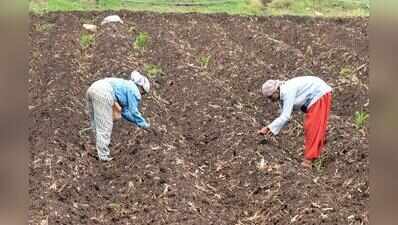
Farm labors sowing groundnut seeds after rain on a field at a village in Karad on Wednesday
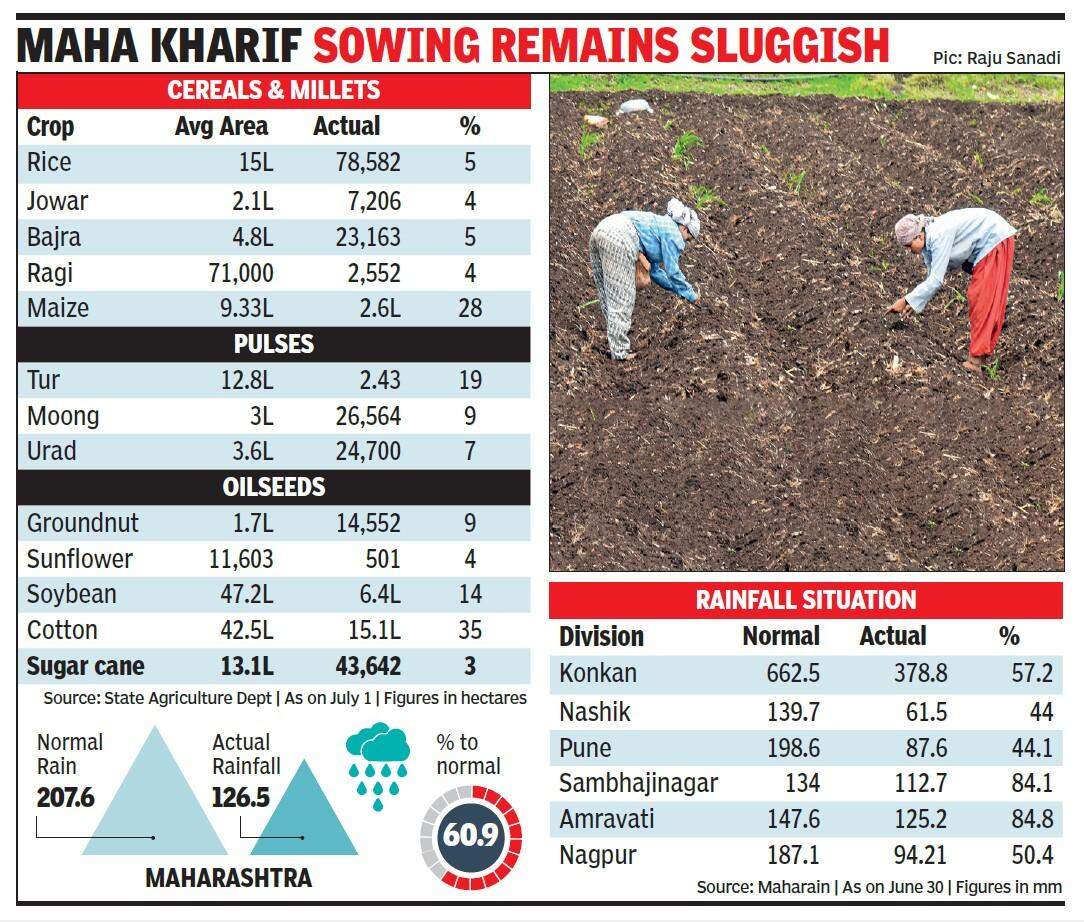
Kolhapur: As scattered showers finally begin to lash Maharashtra, the long-awaited kharif season has stirred into motion — though not without anxiety and uneven progress.As of July 1, sowing data shows a mixed trend. Planting has accelerated sharply, reaching about 20% of the average kharif cultivation area (excluding sugarcane), up nearly 10% points in just three days.
It, however, remains far below last year’s 62% coverage at this point.“Among the major crops, cotton leads with 35% sowing completed, followed by maize (28%), tur (19%) and soybean (14%). Of Maharashtra’s average kharif area of 1.57 crore hectares, sowing has so far been done on 27.8 lakh hectares. This includes a sluggish start to sugar cane plantation at 43,642 hectares against a typical of 13.11 lakh hectares,” an agriculture official said, citing the data.Soybean and cotton together dominate the fields, accounting for an average 57% of all kharif sowing. But this year, state govt has urged farmers to opt for short-duration crops that mature in about 90 days, instead of traditional varieties that take 120 days or more.
Kharif
The reason behind the state’s appeal is simple. Fields need to be cleared in time for the rabi season. “Farmers are gradually moving towards short-duration crops.
Crops like tur (pigeon pea) take four to five months, so their cultivation may drop. Maize and soybean are becoming more attractive,” Haridas Hawale, agriculture development officer from Solapur, said.Across the state, the monsoon’s uneven rhythm is clearly visible. Of 34 districts, 13 have received less than 100mm rainfall by June-end — far below the required level for ensuring adequate soil moisture within a short 3-5 day window.
“The worst-hit is the Nashik division, where all five districts (Nashik, Dhule, Nandurbar, Jalgaon and Ahilyanagar) are yet to receive sufficient rainfall. Pune division (Pune, Solapur, Satara) and parts of Nagpur division (Bhandara, Gondia, Gadchiroli) follow closely, each with three districts still parched.
Even Chhatrapati Sambhajinagar division has two districts struggling with inadequate rain,” another official said.For farmers in the ghat regions, the India Meteorological Department’s agrometeorology unit has issued a cautious call, saying complete rice nursery sowing where possible, but do not rush into large-scale operations without reliable rainfall.On the ground, however, uncertainty hangs heavy. Dharmaraj Patil, a farmer near Dharashiv-Latur border, has taken a calculated risk. “I have begun soybean sowing after a few good showers in the last three to four days.
But just a few kilometres away, there’s no rain at all. Sowing is already delayed by 15 days. Still, I am hoping the monsoon regains strength later,” he said.Meanwhile, sugar cane — one of the most water-intensive crops — remains the slowest to take root. Just 3% of the average planting area has been covered so far. With its long growing period of 16-18 months, farmers are treading cautiously, holding back till they are certain water availability will sustain the crop.








 English (US) ·