

 1 hour ago
5
1 hour ago
5
ARTICLE AD BOX

Khushi Kumar's debut collection, KALANTA – The House Awakens, marked a significant transition for her fashion house at London Fashion Week. Kumar reframed Indian craftsmanship, integrating Banaras zari into architectural, protective structures, signaling a move from quiet building to visible presence. This collection represents a confident, defined voice on the international stage.
At London Fashion Week, where spectacle often dominates the schedule, designer Khushi Kumar chose a different kind of statement. Her debut collection, KALANTA – The House Awakens, felt deeply personal - less about announcing arrival loudly and more about revealing a fashion house finally ready to stand in full form.And for Kumar, the word awakening is not poetic branding. It comes directly from her journey.“The word ‘awakening’ comes from the journey of the house itself,” she explains. “Our scarves were titled Whisper of the House - they were a soft introduction. Ready-to-wear is where the house truly awakens. It’s where form, structure, and identity fully take shape.”

That transition was visible on the runway. What began as an idea has now become a defined design language.“On a personal level, this collection marks my transition from building quietly to standing visibly,” she says. “It reflects my world creatively and culturally, taking its full form.”
Reframing Indian craftsmanship
One of the most striking aspects of KALANTA was how Indian textiles appeared - familiar, yet entirely reimagined.Instead of presenting heritage through expected silhouettes, Kumar placed Banaras zari inside sculpted corsetry and armour-inspired structures.
The result felt architectural rather than ornamental.Interestingly, she doesn’t describe the process as fusion.“Rather than blending, I focused on reframing,” she explains. “Banaras zari traditionally exists in fluid ceremonial contexts. I wanted to challenge that by placing it within sculpted silhouettes typically associated with Western tailoring and protection.”The metallic nature of zari naturally carries strength, and Kumar leaned into that idea.“We treated the craft as structural material,” she says. “Through boning and internal architecture, the craftsmanship becomes protective rather than purely decorative.”The garments didn’t look nostalgic. They looked forward-facing - Indian craft expressed through contemporary global form.
A London Fashion Week homecoming
Showing at Fashion Scout’s Ones to Watch platform marked Kumar’s international runway debut, but the moment carried deeper meaning.“London shaped my fashion language,” she shares. “I trained and worked here. It’s where I learned to think beyond geography. Returning now as a founder presenting my own house feels full circle.”There was a noticeable confidence in the presentation. No tentative experimentation. The collection felt assured of what it wanted to say.“At this stage, it signals clarity and conviction,” Kumar says. “It marks the moment where Khushi Kumar moves from emerging concept to defined voice on an international platform.”
Protection, air and identity - the emotional core
Beyond aesthetics, KALANTA explored themes of protection, air, and identity - ideas translated directly into construction and movement.“Protection is expressed through sculpted silhouettes, corsetry, harnessing, and armour-like structures,” she explains. “They frame the body with intention.”Yet despite strong structures, the garments never felt heavy.
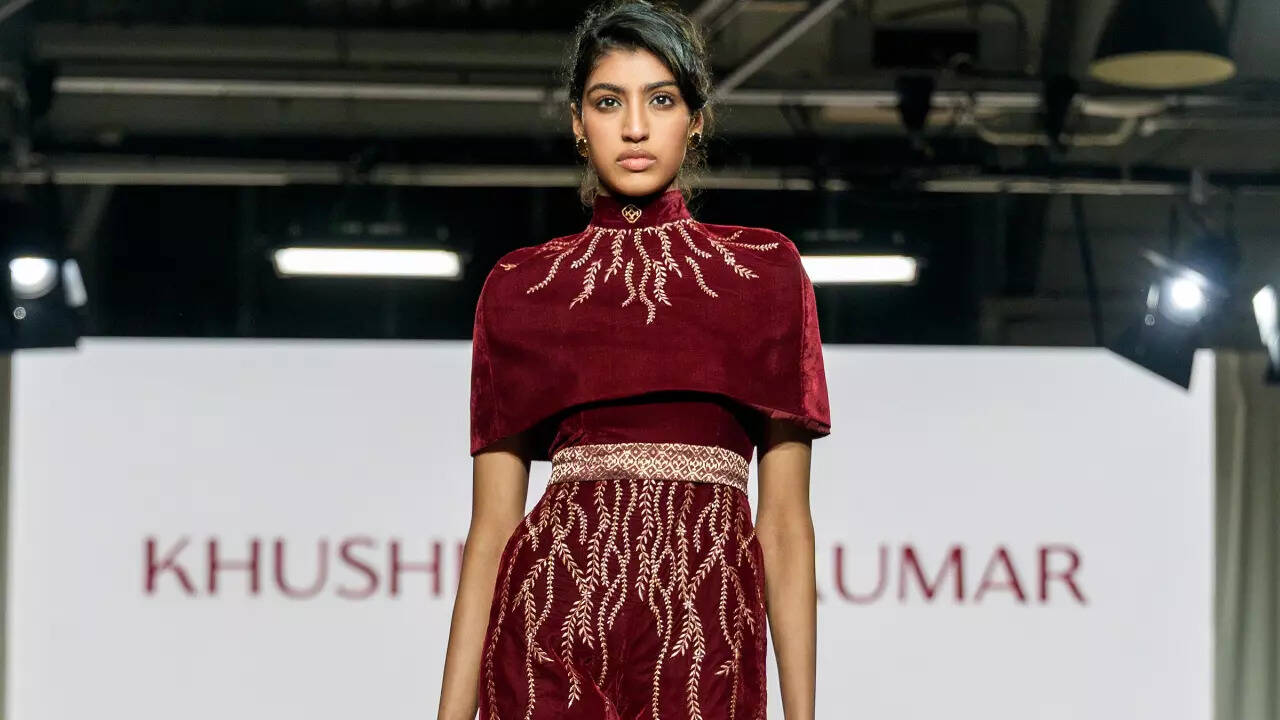
“Air comes through negative space, controlled cut-outs, sheer layering, and engineered lightness,” Kumar adds.
“Even within strong structures, there is breathability and movement.”That balance became central to the collection’s emotional message.“Identity lives in the balance,” she says. “The garments hold the body, but they never restrict it. Protection, in this house, is empowerment.”
A wider shift in Indian fashion
Kumar’s debut arrives at a time when Indian fashion is undergoing a visible transformation globally.For years, international audiences associated Indian design primarily with craftsmanship and embellishment.
Now, designers are pushing conversations toward concept, construction, and intellectual storytelling.“Contemporary Indian fashion is evolving from being perceived primarily through craft to being recognised through concept and structure,” Kumar says. “There’s a shift toward modernity while still honouring heritage.”Her label positions itself within that evolution.“The house treats Indian craftsmanship not as embellishment, but as foundation,” she explains.
“The awakening isn’t just personal - it reflects a wider generational confidence within Indian design.”
When the house rises
Fashion debuts often chase spectacle. Bigger sets. Louder statements. Viral moments engineered for instant attention.KALANTA - The House Awakens moved differently.It felt thoughtful. Intentional. Grounded in design rather than noise.Watching the collection unfold, it became clear that this wasn’t simply a young designer’s first international show. It was the moment a fashion house stepped forward fully formed - aware of its heritage, confident in its structure, and ready to exist globally without explanation.The whisper phase is over.As Kumar puts it, this is the moment “the house rises from whisper to presence.”








 English (US) ·