

 1 hour ago
6
1 hour ago
6
ARTICLE AD BOX
In a dramatic political shift, Raghav Chadha and a group of AAP leaders announced their move towards the BJP, citing ideological drift within the party. The claim that seven of AAP's 10 Rajya Sabha MPs are backing the switch has raised the stakes, as it crosses the threshold needed to avoid anti-defection action.
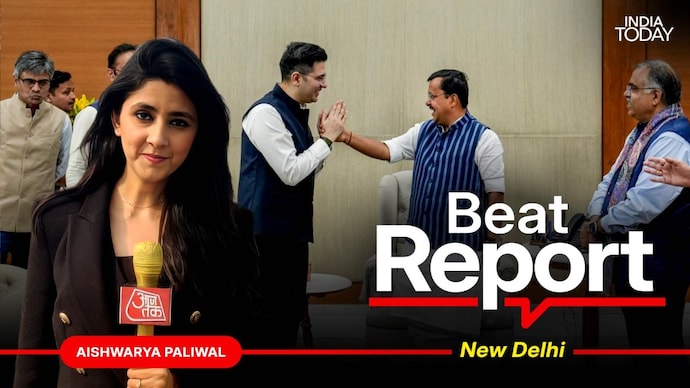
AAP rupture deepens as 7 Rajya Sabha MPs back shift to BJP ahead of Punjab polls
New Delhi,UPDATED: Apr 25, 2026 08:48 IST
The Aam Aadmi Party (AAP), born out of anti-corruption fervour and public trust, now finds itself facing one of its most dramatic internal ruptures. At the centre stands Raghav Chadha, once a rising face of reform politics, now leading a group stepping into the fold of the Bharatiya Janata Party (BJP).
This is not just a political switch. It feels like a larger statement that ideals can bend when the pull of power grows strong enough.
For months, there had been indications that the BJP was preparing for significant political inductions in Punjab, waiting for the right moment to act.
A PRESS CONFERENCE THAT FELT PRE-SCRIPTED
I was at the venue before the leaders arrived. The stage was set, microphones in place, cameras ready. But the real headlines arrived before the speeches began.
Raghav Chadha, Sandeep Pathak and Ashok Mittal walked in together, composed and relaxed. When Chadha and Pathak began speaking, the tone was sharp and measured. Allegations of corruption were laid out, along with claims of ideological drift within the party.
Then came the line that defined the moment: “We came to clean the system, but the system changed us.”
Chadha said, “We did not enter politics for positions or careers. We already had those. We entered politics to change the system. But somewhere along the way, the system we wanted to fix began to overpower the values we stood for.”
Pathak added, “This decision has not been easy. But when the space for honest politics starts shrinking within your own house, you have to find a platform where your voice still matters.”
With that, the emotional break became official.
For those of us present, the bigger shock followed moments later. Chadha claimed that out of the 10 AAP MPs in the Rajya Sabha, seven were backing the move. He went on to name them.
Harbhajan Singh, Swati Maliwal, Rajinder Gupta and Vikram Sahney, apart from the three leaders on the dais, were cited as part of the shift. If this holds, it means two-thirds of AAP’s Rajya Sabha MPs have crossed over, a crucial threshold that protects them from disqualification under the anti-defection law.
THE NUMBERS GAME AND LEGAL ROUTE
A formal letter has reportedly been sent to the Vice President, seeking recognition of the merger of parliamentary groups. Once notified in the Gazette of India, the transition will become official.
In politics, numbers are not just arithmetic. They translate directly into authority.
According to experts on parliamentary procedure, the Vice President, in his role as Chairman of the Rajya Sabha, will examine the request before the Rajya Sabha Secretariat issues a formal notification. Only after this notification will the MPs be formally recognised under the new alignment.
Sources within the BJP indicated that while three MPs have already met the party’s national leadership, the remaining members are expected to follow in the coming days.
A BJP source told India Today that the move is aligned with the upcoming Punjab Assembly elections and is also aimed at strengthening the NDA’s position in the Rajya Sabha. With the addition of seven MPs, the NDA’s tally is expected to rise from 141 to 148, bringing it closer to the two-thirds mark in the Upper House.
PUNJAB IN THE BACKGROUND, STRATEGY IN THE FOREGROUND
This political shift is not unfolding in isolation. With Punjab elections approaching, the BJP’s intent appears clear. The focus is not just on contesting but on expanding its footprint in the state.
What stood out to many observers was the timing. Barely 24 hours after the first phase of the West Bengal elections concluded, attention shifted sharply to developments in the national capital and towards Punjab.
The irony is hard to miss. Leaders who once played a role in AAP’s 2022 Punjab victory are now strengthening its principal rival.
Sources suggest that these developments have been in the works for months. The BJP is now looking to consolidate support across key voter segments in Punjab, with more inductions expected ahead of the elections, including from social and religious circles.
A DEFINING MOMENT FOR LEADERSHIP
This also marks a significant moment for the BJP’s organisational leadership. It is being seen as the first major political induction under party president Nitin Naveen.
These are not symbolic entries, but a high-impact realignment meant to signal a more assertive political phase.
As the leaders entered the BJP headquarters, flanked by senior party figures, it reinforced a familiar reality of Indian politics. Loyalties are rarely permanent and interests evolve with time.
Later in the evening, I saw the BJP president arrive at the headquarters, projecting confidence amid the developments. Coming on the heels of the party’s return to power in Delhi after 27 years, and with fresh gains among Punjab-based MPs, the momentum appears to be building.
As cameras flashed and visuals of the BJP welcoming its new entrants circulated, one thing became clear. In the contest for political relevance, narratives can shift overnight.
- Ends
Published By:
Priyanka Kumari
Published On:
Apr 25, 2026 08:48 IST
Tune In






 English (US) ·