

 40 minutes ago
4
40 minutes ago
4
ARTICLE AD BOX
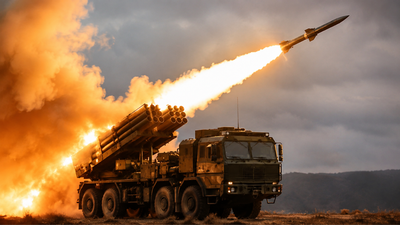
Pinaka is India's indigenous multi-barrel rocket launcher (Generative image)
When Pinaka fires, its bone-rattling roar feels like the wrath of Lord Shiva. The thunderous launch tears through the air, leaving those watching with a bated breath — until the distant impact confirms its devastating reach.Named after Lord Shiva's mythological bow, Pinaka is India's indigenous multi-barrel rocket launcher, embodying the destructive force and precision associated with the divine weapon. Over the years, the system has evolved from an area-saturation rocket launcher into a progressively more accurate and longer-range strike platform, reflecting India's growing emphasis on indigenous precision firepower.That evolution now appears to have reached a defining milestone with the successful flight-test of the Long-Range Guided Rocket (LRGR), which pushes Pinaka into a new category altogether. What was once viewed largely as a saturation-fire system is steadily transforming into a precision deep-strike weapon, capable of reaching farther, striking with greater accuracy and giving the army more options across the battlefield. The latest test, therefore, marks not just a technological achievement, but a significant step in strengthening India's conventional deterrence posture.
From 60km to 120km
The Defence Research and Development Organisation, or DRDO tested the Pinaka Long Range Guided Rocket (LRGR) from the Integrated Test Range in Chandipur, Odisha, and described the trial as successful, with the rocket hitting the target with textbook precision.
The rocket was tested for a minimum range of 60 km, and the upgraded version is expected to have a potential reach of up to 120 km. Crucially, it was launched from an in-service Pinaka launcher, showing that India does not need an entirely new platform to field a more capable weapon.
What makes Pinaka strategically important
In modern warfare, range is not just a number on a brochure as it decides whether an army can hit a bridge, a logistics hub, an artillery concentration or a command post while still staying outside the enemy’s easy counter-fire envelope.
Pinaka’s new guided form therefore changes the conversation from how much area it can cover to what kind of operational effect it can create.
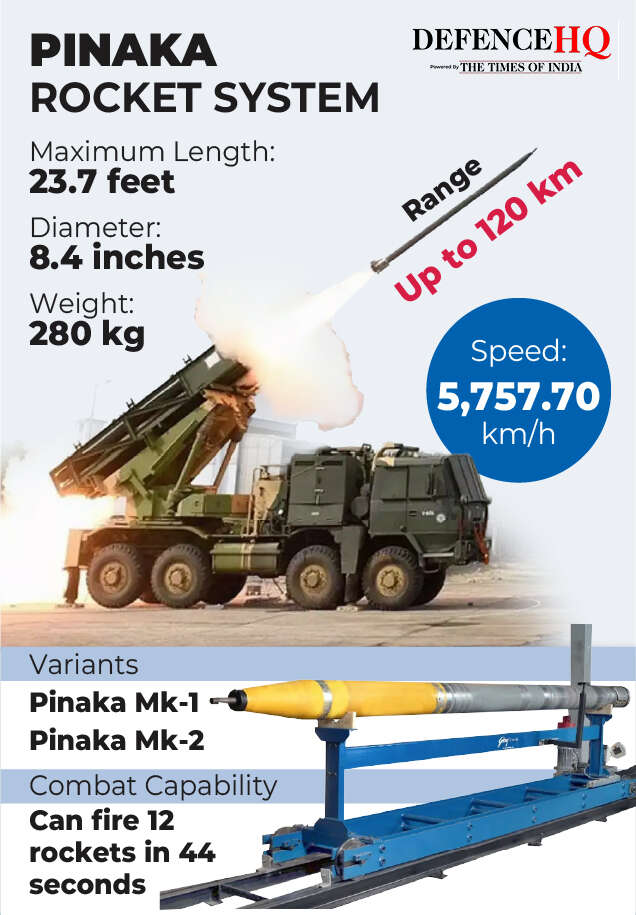
Pinaka rocket system
Defence expert Lt Gen PR Shankar argues that long-range guided artillery is not merely a support weapon, but a battlefield controller, a means of shaping the fight at depth and denying the enemy freedom of movement. Given the latest test, Pinaka system is no longer limited to shorter-range battlefield saturation, but edging into the space where precision and reach combine to create real operational leverage.
Pianka and the two front
The rocket system gets crucial because the Indian has for years been preparing plans for two very different fronts. Against China, the terrain is difficult, the infrastructure is patchy and air power cannot always be relied upon because weather and altitude can limit operations. In such conditions, a mobile precision rocket system that can engage targets from standoff range becomes a critical tool. It allows commanders to strike into depth without depending entirely on aircraft or on heavier missile systems that are costlier and more politically visible.
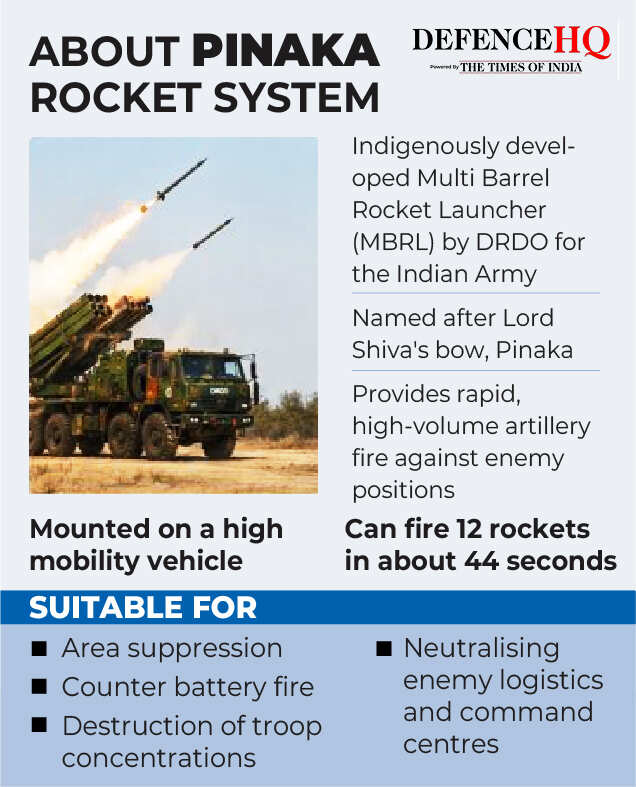
About Pinaka rocket system
Against Pakistan, the value lies in, according to Lt Gen SP Shankar, “deterrence by punishment”. A precise guided rocket can give India a conventional way to impose costs on military targets in depth while keeping escalation under better control than an air campaign might allow. The expert argues that the artillery engagements can offer better control over escalation dynamics. A rocket launcher, especially one that is mobile and can fire quickly, is a serious conventional option in a region where signalling matters as much as firepower.
The stretching horizon
The Pinaka system also fits into a larger international trend as the United States has made long-range precision fires one of its major modernisation priorities, reflecting a worldwide shift towards standoff combat and non-contact warfare. This matters because it shows that India is not alone in pursuing this capability that increasingly rewards systems that can deliver accurate fire from farther away, faster and with greater survivability.
Pinaka’s evolution suggests that India is trying to keep pace with that shift using an indigenous platform rather than relying entirely on imports.
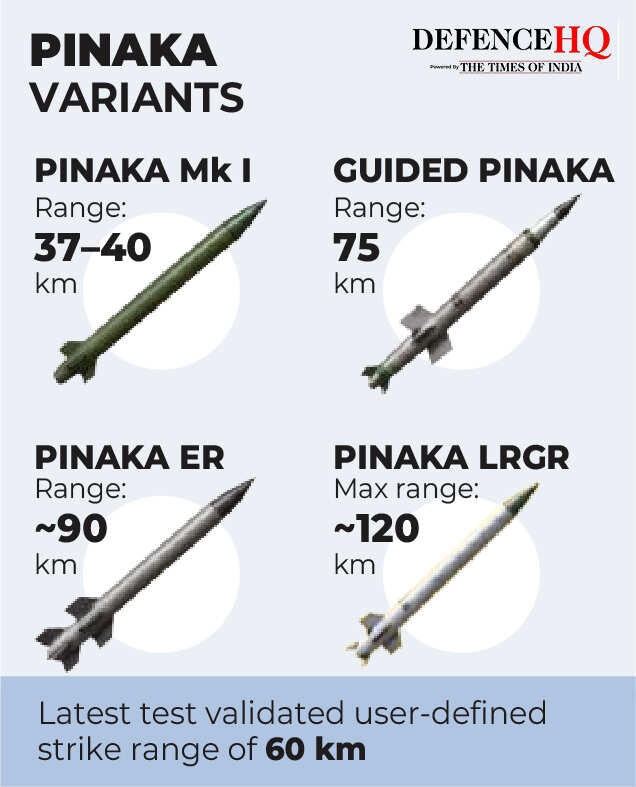
Pinaka varients
Not just a military machine
Pinaka is not just a military machine but a story of Indian industrial capability because the rocket has been designed and developed through a collaboration involving DRDO laboratories, while the launcher system has already been inducted into service and is being supported through industrial upgrades. The recent order given to Larsen & Toubro for overhaul, upgrade and obsolescence management shows that Pinaka is no longer only about development trials. It is now entering the phase where sustainment, modernisation and production scale matter just as much as the original design.That transition is important because a weapon system only becomes truly meaningful when it can be maintained, upgraded and produced in numbers.
A successful test is a milestone, but a fielded capability is what changes military planning.
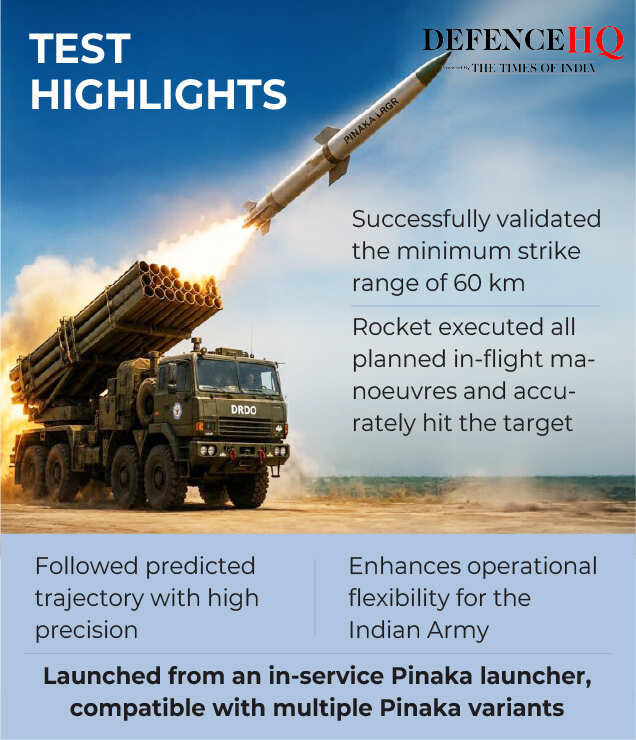
Test highlights
The army currently operates around six Pinaka regiments, with expansion plans that point towards larger numbers over time. In principle, every additional regiment increases the army’s ability to carry out deep fires, counter-battery actions and interdiction missions. In practice, however, the real test will be whether production can keep up with doctrine.Meanwhile, Lt Gen Shankar argues that the programmes often move in series rather than in parallel, with trials, production and future improvements happening one after another instead of together. The process could slow the fielding of capabilities at precisely the moment when the army might need them most. The latest Pinaka development suggests that this caution still applies.
System-of-systems
The challenge is not only technical but also doctrinal because the precision rocket system becomes truly useful only when the army can find the target, track it, prioritise it and assess the result.
That means better intelligence, surveillance and reconnaissance, stronger command and control and faster battlefield networking. A rocket with 120 km reach is impressive, but without real-time targeting and reliable communications, much of that reach can be wasted.
In that sense, Pinaka is not just a weapons story but a system-of-systems story.That is also why the latest test has export significance given India has already become an arms supplier in this category, with Armenia as an early customer for Pinaka systems and ammunition.
Even France is evaluating India's indigenously Pinaka for potential procurement to replace its old artillery systems.
DRDO Successfully Tests Pinaka Long-Range Guided Rocket; Hits Target With Pinpoint Accuracy
Export interest matters because it confirms that the system has value beyond domestic publicity. A weapon that is useful to Indian forces and attractive to foreign buyers strengthens both deterrence and diplomacy. It suggests that India can move from being primarily a buyer of advanced systems to being a supplier of credible battlefield technology.Though a guided rocket cannot replace air power, missiles or tube artillery, it can impressively fill an important gap between them. It gives the commander a tool that is cheaper than many missile strikes, more agile than fixed fire systems and more flexible than aircraft in certain weather or political conditions, which is a real strategic dividend.Indigenous systems also reduce dependence on foreign suppliers, improve availability in wartime and allow India to customize capability to its own terrain and threat environment.
A launcher built for Indian conditions, tested in India and now being upgraded through Indian industry is far more valuable than a system that exists only on paper or remains tied to external supply chains.Therefore, the latest flight-test also reinforces a larger military lesson in modern warfare, which is increasingly about striking first, striking farther and striking accurately enough to matter. Mass fire still has a role, but it is precision that often decides whether a strike is merely destructive or strategically useful. Pinaka’s evolution shows that India grasped this shift and is trying to adapt its artillery accordingly.For a country facing two active land frontiers and an increasingly contested regional environment, that is not just a technical success, but a significant enhancement of India's conventional deterrence.








 English (US) ·