

 2 days ago
6
2 days ago
6
ARTICLE AD BOX
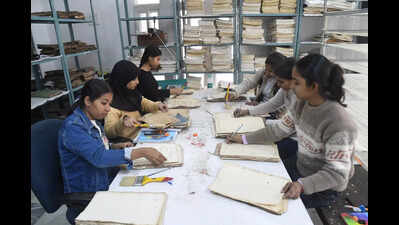
Bihar State Archives stands as a guardian of history, housing everything from ancient Mughal decrees to today's electoral rolls. This treasure trove of primary documents, carefully preserved and continuously digitised, is essential for historians and govt officials alike. It provides concrete evidence of our past, illuminating both historical narratives and current dilemmas
Patna: Archives are civilisation’s witnesses — the state’s memory bank, the citizen’s evidence locker, the paper trail that outlasts govts and fashions. Libraries curate what has been published; archives preserve what was never meant for the bookshop — treaties, orders, minutes, petitions, private letters — original records that show not merely what was said about the past, but what the past actually did.In Bihar, that responsibility sits with the Bihar State Archives (BSA), an institution whose 20th-century expansion tracked the swelling output of permanent govt records. Dr Bharti Sharma, an archivist at the BSA, calls these holdings “primary sources”, indispensable to scholars from India and abroad and routinely consulted by officials seeking earlier orders and precedents. In an age that treats information as infinitely reproducible, the archive remains stubbornly material — the place where the state’s authority is written down, filed, and, if properly cared for, retrievable.The departmental collection, dating from 1772 to 1960, is stored at the rear of the building and runs to more than 10 lakh documents. The record rooms are deliberately dim; sunlight is no benign visitor but a slow predator of ink and paper. Across nine repositories, shelves rise in dense ranks, stacked with departmental files — industry, education, veterinary services, Board of Revenue records, gram panchayat papers — each bundle a small unit of governance.
Alongside them sit the state cabinet proceedings from 1950 to 2024, the Calcutta Gazette from 1832, the Bihar and Orissa Gazette, the India Gazette, and electoral rolls from 1975.Dr Rashmi Kiran, another archivist, recalls how the 2019-20 announcement of the NRC sent migrants back to the archive in search of proof. Electoral rolls, in that moment, were not history but livelihood. The BSA’s value is not abstract. Dr Kiran says that major scholarship, including K K Datta’s ‘History of the Freedom Movement in Bihar’, drew heavily on materials preserved here.
Researchers find a breadth that unsettles neat narratives: Political Special files, Bihar and Orissa Police Abstract of Intelligence, the ‘Report on Vernacular Newspapers of Bihar and Orissa’, British commissioner-level correspondence, Mughal-era ‘farman’, and, in a different register, a handwritten plea from an ordinary citizen asking that Bankipur Lawn be renamed Gandhi Maidan.
The archive’s democratic force lies in that juxtaposition: empire and municipality, policy and petition, the powerful and the pleading, all bound by the same administrative habit of keeping paper.For scholars, the encounter can be bracing. Nidhi Singh, a research scholar at B R Ambedkar University, Muzaffarpur, working on Bettiah Raj (1629-1897), describes the difference between reading a history book and handling records as the difference between a finished story and its working notes. Regional histories, she argues, are often where the gaps are widest; the archive is where those gaps can be narrowed, complicated, or exposed.
For students, too, the place functions as a kind of civic laboratory.Raghuvendra Kumar, an undergraduate intern from A N College, calls it “a practical lab”: theory becomes tangible when the very documents one has read about are there to be opened, weighed, and understood. The BSA is also trying to meet citizens where they now live – online. Digitisation began in 2013, and, according to Dr Kiran, 1.50 crore folios have already been completed.
Priority goes to the oldest and most fragile items, and to records in high demand, such as cabinet proceedings.
The ambition is straightforward — digitise what is held across offices, extend the life of the originals and make access less dependent on physical presence and bureaucratic familiarity. Yet the digital future does not abolish the need for conservation. It sharpens it. Outside, the world accelerates towards screens.
Inside, a conservation wing works to ensure that Bihar’s paper past — stretching back to 1772 — does not simply powder away.The rooms are ventilated and functional — basins for chemical treatments, shelves for drying sheets wrapped in tissue, a steady rhythm of handling and repair. The process begins with pagination. Sarpanch Ram, the conservation in-charge, watches interns brush dust from pages before ink-solubility and pH tests, insisting on the obvious truth that is too often ignored: if a page is lost, history is lost.Fragile documents are laminated with Japanese tissue, then given reversible binding so that files can be reopened and treated again if decay returns. Dr Sharma is blunt about the adversaries: temperature, humidity, insects. Records arrive after 25 years from various departments, are categorised, conserved if necessary, and then — crucially — must be checked again over the long haul. Even conserved files are not “done”; they are merely stabilised, pending the next cycle of vigilance.
The archive is less a vault than a living system, requiring routine attention rather than occasional ceremony. Alongside the files sits a library of more than 25,000 books.Ramkumar Singh, former librarian and archivist, says the holdings include history books for educational use, census reports, and donated collections from historians such as Ram Sharan Sharma, Vijay Kumar Thakur, and Raja Radhika Raman Prasad Singh. The catalogue is computerised, though the library itself is not yet digitised.








 English (US) ·