

 1 hour ago
3
1 hour ago
3
ARTICLE AD BOX

Indian cardiologists are witnessing a concerning trend: young adults exhibiting arterial stiffness typically seen in much older individuals. This 'early vascular ageing,' driven by modern lifestyles, stress, and poor health habits, silently damages blood vessels. Experts emphasize that biological age, not just chronological age, dictates heart health, urging proactive lifestyle changes for prevention.
Biological age and chronological age are no longer the same conversation. A birth certificate may say 35. The arteries may tell a different story. Cardiologists across India report a steady rise in young adults with stiff, ageing blood vessels.
They look fit. They work long hours. They feel fine. Yet their scans resemble those of someone 15 or 20 years older. This silent gap is what doctors call early vascular ageing. And it is changing how heart health is understood.
Chronological age vs biological age
We spoke to Dr Vivek Kumar, Director – Interventional Cardiology & Head of Structural Heart Program, Max Super Speciality Hospital, Vaishali, who explained it clearly, “When doctors discuss age, they are now focusing on two very distinct ideas.
Chronological age is just the number of years someone has been alive. Biological age shows how well or how badly the body's organs are working. This gap shows why some people in their 35s might have blood vessels that look more like those of someone in their 50s, especially when it comes to how healthy their arteries are.
”Chronological age moves forward every year. Biological age moves according to lifestyle, stress, and disease burden.
Healthy arteries are flexible. They stretch with each heartbeat and allow smooth blood flow. Ageing arteries become stiff and thick. Microscopic damage builds up inside their lining. Blood flow becomes less efficient. Risk begins to rise quietly.
What is early vascular ageing?
Early vascular ageing does not announce itself. There is no warning siren.Dr Vivek Kumar notes, “From a medical point of view, arteries are some of the first body parts to show signs of faster ageing.
Healthy arteries are able to stretch and adjust, which helps blood move through them easily. Over time, especially when exposed to harmful lifestyle factors, they become stiff and thick and start to have tiny damages at the microscopic level. This process, called early vascular ageing, can start quietly during young adulthood.
”The phrase sounds technical, but the idea is simple. The arteries lose their youth before the person does.The Indian Council of Medical Research–India Diabetes (ICMR-INDIAB) study has shown a high and rising burden of diabetes and prediabetes in India, even among younger adults.Diabetes, high blood pressure, and abnormal cholesterol are strong drivers of arterial damage. When these begin early, the arteries age early.

Diabetes, high blood pressure, and abnormal cholesterol are strong drivers of arterial damage.
Why are young arteries ageing faster?
Dr Mukesh Goel, Senior Consultant, Cardiovascular and Cardiothoracic Surgery, Heart and Lung Transplant Surgery, Indraprastha Apollo Hospitals, told TOI Health, “Chronological age gives us the number of years a person has lived, but biological age gives us the quality of how well the body has aged.
As cardiologists, we are seeing more and more patients in their mid-30s whose arteries are similar to those of a 15 to 20-year-older person. This discrepancy is mainly due to modern lifestyles and often goes unnoticed until a major incident happens.”
The modern pattern is predictable:
- Long sitting hours
- High stress jobs
- Ultra-processed foods
- Poor sleep
- Smoking or vaping
- Untreated blood pressure or sugar
A study done by BMC Public Health has shown rising rates of hypertension and obesity among adults.Stress hormones, high sugar levels, and excess salt damage the inner lining of blood vessels.
Inflammation becomes chronic. Plaque forms. Elasticity reduces.Dr Goel explains further, “Arteries age faster due to stress, lack of exercise, unhealthy eating, smoking, lack of sleep, and poorly managed conditions like hypertension, diabetes, and high cholesterol. These factors cause the arteries to become stiff, develop plaque, and decrease blood flow, which are major risk factors for heart attacks and strokes even in young people.”
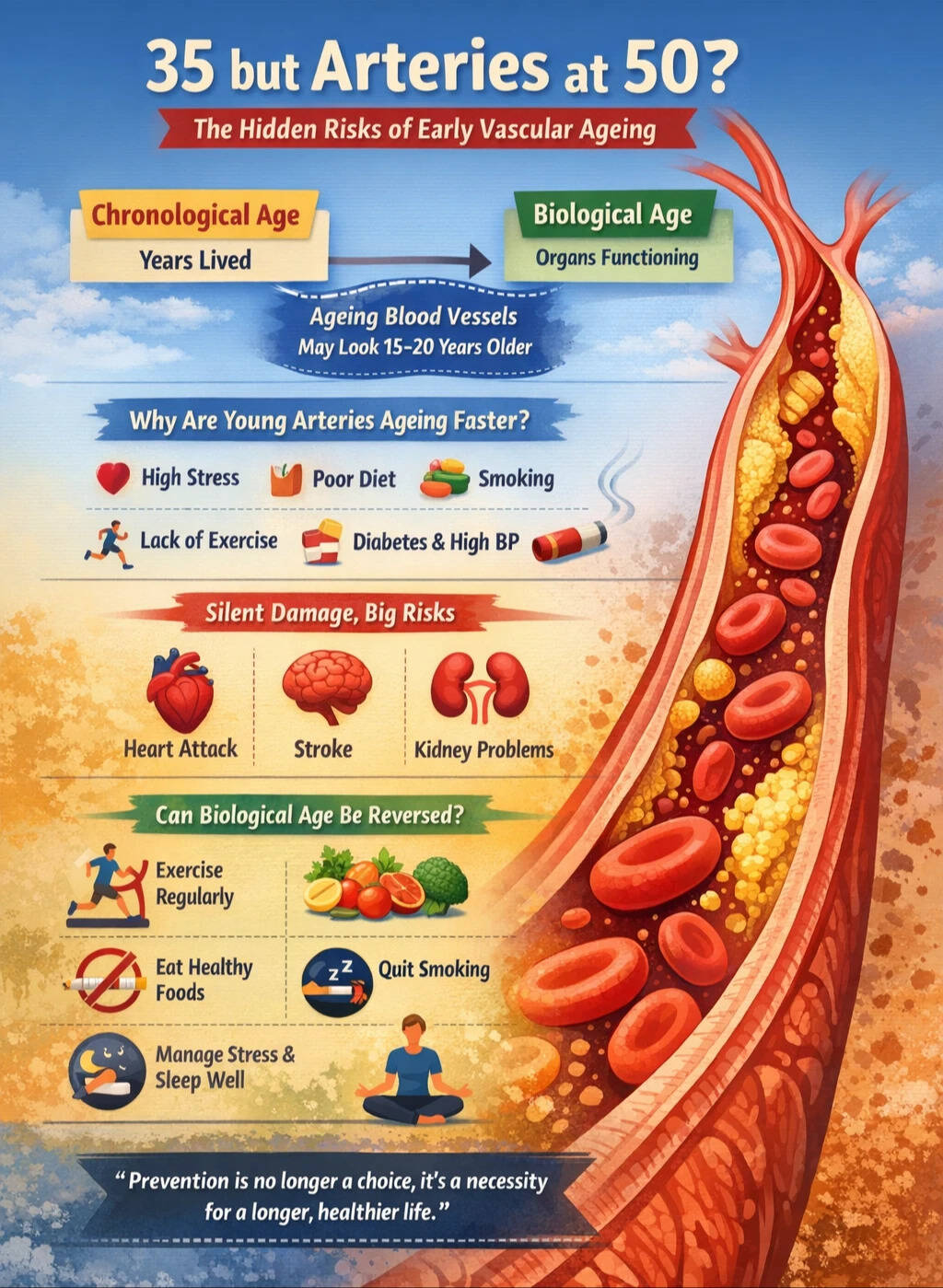
Stiff arteries raise blood pressure. High pressure further damages the vessel wall.
The myth of “I feel fine”
One of the biggest dangers is the illusion of safety.Dr Goel addresses this directly, “The most common myth is that young people are protected from heart disease. Many people feel ‘fine’ and believe that since their routine tests are normal, their heart is healthy. The truth is that the damage to the arteries may be silently progressing for years, and the first sign of it may be a potentially life-threatening heart attack.”A person can run meetings, travel, and manage deadlines. Yet inside, arteries may already be stiff.Tests such as pulse wave velocity, carotid intima-media thickness, or coronary calcium scoring can reveal early damage. These are not routine for everyone, but they matter in high-risk individuals.The World Health Organization states that cardiovascular diseases remain the leading cause of death globally. The risk is no longer limited to the elderly.
What happens when arteries age early?
Stiff arteries raise blood pressure. High pressure further damages the vessel wall. The cycle feeds itself.
Reduced blood flow can affect:
- The heart, leading to heart attack
- The brain, increasing stroke risk
- The kidneys, affecting filtration
- Even sexual health in men
The tragedy is timing. Events that once occurred in the 60s are now seen in the 30s and 40s.
Can biological age be reversed?
There is good news.Dr Goel reassures, “The encouraging truth is that biological aging can be avoided. Unlike chronological age, biological aging can be altered. Exercise, healthy eating, stress management, sound sleep habits, and regular cardiovascular checks can reverse vascular aging.
The good news is that vascular aging can be reversed before it becomes a problem. Conversations about heart health need to start earlier than they used to.
When people begin to think not about their age but about the reality of their age, they have the power to protect their future. Prevention is no longer a choice it’s a necessity if we want to live longer, healthier lives.”Research consistently shows that aerobic exercise improves arterial flexibility.
Strength training supports metabolic health. Diets rich in vegetables, fruits, nuts, and whole grains reduce inflammation. Seven to eight hours of sleep stabilise stress hormones. Even quitting smoking can begin to improve vascular function within months.Biological age is not a fixed label. It responds to daily choices.A 35-year-old body can still feel invincible. But arteries do not negotiate with denial.The real question is not “How old am I?” It is “How well are my arteries ageing?”That shift in thinking may save decades of life.Medical experts consulted This article includes expert inputs shared with TOI Health by: Dr Vivek Kumar, Director – Interventional Cardiology & Head of Structural Heart Program, Max Super Speciality Hospital, VaishaliDr Mukesh Goel, Senior Consultant, Cardiovascular and Cardiothoracic Surgery, Heart and Lung Transplant Surgery, Indraprastha Apollo HospitalsInputs were used to explain the difference between biological and chronological age, why some 35-year-olds may have prematurely ageing arteries, and why medical evaluation and early lifestyle intervention are crucial to prevent future heart disease.









 English (US) ·