

 1 hour ago
8
1 hour ago
8
ARTICLE AD BOX
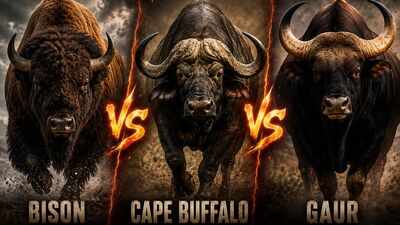
Across grasslands, forests and savannas, three enormous members of the cattle family dominate their respective landscapes. The bison of North America and Europe, the Cape buffalo of sub-Saharan Africa, and the gaur of South and Southeast Asia are often compared because of their size and reputation.
At first glance, they appear similar: heavy bodies, curved horns and a life built around grazing. Yet they evolved in very different environments and developed distinct behaviours, social structures and survival strategies. One thrives on snowy plains, another lives alongside lions, while the third moves through tropical forests where tigers remain its chief natural rival. Looking beyond appearances reveals three animals that share a common ancestry but differ in surprisingly important ways.
Key differences between Bison, Cape Buffalo and Gaur
| Parameter | Bison | Cape buffalo | Gaur |
| Scientific name | Bison bison / Bison bonasus | Syncerus caffer | Bos gaurus |
| Region | North America and parts of Europe | Sub-Saharan Africa | South and Southeast Asia |
| Height | Up to 2 m | About 1–2 m | Around 1.7–2.2 m |
| Weight | Up to 900 kg or more in large bulls | 300–835 kg | Often 700–1,000 kg, sometimes more |
| Habitat | Grasslands, plains, woodland | Savannas, forests and bushland | Forests with open glades and water sources |
| Diet | Grasses, herbs, leaves and twigs | Mainly grasses | Grasses, shrubs and tree vegetation |
| Herd structure | Female groups with separate male groups | Large mixed herds, sometimes thousands | Female herds led by bulls during breeding |
| Main predators | Wolves and humans historically | Lions, hyenas, wild dogs and humans | Tigers, crocodiles and humans |
| Conservation status | Near threatened | Least concern overall | Vulnerable |
| Temperament | Usually defensive but can charge | Highly defensive and unpredictable | Generally shy but extremely powerful |
| Lifespan in the Wild | Up to 30 years | Up to 30 years | Up to 30 years |
Comparing the world's largest wild bovine
Size and physical buildAll three species are heavily built, though their body shapes differ. Bison carry much of their mass over the shoulders, creating their distinctive hump. Cape buffaloes are stockier and lower-set. Gaur stand exceptionally tall and muscular, often appearing more upright than either rival.Weight and strengthAdult bulls from each species can be formidable, but gaur frequently rank among the heaviest wild bovines alive today. Bison combine weight with remarkable speed, while Cape buffaloes rely on compact strength and dense muscle, particularly around the neck and shoulders.
Habitat and environmentThe landscapes they occupy shaped their evolution. Bison became adapted to open plains, severe winters and long migrations. Cape buffaloes occupy a broad range of African habitats close to water. Gaur favour forested regions where grazing areas meet dense vegetation.Social behaviourBison usually form smaller family-based herds, with mature males often remaining apart except during breeding periods. Cape buffaloes can gather in enormous numbers, especially when conditions are favourable.
Gaur herds tend to be smaller and more fluid throughout the year.Predators and survivalPredator pressure varies dramatically. Bison historically faced wolf packs and human hunters. Cape buffaloes live among some of Africa's most effective predators, particularly lions. Gaur contend with tigers and, in some regions, large crocodiles capable of attacking adults.Horns and defenceEach species uses its horns differently. Cape buffaloes possess broad, heavily reinforced horn bases that form a protective shield across the forehead.
Gaur have tall, upward-curving horns, while bison rely less on horn combat and more on sheer mass and momentum.Conservation statusPopulation histories tell different stories. Bison nearly disappeared from much of their historic range before recovering through conservation efforts. Cape buffalo populations remain relatively widespread. Gaur face greater pressures from habitat loss and hunting, leading to their vulnerable status.Temperament and encounters with humansCape buffaloes have a reputation for reacting aggressively when threatened or cornered. Bison often appear calm but can charge suddenly if approached too closely. Gaur generally avoid confrontation, although their size makes them dangerous when provoked.
Bison vs Cape Buffalo vs Gaur: The ultimate battle of the bovines
A direct contest between these animals would depend on terrain, age and individual condition, making any prediction speculative. A mature Cape buffalo brings aggressive defensive behaviour and powerful horns. A large bison offers exceptional bulk and momentum. Yet in a simple comparison of size and raw physical strength, a fully grown gaur would probably hold the advantage. It is often the tallest and heaviest of the three, with immense muscle mass and substantial horns.
Even so, encounters in the wild would rarely unfold as a straightforward contest, since these animals evolved on different continents and survive by avoiding unnecessary fights rather than seeking them.








 English (US) ·